

🔴 LIVE: Trump Signs Executive Order Reclassifying Cannabis
Watch the full NBC News coverage here
NBC News
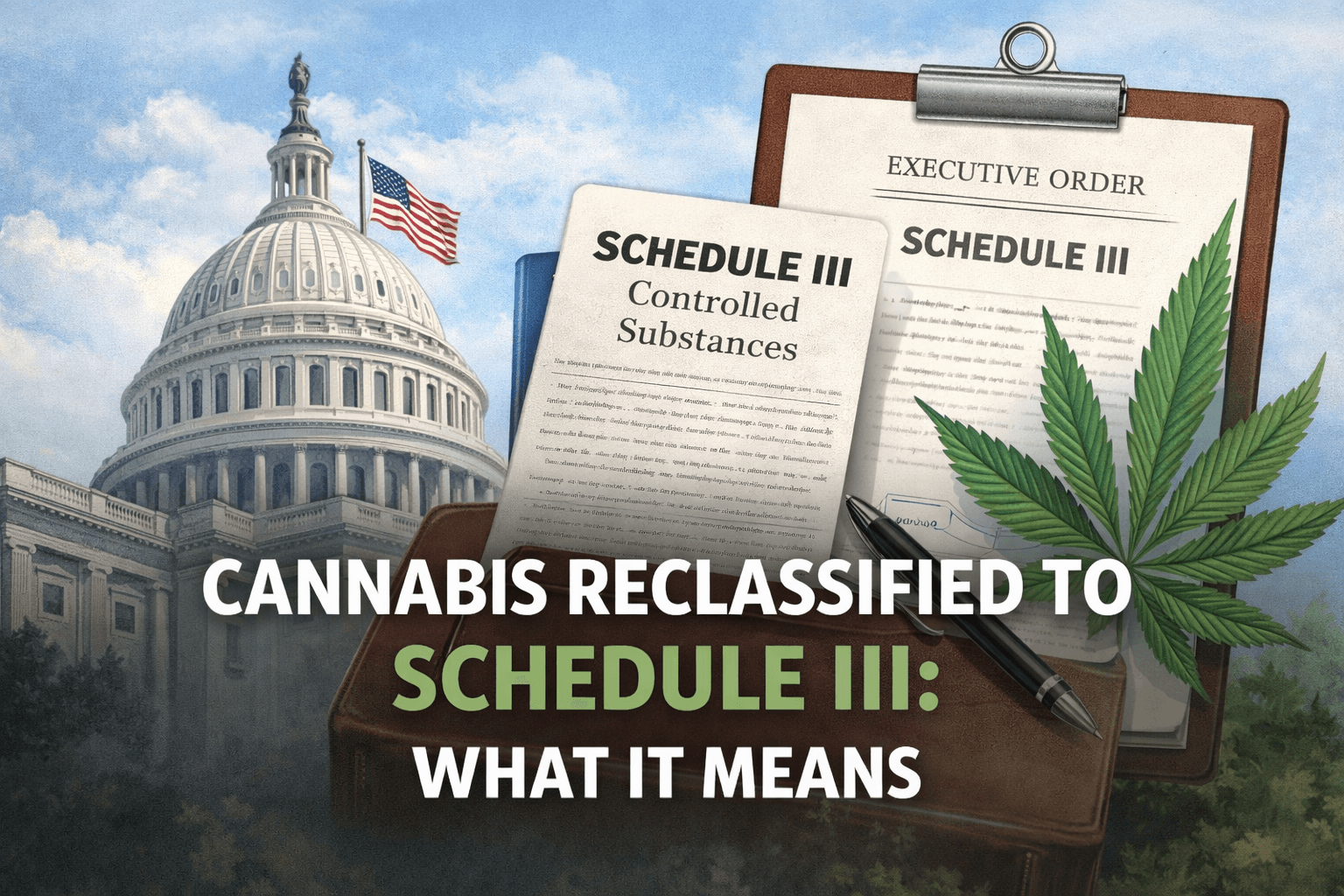
President Trump signs an executive order to fast-track the reclassification of cannabis from Schedule I to Schedule III. While this does not legalize cannabis federally, it could help remove research restrictions and reduce regulatory barriers to medical studies.
A New Era May Be Starting—But We're Not There Yet
President Donald Trump’s recent executive order has set in motion a federal review to potentially move cannabis from a Schedule I to a Schedule III classification under the Controlled Substances Act. This could, eventually, ease major restrictions on cannabis research, taxation, and insurance—but it’s important to emphasize: nothing has been finalized.
If enacted, this change would mark the most significant federal policy shift for cannabis in over 50 years. It could acknowledge the medical utility of cannabis and reduce its risk classification, grouping it with substances like ketamine or anabolic steroids instead of heroin and LSD. But this is only the start of a long regulatory process.
As always, Paragon is here to interpret what this means for cannabis operators—not just at a headline level, but operationally, financially, and strategically.
Why This Moment Matters—And Why It’s Complicated
This potential reclassification isn’t just a policy update—it’s personal. For thousands of patients, operators, employees, and families, this signals long-overdue federal recognition of what they've known for years: cannabis has value. It has helped people heal, stay employed, and build generational businesses.
Still, it’s not time to pop champagne. What this executive order begins is a regulatory review—not a guarantee. The DOJ and DEA will assess medical evidence, accept public input, and decide whether or not to move forward. That process could take months—or years.
At Paragon, we believe this moment is worthy of recognition—but not overreaction. Let’s walk through what could change, what won’t, and how to position yourself to thrive either way.
What Rescheduling Could Unlock
1. Relief from 280E Tax Burdens
Schedule III drugs are not subject to IRS Code 280E, meaning businesses may be able to deduct normal operating expenses. For cannabis companies, this could dramatically improve profit margins.
2. More Access to Research
Universities and medical institutions currently face tight restrictions when studying cannabis. Rescheduling could expand access and support more clinical trials and FDA pathways.
3. Expanded Insurance Opportunities
If cannabis-based products become FDA-approved under Schedule III, insurance reimbursement—especially for CBD or full-spectrum products—may follow.
4. Increased Institutional Investment
Rescheduling could lower risk perceptions and attract capital from pension funds, private equity, and REITs who currently stay away due to federal prohibition.
5. Normalization in the Eyes of Financial Partners
From banking to insurance to employee benefits, federal acknowledgment would make it easier for cannabis businesses to be treated like businesses.
What Rescheduling Will Not Do—Yet
It Does Not Legalize Cannabis Federally
Cannabis remains federally illegal outside of very narrow medical channels. States continue to govern access, enforcement, and licensing.
Example: Texas still enforces strict cannabis laws despite growing demand for medical reform.
Paragon Insight: We support clients in red states who face tight restrictions, helping them operate compliantly within their state boundaries.
It Does Not Offer Expungement or Justice Reform
No clemency, record clearance, or policy changes have been announced for those incarcerated for cannabis offenses.
Example: Individuals with federal charges are still serving sentences for actions that are legal in other states.
Paragon Insight: We help employers navigate fair chance hiring, especially in states where cannabis expungement laws are evolving.
It Does Not Guarantee DEA Approval
This executive order begins a process—but that process could stall, reverse, or be altered.
Example: In 2016, the DEA rejected rescheduling despite widespread calls for reform.
Paragon Insight: Until published in the Federal Register, 280E remains in effect. We advise clients to model both scenarios.
It Does Not Eliminate Regulatory Complexity
Local and state compliance will remain just as important. Payroll, HR, taxes, and banking still require cannabis-specific navigation.
Example: A licensed retailer in Oregon faced penalties for wage misclassification—federal rules wouldn’t have prevented that.
Paragon Insight: Our payroll platform is built for state-by-state compliance. We know how to handle high-risk audits and multi-jurisdiction reporting.
It Does Not Immediately Eliminate 280E
The tax code doesn’t change overnight. Implementation, comment periods, and legal challenges could slow things down.
Example: Operators who preemptively adjusted deductions based on past reform optimism faced audits and back taxes.
Paragon Insight: Our CFO partners are asking the right questions. We help them prepare—not presume.
The Part No One Wants to Say Out Loud: Schedule III ≠ Business as Usual
There’s a critical piece of this conversation that deserves sunlight—especially for small and mid-sized operators.
If cannabis is ultimately treated as a Schedule III substance, FDA oversight becomes part of the equation. And here’s the uncomfortable truth: the vast majority of cannabis operators today do not operate in FDA-compliant facilities—because they were never built to.
FDA-compliant manufacturing standards (GMPs, validated processes, controlled environments, documentation protocols, and inspection readiness) are not a light lift. They require massive capital investment, operational overhauls, and ongoing regulatory maintenance. For many independent operators, building or retrofitting facilities to FDA standards would be financially impossible without deep-pocketed backing.
This is why rescheduling is so divisive.
Without a clear federal memo or guidance explicitly exempting state-licensed cannabis operators from FDA manufacturing requirements, Schedule III could become less of a liberation—and more of a choke point. One that quietly advantages MSOs, pharmaceutical-backed entities, and institutional players, while pushing legacy operators and small businesses to the brink.
We’ve heard this fear directly from operators across the country. In fact, when Paragon shared a poll with the industry, nearly half of the respondents expressed concern that Schedule III—without protective guidance—could force smaller license holders out of the market entirely.
That concern is valid.
Everything people hope Schedule III might unlock—280E relief, insurance access, research expansion, capital inflows—hinges on how the federal government handles this FDA question. Without clarity, those “wins” risk becoming theoretical benefits that only a few are positioned to capture.
At Paragon, we refuse to ignore this reality. Supporting cannabis means advocating for policies that don’t erase the very operators who built this industry before it was politically convenient.
Hope matters—but so does honesty.

What to Consider Now: Strategic and Operational Angles
This moment invites deeper reflection for cannabis operators—not just about taxes or legality, but about long-term positioning, workforce stability, and scale readiness. What happens if you suddenly gain access to federal deductions—but don’t have a clean ledger or HR records to prove eligibility? What if investor interest surges, but your payroll records can’t withstand due diligence?
Consider this: According to payroll industry research, "about 1 in 3 U.S. companies has issues with payroll accuracy or errors — for example, general error rates are still common in payroll runs across industries", Yomly under state labor laws, let alone federal ones. Payroll isn't just a back-office function; it’s a critical point of exposure or advantage, depending on how it’s managed.
As rescheduling conversations gain steam, smart operators are using this window to stabilize their systems, get compliant, and benchmark their readiness across HR, payroll, onboarding, and tax reporting.
Best Next Steps for Cannabis Operators
-
Reconcile payroll records against both state and federal standards.
-
Forecast both short-term and long-term financial models—with and without 280E.
-
Meet with your HR/payroll provider and clarify compliance guarantees.
-
Review onboarding, I-9, and employee classification workflows.
-
Start preparing investor-friendly financial statements.
-
Don’t wait for the law to change—position your business now.
Why Cannabis-Committed Partnerships Matter
A federal shift—even a partial one—will inevitably expose any vendor or partner not already familiar with cannabis compliance. It’s not just about knowing the plant or the policies—it’s about understanding how compliance, audits, HR, taxes, and risk intersect across state lines and regulatory gray zones.
As federal scrutiny increases, so will the stakes of getting it wrong. Vendors who are unfamiliar with how 280E impacts payroll classifications, how state HR laws differ, or how to support multi-entity reporting may become liabilities instead of assets. Relying on generalist providers opens operators up to audit risk, HR penalties, and implementation delays.
What should you look for in a cannabis-committed partner?
-
Deep experience across cannabis verticals: cultivation, retail, distribution, manufacturing.
-
Proven multi-state compliance track record.
-
Integration with banks and insurance partners that actively support the cannabis industry.
-
Transparent communication, direct access to experts, and proactive issue resolution.
-
Tools designed for the speed and complexity of cannabis hiring, turnover, and regulation—not retrofitted solutions.
This isn’t the time to gamble on vendors who “might be able to figure it out.” It’s the time to double down on partners who’ve already proven they can navigate this space.
Why Paragon Is Built for This
At Paragon, we’re not waiting for federal policy to validate our commitment. We’ve built our business to serve cannabis operators in complexity, not in spite of it.
-
650+ operators served across the cannabis supply chain
-
Fully compliant onboarding, LMS, payroll, HR, and tax tools
-
Built-in support for multi-entity and multi-state employers
-
Isolation from mainstream vendor risk—we know cannabis and act like it
-
Real relationships. No ghosting. No shortcuts. No excuses.
We’re not adapting to cannabis—we’re built for it.
Ask These Questions Now:
-
Are we documenting payroll and tax records thoroughly?
-
What happens to our margins if 280E goes away—or doesn’t?
-
Are we hiring with speed and compliance?
-
Do our vendors understand cannabis risk—or are they guessing?
Read More: Trusted Sources & Deeper Context
For additional reporting and official insight into cannabis policy and federal scheduling changes, check out:
-
Reuters – Federal cannabis policy & Schedule III coverage
https://www.reuters.com -
Associated Press (AP News) – Cannabis law and regulation reporting
https://apnews.com -
U.S. Department of Justice (DOJ) – Controlled Substances Act & scheduling facts
https://www.justice.gov -
Drug Enforcement Administration (DEA) – Controlled substance schedules information
https://www.dea.gov -
National Institutes of Health (NIH) – Medical cannabis research context
https://www.nih.gov
This is a Step Forward
...but it’s not the finish line. Operators deserve clarity, not chaos. Our role is to keep you aligned, supported, and ready.
👉 Let’s Talk → https://www.paragonpayroll.com/lets-talk
