

We thought we were covered—until they found out we were cannabis.
This is the line we hear most when someone reaches out after their payroll platform ghosts them. One day, everything works fine. The next? Accounts frozen. Support goes silent. No explanation—just termination. The kicker? Many platforms never explicitly say they don’t support cannabis. They just quietly back out when it matters most.
This guide is for any operator using a payroll platform that seems okay for now—but might not be built to handle what your business really is.
What You’ll Learn
-
What “cannabis-ready” actually means (beyond lip service)
-
How to spot the warning signs that your platform might drop you
-
The hidden risks of using general payroll systems in cannabis
-
What to look for in a truly compliant, industry-aligned provider
-
What happens if you wait too long to switch
The Myth of “It Hasn’t Been a Problem Yet”
If you’ve been running payroll without issue so far, that’s great. But don’t mistake silence for support. Most generic payroll providers don’t proactively ban cannabis businesses—they just leave the issue in a gray area until your account gets flagged.
That flag might come from a keyword trigger, a new tax form, or a support rep reviewing your NAICS code. And when it does, your account could be suspended mid-pay cycle—with zero recourse or notice. We’ve seen it happen to operators across the country.
What Cannabis-Ready Actually Means
Being cannabis-ready isn’t just about “allowing” cannabis clients. It means the platform is:
-
Registered to file cannabis payroll taxes in every legal state
-
Not subject to internal restrictions from federal compliance teams
-
Able to integrate with banks serving cannabis businesses
-
Staffed with support teams trained on cannabis licensing and audit risks
-
Proactively updating features for 280E, tax reporting, and dual-entity setups
Most providers simply weren’t built with these needs in mind. And if they don’t say anything about cannabis? That’s usually a sign they’re avoiding the topic entirely.
The Red Flags You Can’t Ignore
Wondering if your current provider might bail? Here are a few warning signs—each with serious implications:
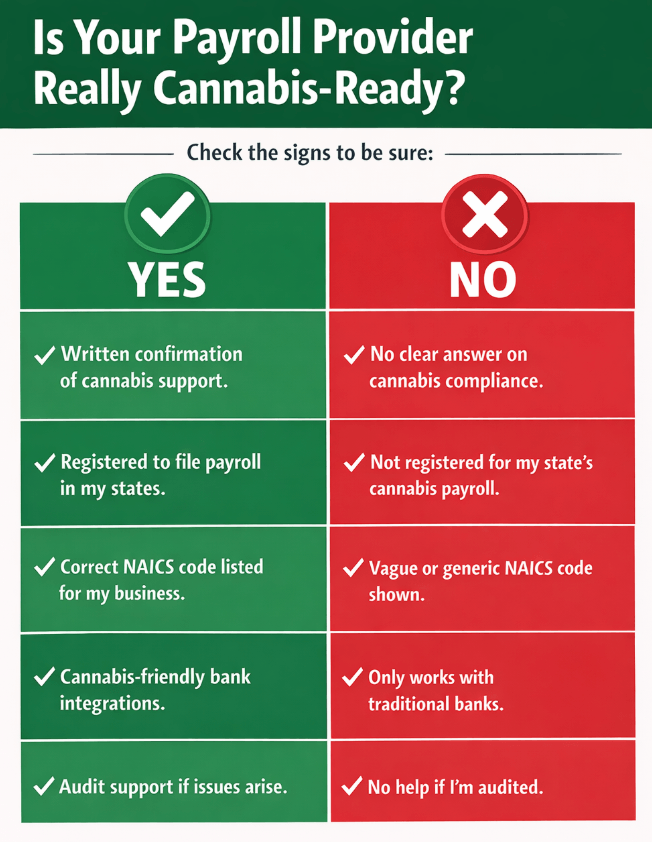
They never asked if you were cannabis, or what your license status is
If your provider hasn’t asked what kind of business you are, it’s not because they’re cannabis-friendly—it’s because they’re not paying attention. In this industry, silence is a red flag. Any platform that serves cannabis should confirm your license status and understand how that affects compliance.
Their support team won’t answer direct questions about cannabis
If you ask, “Do you support licensed cannabis operators?” and the answer is anything short of confident, documented clarity, that’s a concern. Vague or evasive responses often mean they’re avoiding liability—or planning to exit quietly.
Your NAICS code isn’t listed correctly—or is vague (like 999999)
NAICS codes (North American Industry Classification System) are six-digit identifiers used by government agencies, banks, and insurers to categorize your business. If your NAICS code isn’t accurate—or is listed under a generic or placeholder code like 999999—it can trigger compliance reviews or get your account flagged.
For example, cannabis cultivators typically fall under 111419 (Other Food Crops Grown Under Cover), while retail dispensaries may be classified as 453998. If your business operates under a general consulting or administrative code, your provider or financial institution may be unaware you’re plant-touching—until it’s discovered through another channel. When that happens, the fallout can be immediate.
NAICS codes are used for everything from insurance classification to banking and audits. A placeholder code like 999999, or one that misrepresents your operation, can delay underwriting, trigger reviews, or misinform key compliance systems.
You’ve had minor feature issues brushed off with vague responses
If small glitches are met with “We’re not sure” or “That’s not something we support right now,” it may mean their system wasn’t built for businesses like yours. These gaps usually grow over time—and show up when it matters most.
The earlier you spot these, the better. If your provider can’t confirm cannabis support in writing, assume they don’t—and plan accordingly.
What Happens When You Get Dropped
Getting dropped mid-payroll is more than an inconvenience. It can:
-
Delay employee pay
-
Disrupt tax filing schedules
-
Create accounting mismatches
-
Force emergency transitions under stress
-
Expose you during audits or banking reviews
It also destroys team trust. Nothing rattles staff like missing a paycheck or hearing their company is scrambling behind the scenes.
Real-World Example: The Quiet Flag
One West Coast cultivator used a national platform for two years without issue. Then they hired their tenth employee—and their account was flagged during a routine review. The platform froze their ability to run payroll the day before checks were due.
No warning. No support. Just a shutdown email citing “terms of service violations.” They came to us in panic. We rebuilt their system, onboarded all employees, and ran payroll in three business days. But the trust with staff was already shaken.
What a Cannabis-Ready Platform Should Offer
Cannabis-compliant tax filing (local, state, and federal where applicable)
Your provider should be registered to file payroll taxes in every cannabis-legal state—because every state has different rules. For example, Michigan requires specific quarterly filing documentation tied to cannabis licensing, while California enforces additional local employment taxes in cannabis-heavy cities. Federal filing may still be limited by 280E implications, but cannabis-compliant platforms know how to navigate this without triggering audit risk.
Equally important is the provider’s ability to handle state-specific wage garnishments, labor compliance updates, and employer contribution thresholds. If your system can’t handle Colorado’s cannabis-specific employee surcharges or Massachusetts’s sick time accrual laws, it’s not ready for cannabis.
Proper W-2 and 1099 support with cannabis-specific codes
Misclassification is a top audit trigger. Cannabis operators often employ seasonal workers, trimmers, delivery staff, and consultants—making it easy to blur W-2 and 1099 lines. A cannabis-ready provider doesn’t just run payroll—they help you classify workers properly based on your state’s cannabis employment guidance.
They also ensure that year-end filings reflect cannabis-specific industry codes. Using generic SIC or NAICS codes on W-2s or 1099s can either raise red flags or mask your business entirely—both risky moves. Proper coding reinforces transparency and keeps your records in sync across tax and licensing bodies.
Bank integrations for cannabis-friendly institutions
The right payroll partner integrates with banks that actively support cannabis—not just tolerate it. That means ACH transfers don’t get flagged, and direct deposits flow without interruption. In states like Arizona and Nevada, where banking partners have cracked down on cannabis operations, we’ve seen operators get dropped due to mismatched payroll activity.
Integrations also ensure that reporting formats align with your bank’s BSA/AML protocols, which cannabis accounts are especially subject to. If your payroll system doesn’t sync cleanly, you may be forced to manually reconcile statements—costing you time, credibility, and exposure.
I-9 and onboarding tools that account for dual-entity setups
Many cannabis businesses use dual entities (one for plant-touching operations, another for ancillary services). Your system must allow employee onboarding across both while keeping records airtight. For example, an I-9 filed under the wrong entity can create liability during an ICE audit or renewal review.
A cannabis-aligned platform should guide you through assigning EINs properly, capturing start dates, tracking document expirations, and housing digital onboarding packets that survive licensing inspections. This becomes especially critical in states like New York and Illinois, where documentation gaps can stall license renewals.
Responsive support teams that know the industry inside and out
When something breaks—or changes—you need answers fast. Cannabis operators don’t have time to wait 3–5 days for a generic help desk response. A true cannabis partner offers direct access to trained support reps who understand how your license, state, and tax situation affect payroll.
Whether you’re navigating multi-location reporting in Maryland, or hit with a surprise audit in Oregon, you want support that knows what compliance looks like in your context. That’s the difference between a vendor—and a partner.
Want to understand why we built Paragon the way we did? Read our cannabis commitment manifesto: What Does It Mean to Be Cannabis Committed?
-
Cannabis-compliant tax filing (local, state, and federal where applicable)
-
Proper W-2 and 1099 support with cannabis-specific codes
-
Bank integrations for cannabis-friendly institutions
-
I-9 and onboarding tools that account for dual-entity setups
-
Responsive support teams that know the industry inside and out
This isn’t about bells and whistles. It’s about not being stranded when compliance gets real.
FAQs
My provider hasn’t dropped me—should I still switch?
Yes—if your provider won’t confirm in writing that they support licensed cannabis operators, you’re at risk. In states like Michigan and Massachusetts, we’ve seen providers shut down cannabis clients mid-quarter due to internal policy shifts. In Arizona and New Jersey, clients were asked to migrate after compliance teams reviewed NAICS classifications. Just because it hasn’t happened yet doesn’t mean it won’t. Transitioning on your timeline is far safer than being forced into a scramble.
Is switching payroll systems hard?
Not when you’re working with a cannabis-aligned partner. We’ve helped operators in California, Missouri, and New York fully transition payroll in 3–5 business days—even mid-cycle. It typically involves exporting current employee data, verifying tax IDs, and importing into our cannabis-compliant platform. Most clients are surprised how smooth it is with experienced guidance.
Can I use different providers for W-2 vs. 1099?
Technically yes, but it introduces unnecessary complexity. We’ve seen operators in Colorado and Illinois try this approach, only to run into tax reporting mismatches and duplicate compliance burdens. Using a unified system allows for consistent classification, audit-readiness, and faster reconciliation during renewals or inspections.
Operator Sanity Check: Ask Your Current Provider These Questions
-
“Do you support licensed cannabis operators across all legal states?”
-
“What happens if my account gets flagged for cannabis activity?”
-
“Can you show me clients in cannabis that you’ve worked with long-term?”
-
“How do you ensure tax compliance for dual-entity or plant-touching businesses?”
If they can’t answer clearly—or avoid the questions entirely—it’s time to move on.
What’s Coming in 2026
As cannabis moves toward federal rescheduling—likely from Schedule I to Schedule III—expect seismic shifts in how payroll and financial compliance are monitored. While this reclassification won’t fully legalize cannabis federally, it will ease restrictions for research, open doors for banking reform, and likely trigger new IRS reporting obligations tied to employment and tax deductions.
The Department of the Treasury and FinCEN are expected to expand BSA/AML guidance for cannabis-related businesses, especially as banks and credit unions onboard more operators. Platforms that can’t demonstrate full traceability, clean payroll flows, and proper employee classification will quickly be identified as non-compliant. Meanwhile, states like California, New York, and Maryland are proposing stricter labor enforcement initiatives targeting cannabis employers—especially those using dual entities or informal payroll.
Query audits (triggered by mismatches in EIN, NAICS, and wage reporting) are also increasing in several regions. This means regulators will be comparing your payroll data with licensing, insurance, and tax documents automatically—and inconsistencies could result in license holds or renewal denials.
Those who switched early to cannabis-aligned systems—where payroll, onboarding, and compliance are unified—will be ahead of the curve. Those who delay may find themselves racing to clean up systems in a much less forgiving regulatory environment.
If You’ve Got a Gut Feeling Something’s Off—You’re Probably Right
Trust your instinct. If your payroll system feels like it’s not telling you the full story, it probably isn’t. You deserve clarity, not silence.
Let’s talk and make sure your foundation is solid—before you’re forced to rebuild it under pressure.
The “What’s Coming in 2026” section now includes expanded insights on expected legislation, IRS implications, FinCEN scrutiny, and state-level enforcement—helping readers understand the urgency and regulatory landscape with real depth.
Want to begin drafting blog #5 next?
If You’ve Got a Gut Feeling Something’s Off—You’re Probably Right
Trust your instinct. If your payroll system feels like it’s not telling you the full story, it probably isn’t. You deserve clarity, not silence.
Let’s talk and make sure your foundation is solid—before you’re forced to rebuild it under pressure.
