

A lot of cannabis operators start out thinking payroll and HR are basically the same thing.
Until things start breaking.
Maybe payroll suddenly takes two full days every cycle because managers keep manually fixing timecards.
Maybe onboarding paperwork is scattered across inboxes, spreadsheets, and random folders nobody can find later.
Maybe employees are frustrated because nobody can clearly explain PTO balances, overtime calculations, or scheduling inconsistencies.
Or maybe leadership is quietly sitting there wondering:
“Why does running operations suddenly feel harder than everything else?”
That feeling is more common in cannabis than most people realize.
Because cannabis businesses are rarely operating under normal conditions.
You are trying to scale inside an industry filled with:
- compliance pressure
- banking instability
- staffing challenges
- rapid growth
- operational unpredictability
- workforce turnover
- licensing stress
And somewhere in the middle of all that, operators are also expected to somehow build organized workforce systems.
Usually without much guidance.
That is why understanding the difference between payroll systems, HR systems, and HCM platforms matters so much in cannabis.
Because these systems are not just “software.”
They directly affect:
- employee trust
- compliance
- retention
- management burnout
- operational stability
- scalability
And most cannabis businesses realize that later than they wish they had.
Quick Summary: Payroll vs HR vs HCM in Cannabis
A lot of cannabis operators hear terms like payroll software, HR systems, and HCM platforms thrown around constantly and quietly assume everyone else already understands the difference.
Most people do not.
Especially newer operators.
So before diving deeper, let’s simplify what each system actually does.
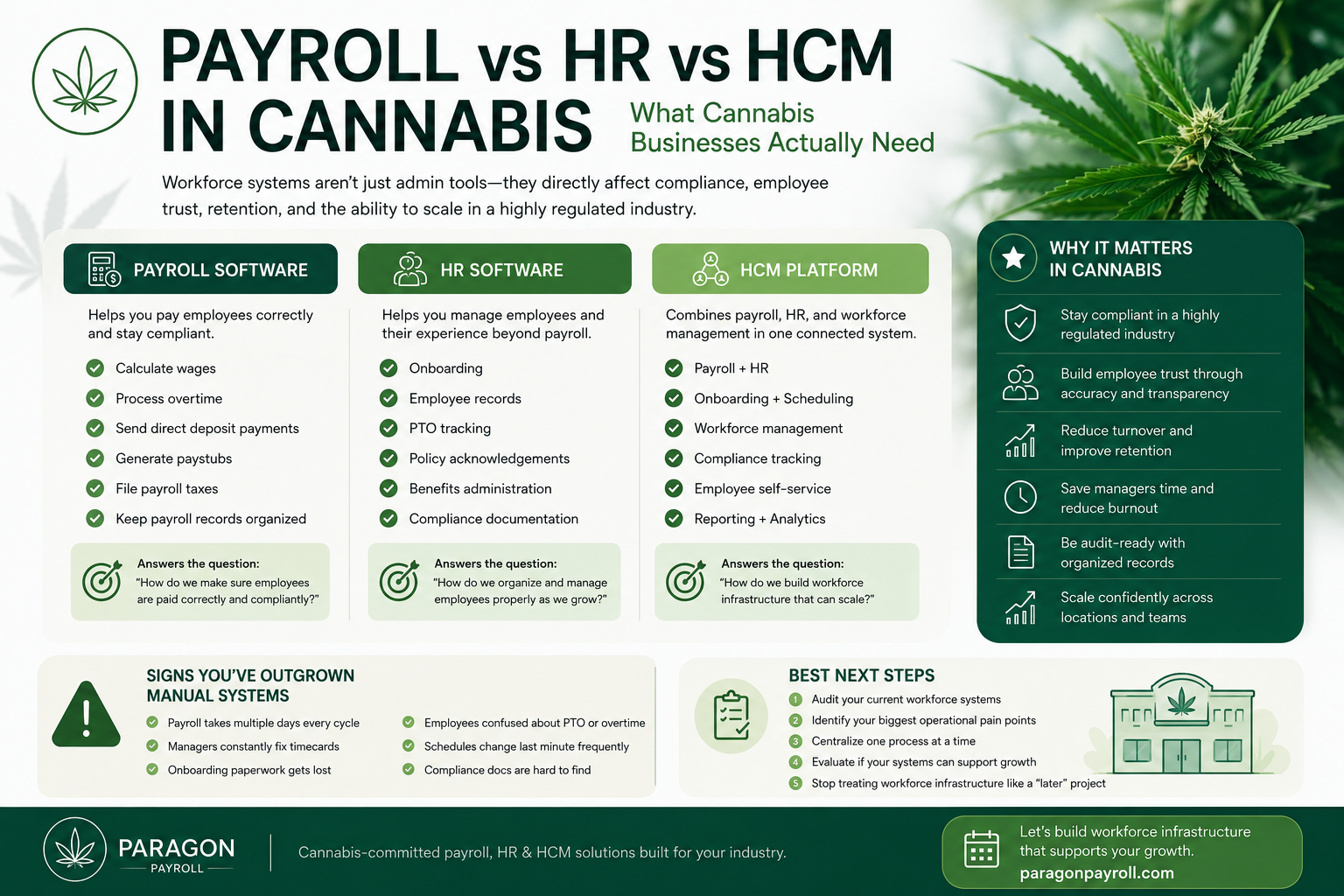
Payroll Software Helps You Pay Employees Correctly
Payroll software is the system responsible for calculating employee pay and processing payroll.
At its core, payroll software helps businesses:
- calculate wages
- process overtime
- send direct deposit payments
- generate paystubs
- file payroll taxes
- keep payroll records organized
In cannabis, payroll systems become especially important because labor compliance issues can escalate quickly if overtime, scheduling, or wage calculations are handled incorrectly.
Payroll software answers the question:
“How do we make sure employees are paid correctly and compliantly?”
HR Software Helps You Manage Employees Beyond Payroll
HR stands for Human Resources.
HR software focuses on the employee experience outside of simply issuing paychecks.
That includes things like:
- onboarding
- hiring paperwork
- PTO tracking
- employee records
- policy acknowledgements
- benefits administration
- compliance documentation
HR software answers the question:
“How do we organize and manage employees properly as the business grows?”
HCM Platforms Combine Payroll and HR Together
HCM stands for Human Capital Management.
An HCM platform combines:
- payroll
- HR
- onboarding
- scheduling
- workforce management
- compliance tracking
- employee communication
- reporting
…into one connected system.
Instead of juggling disconnected software, spreadsheets, text messages, and manual paperwork, HCM systems centralize workforce operations in one place.
HCM platforms answer the question:
“How do we build workforce infrastructure that can actually scale?”
Payroll vs HR vs HCM Comparison Table
|
Feature |
Payroll Software |
HR Software |
HCM Platform |
|
Employee Pay Processing |
Yes |
No |
Yes |
|
Payroll Tax Filing |
Yes |
No |
Yes |
|
Direct Deposit |
Yes |
No |
Yes |
|
Employee Onboarding |
Limited |
Yes |
Yes |
|
PTO Tracking |
Sometimes |
Yes |
Yes |
|
Scheduling Integration |
Sometimes |
Sometimes |
Yes |
|
Workforce Analytics |
Limited |
Limited |
Yes |
|
Compliance Documentation |
Limited |
Yes |
Yes |
|
Employee Self-Service |
Sometimes |
Yes |
Yes |
|
Workforce Infrastructure |
No |
Partial |
Full |
A lot of cannabis businesses start with payroll software because paying employees correctly feels like the most urgent operational problem initially.
But as businesses grow, operators usually realize workforce problems extend far beyond payroll itself.
Eventually businesses begin struggling with:
- onboarding
- scheduling
- compliance paperwork
- employee communication
- PTO management
- workforce visibility
That is usually when cannabis operators begin moving toward HR systems or full HCM platforms capable of centralizing workforce operations into one connected infrastructure.
Why Cannabis Businesses Struggle With Workforce Systems
Cannabis businesses move differently than traditional companies.
Growth often happens fast.
Turnover happens fast.
Compliance pressure never really stops.
And most operators are already carrying enormous mental pressure long before workforce systems become a problem.
According to the 2024 Vangst Jobs Report, cannabis employee turnover rates remain significantly higher than many traditional industries, especially in retail dispensary environments where burnout and staffing instability remain ongoing challenges.
A dispensary owner might be juggling:
- inventory
- licensing
- banking
- vendor management
- staffing
- customer experience
- compliance audits
…while also trying to onboard employees and run payroll correctly.
That is a lot for anyone.
Especially in an industry where many businesses are still building operational infrastructure in real time.
This is why workforce systems in cannabis often become reactive instead of intentional.
At first, manual processes may feel manageable.
Maybe scheduling happens through text messages.
Maybe PTO is tracked in spreadsheets.
Maybe onboarding paperwork is buried in email chains.
Maybe payroll corrections happen manually every pay cycle.
That can work temporarily.
But cannabis businesses often outgrow those systems faster than leadership expects.
Imagine opening a second dispensary location while still trying to manually manage:
- onboarding
- payroll
- schedules
- overtime
- compliance documentation
- employee records
…across disconnected systems.
Eventually operational confusion starts becoming operational risk.
Managers burn out.
Employees lose trust.
Leadership spends more time fixing administrative problems than actually growing the business.
And honestly, that emotional exhaustion compounds quietly over time.
What Payroll Software Actually Does in a Cannabis Business
Payroll software is the system responsible for paying employees correctly and keeping records of those payments.
At a basic level, payroll software helps cannabis businesses:
- calculate wages
- process overtime
- send direct deposit payments
- generate digital paystubs
- file payroll taxes
- keep payroll records organized
At first glance, those tasks may sound simple.
Until you are actually running a cannabis business.
Because in cannabis, payroll is rarely just:
“people worked, so we paid them.”
Cannabis payroll is tied directly to:
- labor compliance
- employee trust
- workforce stability
- onboarding
- scheduling
- overtime laws
- tax reporting
- operational organization
And when payroll systems are weak, employees feel it quickly.
Why Accurate Wage Calculations Matter in Cannabis
Calculating wages sounds straightforward until cannabis businesses start growing.
For example, a dispensary may have:
- hourly budtenders
- salaried managers
- tipped employees
- shift leads
- delivery drivers
- overtime workers
Now imagine trying to manually track:
- regular hours
- overtime
- different pay rates
- shift differentials
- tips
- holiday pay
- bonuses
…across multiple employees and schedules every pay cycle.
That is where payroll mistakes start happening.
And employees notice immediately when pay feels inconsistent.
Especially in cannabis, where many employees are already navigating:
- financial stress
- inconsistent scheduling
- emotional burnout
- customer-facing pressure
- staffing shortages
When paychecks are wrong, it stops feeling like:
“an accounting issue.”
It starts feeling personal.
That emotional reality matters more than many operators initially realize.
How Do You Know When Your Cannabis Business Has Outgrown Manual Workforce Processes?
A lot of cannabis businesses do not intentionally avoid workforce infrastructure.
Usually, they are just trying to survive growth.
At first, manual systems feel manageable.
Maybe schedules are built in spreadsheets.
Maybe PTO requests happen through text messages.
Maybe onboarding paperwork lives in email chains.
Maybe payroll corrections are handled manually every Friday.
That works temporarily.
Until growth compounds complexity faster than leadership expected.
For example, imagine:
- opening a second dispensary
- onboarding seasonal cultivation workers
- adding overnight manufacturing shifts
- hiring delivery drivers
- expanding into another state
…while still relying on disconnected workforce systems.
That operational pressure builds quietly.
And eventually businesses stop feeling organized and start feeling reactive.
Some of the biggest warning signs your cannabis business has outgrown manual workforce systems include:
- payroll taking multiple days every cycle
- managers constantly correcting timecards
- onboarding paperwork getting lost
- employees confused about PTO or overtime
- leadership avoiding workforce conversations because everything feels overwhelming
- scheduling constantly changing last minute
- employee records scattered across systems
- compliance documentation becoming difficult to locate quickly
The dangerous part is that many cannabis operators normalize this chaos because the industry itself already feels chaotic.
But operational instability compounds over time.
Especially when leadership is already emotionally exhausted trying to manage growth, compliance, staffing, and cash flow simultaneously.
This is often the moment businesses realize:
“We do not just need payroll software anymore. We need infrastructure.”
The Hidden Cost of Disconnected Workforce Systems in Cannabis
Most cannabis businesses do not realize how expensive disconnected workforce systems become because the costs rarely appear all at once.
Instead, they show up slowly through:
- manager burnout
- payroll corrections
- employee frustration
- turnover
- compliance stress
- leadership exhaustion
- operational inefficiency
For example:
- managers staying late fixing timecards every payroll cycle
- leadership manually searching for onboarding paperwork during audits
- employees repeatedly asking payroll questions because systems lack transparency
- scheduling conflicts creating overtime surprises
- compliance documentation scattered across disconnected systems
Individually, these problems may feel manageable.
Together, they create operational drag that quietly slows the entire business down.
And honestly, many cannabis operators normalize this stress because the industry itself already feels stressful.
But operational chaos compounds over time.
What Happens When Cannabis Employees Stop Trusting Workforce Systems?
A lot of operators underestimate how emotionally tied employees become to workforce consistency.
Employees may tolerate operational stress for a while.
They may tolerate:
- long retail lines
- understaffed shifts
- stressful customers
- fast operational changes
- inventory issues
But once employees stop trusting:
- payroll
- scheduling
- PTO balances
- overtime calculations
- onboarding processes
…the emotional relationship between the employee and the company often starts deteriorating quickly.
Because workforce systems communicate something deeper psychologically:
“Does leadership actually have control of the business?”
For example:
- incorrect paychecks create financial stress
- inconsistent schedules create personal instability
- missing onboarding paperwork creates confusion
- delayed responses create frustration
- disconnected systems create distrust
This becomes especially important in cannabis because many employees already operate inside emotionally demanding environments.
A burned-out budtender dealing with paycheck confusion may not view it as:
“an administrative mistake.”
They may view it as:
“this company does not have its act together.”
That emotional distinction matters.
Because workforce systems do not just affect operations.
They affect:
- morale
- trust
- retention
- company culture
- employee stability
And honestly, cannabis employees talk to each other constantly.
Operational reputation spreads quickly inside this industry.
Questions Cannabis Operators Constantly Ask Online About Payroll & HR
“Do I Really Need HR Software if I Only Have One Dispensary?”
A lot of operators initially think payroll alone is enough because hiring volume still feels manageable.
But once onboarding, PTO tracking, scheduling, compliance paperwork, and employee documentation begin spreading across disconnected systems, workforce management often becomes significantly harder than leadership expected.
“Why Does Scheduling Feel Impossible in Cannabis?”
Cannabis scheduling becomes difficult because businesses are balancing:
- compliance requirements
- fluctuating staffing needs
- turnover
- overtime management
- customer traffic variability
- seasonal workforce changes
Without integrated workforce systems, scheduling often becomes reactive instead of organized.
“Why Are Employees Constantly Frustrated About Payroll or PTO?”
Employees usually become frustrated when workforce systems lack transparency.
For example:
- unclear PTO balances
- delayed payroll communication
- inconsistent scheduling
- incorrect overtime calculations
- difficulty accessing paystubs
These issues create emotional instability for employees quickly.
“What Is the Difference Between HCM and HRIS?”
HRIS stands for Human Resources Information System.
An HRIS system primarily stores and organizes employee information like:
- employee records
- benefits information
- onboarding documentation
- PTO balances
HCM platforms typically go further by combining:
- payroll
- workforce management
- scheduling
- analytics
- onboarding
- employee engagement
Many cannabis businesses eventually outgrow basic HRIS systems once operational complexity increases.
Which Workforce System Does Your Cannabis Business Actually Need?
Not every cannabis business needs a full HCM platform immediately.
The right workforce infrastructure usually depends on:
- company size
- hiring volume
- operational complexity
- compliance pressure
- growth plans
Payroll Software May Be Enough If:
- you have a very small team
- hiring is infrequent
- schedules are relatively simple
- operations are centralized in one location
HR Software Becomes Important When:
- onboarding becomes overwhelming
- employee records become difficult to manage
- compliance paperwork starts getting disorganized
- managers spend excessive time handling administrative tasks manually
HCM Platforms Usually Become Necessary When:
- businesses operate across multiple locations
- workforce growth accelerates
- overtime tracking becomes difficult
- scheduling becomes complex
- compliance pressure increases
- leadership needs workforce visibility across the company
This section creates:
- self-identification
- buyer awareness
- operational clarity
And honestly, many operators realized they needed better workforce infrastructure months before they actually invested in it.
Most Cannabis Businesses Don’t Realize This Until Workforce Problems Start Affecting Growth
A lot of cannabis businesses think workforce infrastructure is something they can “figure out later.”
And honestly, that makes sense at first.
When businesses are focused on:
- licensing
- expansion
- staffing
- inventory
- banking
- staying operational
…HR systems and workforce infrastructure often feel less urgent.
Until operational stress starts leaking everywhere.
Managers burn out.
Employees become frustrated.
Payroll mistakes become recurring.
Turnover increases.
Leadership spends more time fixing administrative problems than actually growing the business.
That is usually when operators realize workforce systems were never “back office tools.”
They were operational infrastructure all along.
Helpful Government & Workforce Resources for Cannabis Businesses
U.S. Department of Labor
Helpful for:
- overtime laws
- wage guidance
- employee classification
- labor compliance
IRS Payroll Tax Guidance
Helpful for:
- payroll taxes
- withholding guidance
- employer tax obligations
OSHA Workplace Guidance
Helpful for:
- workplace safety
- employee protections
- labor requirements
Cannabis Workforce Infrastructure Checklist
☐ Payroll system
☐ HR system
☐ Onboarding workflows
☐ PTO policies
☐ Scheduling integration
☐ Overtime alerts
☐ Employee handbook
☐ Digital paystubs
☐ Compliance storage
☐ Workforce communication system
☐ Mobile employee access
☐ Payroll audit preparation
Key Takeaways for Cannabis Operators
- Payroll software and HR systems are not the same thing
- Payroll focuses on paying employees correctly and compliantly
- HR systems help manage the employee experience beyond payroll
- HCM platforms combine payroll, HR, onboarding, scheduling, and workforce management together
- Disconnected systems create operational stress and compliance risk
- Workforce infrastructure directly affects retention and employee trust
- Cannabis businesses face workforce challenges traditional industries often do not
- Cannabis-committed providers understand operational realities more deeply
- Businesses that centralize workforce systems early usually scale more smoothly
Why Cannabis Businesses That Build Workforce Infrastructure Early Usually Scale Better
Most cannabis businesses start by focusing on survival.
Licensing.
Inventory.
Expansion.
Banking.
Compliance.
Sales.
Keeping the doors open.
Workforce infrastructure usually gets pushed further down the priority list because there are always more immediate fires demanding attention.
That is understandable.
But eventually every cannabis business reaches a point where disconnected workforce systems start creating emotional and operational weight that leadership can no longer ignore.
Managers burn out.
Employees lose trust.
Payroll errors become recurring.
Compliance feels reactive instead of organized.
Leadership spends more time fixing operational breakdowns than actually growing the company.
And over time, that pressure compounds quietly.
The cannabis businesses that scale most successfully are usually not the ones with the flashiest branding or the loudest marketing.
They are often the ones that built stable operational systems early enough to support growth before chaos took over.
Because in cannabis, payroll and HR systems are never just administrative tools.
They are part of the infrastructure holding the entire employee experience together.
Best Next Steps for Cannabis Businesses Evaluating Payroll, HR, or HCM Systems
If you are reading this and quietly realizing:
“Honestly… our workforce systems are more reactive than organized,”
you are not alone.
A lot of cannabis businesses wait until operational stress becomes overwhelming before improving workforce infrastructure.
Usually because there are always more immediate fires:
- licensing
- inventory
- staffing
- compliance
- expansion
- cash flow
That is understandable.
But workforce chaos compounds quietly.
And eventually it starts affecting:
- employee morale
- retention
- payroll accuracy
- leadership bandwidth
- operational stability
- scalability
The good news is you do not need to fix everything overnight.
Most cannabis businesses improve operational stability gradually by solving the biggest friction points first.
Best Next Tangible Steps for Cannabis Operators
Audit Your Current Workforce Systems Honestly
Start by mapping out:
- where payroll lives
- where onboarding happens
- where scheduling happens
- where employee records are stored
- how PTO is tracked
- how managers communicate workforce updates
A lot of operators discover their workforce information is scattered across:
- spreadsheets
- email chains
- text messages
- disconnected apps
- paper documentation
That fragmentation is usually the first sign systems have outgrown the business.
Identify What Is Consuming the Most Emotional Energy Internally
Do not just ask:
“What is inefficient?”
Ask:
“What is exhausting everyone?”
For example:
- managers constantly fixing payroll errors
- employees confused about schedules
- onboarding taking too long
- compliance paperwork constantly missing
- leadership spending entire days reacting instead of planning
Those are usually the areas creating the most operational drag.
And honestly, the systems creating the most emotional exhaustion are often the first ones worth fixing.
Centralize One Workforce Process at a Time
A lot of operators assume workforce infrastructure upgrades require rebuilding the entire company overnight.
They do not.
Sometimes the best next step is simply:
- centralizing onboarding
- integrating scheduling with payroll
- implementing digital paystubs
- improving PTO tracking
- reducing manual payroll corrections
Operational stability usually improves incrementally.
The goal is not perfection immediately.
The goal is reducing chaos consistently.
Evaluate Whether Your Current Systems Can Actually Support Growth
A system that works for:
- one dispensary
- eight employees
- one location
…may completely fail once the business expands.
Ask yourself:
- Can our current systems support another location?
- Can managers scale this operationally?
- Can employees easily access workforce information?
- Can we handle audits confidently?
- Can we onboard employees quickly during growth periods?
- Can leadership actually see workforce data clearly?
If the answer to several of those questions is “not really,” that usually signals infrastructure gaps already exist.
Stop Treating Workforce Infrastructure Like a “Later Problem”
This is one of the biggest mindset shifts cannabis businesses eventually have to make.
Payroll, HR, onboarding, scheduling, and workforce management are not just “back office administration.”
They directly affect:
- employee trust
- operational stability
- retention
- compliance
- leadership burnout
- scalability
And the longer workforce systems stay reactive, the harder operational cleanup usually becomes later.
Especially in cannabis.
Questions Cannabis Operators Should Ask Themselves
Before investing in new payroll, HR, or HCM systems, ask yourself honestly:
- Are our workforce systems reducing stress or creating more of it?
- Do employees trust our payroll and scheduling processes?
- Are managers spending too much time fixing administrative problems manually?
- Could our current systems handle another location or another 20 employees?
- Are compliance documents easy to locate quickly?
- Is onboarding organized or reactive?
- Are employees constantly confused about PTO, payroll, or schedules?
- Are disconnected systems slowing leadership down operationally?
- Are we building workforce infrastructure intentionally or just reacting week-to-week?
- If a labor audit happened tomorrow, would we feel prepared or panicked?
And maybe the biggest question of all:
Are our current workforce systems helping this business grow… or quietly making growth harder?

