

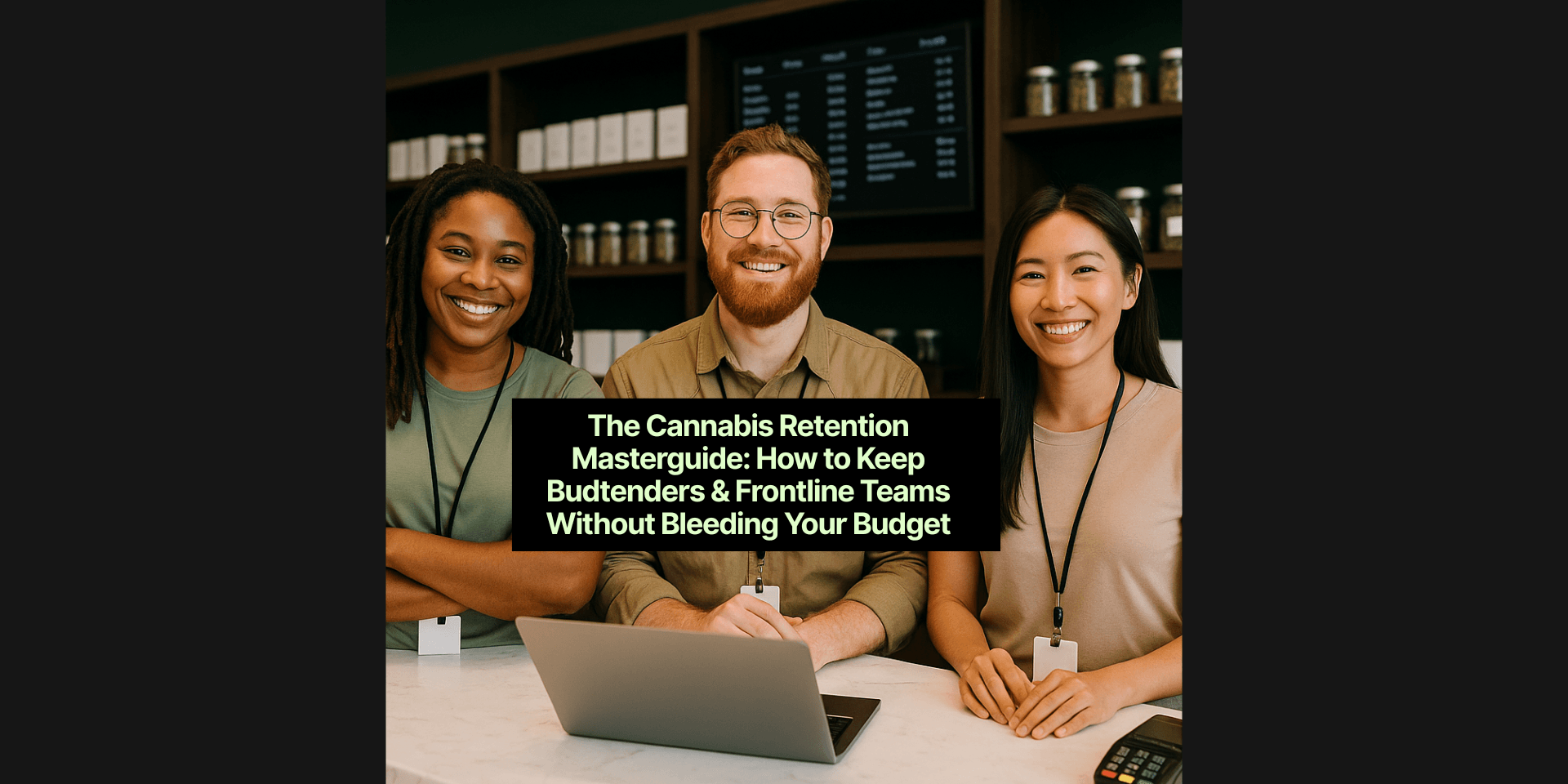
Okay, so… this one’s a long one.
The kind you’ll probably want to bookmark, save, or send to that coworker who keeps saying, “Yeah yeah, I’ll read it later.”
And honestly? You should.
We’re about to dig into some meaty, come-back-to-it, maybe-even-listen-to-it-in-your-car-on-the-way-to-the-dispensary substance.
If you’ve spent any time in cannabis, you’ve heard the same phrase ricochet through dispensaries, grow rooms, group chats, and management meetings:
“It’s just hard to keep good people.” - EVERYONE THAT'S OVERWHELMED!
It’s said so often it might as well be printed on rolling papers.
It’s tossed around with the same energy as “traffic was crazy today” or “my badge expires again next week”—so casually it’s taken on the weight of a universal truth, something baked into the industry’s DNA.
But here’s the pivot.
THE LIE EVERYONE REPEATS
That phrase—“It’s just hard to keep good people”—isn’t wisdom.
It’s a reflex. A default. A comforting explanation we’ve repeated so many times it feels true… even when it isn’t.
And today?
We’re finally going to unpack it.
But if we’re being honest, that line isn’t an observation — it’s a coping mechanism. It’s the thing operators say when they’re exhausted from writing the same job posting for the fourth time in a year. It’s what HR whispers when another great budtender leaves after six months. It’s the story owners lean on when turnover feels less like a problem and more like a permanent condition.
Still, the question hangs in the air, often unspoken:
What exactly are you giving people to stay?
Not in a guilt-tripping way. Not in a “you’re doing everything wrong” way. In a real, grounded, human way. Because good people don’t leave workplaces that invest in them. They leave workplaces that don’t.
This isn’t a criticism of you or your leadership. It’s an indictment of how cannabis as a whole treats its frontline workforce — the budtenders, cultivation techs, delivery drivers, packagers, and lab assistants who hold this industry up every single day. And if you want to keep them, you have to understand what they’re actually experiencing.
A REALISTIC LOOK AT YOUR FRONTLINE TEAM
Let’s start with budtenders.
Picture the scene: It’s a busy afternoon at your dispensary. Customers are lined out the door. IDs are being scanned. A new customer wants a 101 crash course on indicas vs. sativas. Someone else wants recommendations for anxiety. Someone else wants the highest THC on the shelf. Your budtender has repeated the same explanations twelve times in three hours, and there’s still a line waiting.
They’re friendly, knowledgeable, and in tune with your customers. They’re the face of your brand. And they’re tired.
Rent is high. Bills are relentless. And most dispensaries don’t offer a single long-term benefit. So when another shop offers 75 cents more per hour, even if everything else is worse — no culture, no vision, no loyalty — it’s tempting. Because survival trumps satisfaction every time.
Now think about your cultivation team.
These folks work in demanding environments: humidity-controlled rooms, precise nutrient schedules, repetitive tasks that require both accuracy and physical stamina. Harvest weeks feel like endurance marathons. Trimming days leave wrists sore. The work is both agricultural and scientific, and it’s undervalued far too often.
Cultivation techs rarely get benefits in cannabis. But in other industries — agriculture, biotech, food production — workers doing similar jobs do. So when they leave, it’s not because they lack loyalty. It’s because they lack long-term support.
And don’t forget delivery drivers.
They’re dealing with safety risks, traffic, customers, and sometimes their own vehicles. It’s a job that demands trust and responsibility. And yet, in many markets, delivery drivers receive the fewest long-term protections. It sends a message, even if unintentionally: “You’re replaceable.”
That message drives people away faster than wages ever can.
Meanwhile, you're dealing with the chaos behind the scenes.
Schedules shifting at the last minute. New hires not showing up on day one. A manager covering a shift because someone quit on Friday night. HR rewriting the onboarding process for the tenth time this quarter. Owners calculating turnover costs like they’re tallying losses in a casino — because that’s what it feels like.
This isn’t because you’re a bad leader. It’s because you’re operating in a system built on short-term thinking. And short-term thinking creates short-term employees.
THE REAL REASON PEOPLE LEAVE (AND WHY MONEY ALONE ISN’T FIXING IT)
Let’s dispel the biggest myth right now:
People don’t leave because they don’t like the job.
People leave because they don’t like the lack of security.
You can keep raising wages, but if your team still feels financially vulnerable, emotionally disposable, or professionally stuck, all you’ve done is buy yourself a few more months. A $1 raise doesn’t fix a $1,200 emergency. A small bonus doesn’t fix systemic burnout.
What people actually want — and what keeps them in your business long-term — is stability.
They want to feel like their job isn’t one bad month away from disaster.
They want to know their employer sees them as human, not as headcount.
They want to believe there is a path forward.
Wages solve the immediate moment.
Benefits solve their future.
This isn’t hypothetical. SHRM reports that 73% of employees cite benefits as a major factor in staying with an employer, compared to 55% who cite pay alone. The data in cannabis mirrors this: Vangst’s 2024 Jobs Report shows that workers are hungry for professional development, support, and long-term value.
The industry keeps thinking employees leave because someone else offered $18 instead of $17. But in reality? They leave because wherever they’re going makes them feel more secure.

TURNOVER ISN’T A PEOPLE PROBLEM — IT’S A STRUCTURE PROBLEM
Here’s a truth many operators don’t want to acknowledge:
High turnover isn’t an employee failure.
It’s an operational failure.
Not a moral one — a structural one.
Because the systems cannabis has inherited from legacy, from prohibition, from rapid scaling, and from cash-based chaos weren’t built for stability. They were built for survival.
You can see the remnants everywhere:
-
Fast hiring, faster firing
-
Constantly shifting roles
-
Minimal long-term planning
-
Lack of formal development
-
Inconsistent benefits
-
A “just get through the week” mentality
This produces employees who behave exactly like the system expects: temporary, transactional, disconnected.
Not because they want to be — because the structure leaves them no other choice.
When you improve the structure, you improve retention.
And nothing improves structure faster or more effectively than benefits.
Especially retirement benefits.
BENEFITS BUILD THE CULTURE MONEY CAN’T
A raise says, “We value your time.”
A bonus says, “We appreciate your work.”
But benefits say, “We’re building a future, and we want you in it.”
That’s what sticks.
That’s what builds loyalty.
That’s what transforms frontline employees into long-term, engaged contributors.
A 401(k) — when done correctly, compliantly, and consistently — tells your people:
-
“We see you.”
-
“We believe in your potential.”
-
“We plan to be around.”
-
“We want you to grow with us.”
No pizza party or swag box in the world can compete with that.
THE ECONOMICS OF RETENTION (AND WHY BUDGETS ARE BLEEDING FROM THE WRONG PLACE)
You already know turnover feels expensive — but most cannabis operators underestimate just how expensive it really is. Because turnover doesn’t hit your budget in one place; it hits everywhere at once. It drains time, morale, training capacity, productivity, compliance consistency, and your ability to build a stable culture.
Let’s break down the real numbers.
THE TRUE COST OF LOSING ONE BUDTENDER OR CULTIVATION TECH
Vangst’s 2024 cannabis workforce analysis shows what most cannabis operators feel intuitively: replacing one frontline employee costs anywhere from $3,500 to $8,000, depending on the role.
Here’s where that money goes:
-
Recruiting: job posts, ads, hiring platforms
-
Management labor: interviewing, onboarding, scheduling gaps
-
Training hours: paid shadow shifts, compliance training, product education
-
Lost customer experience: inconsistent service quality impacts sales
-
Burnout contagion: one departure often triggers more
-
Compliance risk: inexperienced staff make more mistakes
Now multiply that across your year. If your dispensary turns over ten budtenders annually (not uncommon), you’re spending $35,000 to $50,000 just to return to “baseline.”
If your grow cycles through 15 cultivation techs a year, you’re eating $75,000 to $120,000 in replacement costs.
Those numbers aren’t theoretical. They’re actively draining your margins right now.
And here’s the kicker:
A retirement plan costs a fraction of that.
And it actually reverses the trend.
THE WORST FINANCIAL TRAP IN CANNABIS: COMPETING ON WAGES ALONE
You already feel the squeeze:
Inflation + regional competition + razor-thin margins + 280E + endless operational demands = almost no room for wage inflation.
But many operators still default to the same reaction every time a good employee threatens to leave:
“Let’s bump their pay.”
Here’s why that’s unsustainable:
1. Raises scale infinitely; benefits scale predictably.
If you raise someone $1 per hour, that’s roughly $2,000 more per year — every year, per employee.
Do that five times and you’ve suddenly committed to $10,000 annually without improving retention beyond the next six months.
2. Raises increase payroll taxes; employer contributions often don’t.
Under ERISA, employer contributions to retirement plans are tax-deductible.
Raises?
Taxable.
Always.
No exception.
3. Raises don’t change the psychological story.
A budtender making $17/hour instead of $16/hour is still living shift-to-shift.
A budtender with a retirement plan feels like someone investing in their future.
One raises income.
The other raises identity.
THE PSYCHOLOGY OF STAYING (WHAT FRONTLINE EMPLOYEES WON’T SAY OUT LOUD)
If you pull your best budtender aside — the one your regulars love, the one with product knowledge that rivals your vendors — and ask them why they’ve ever thought about leaving, their real answers won’t be about money.
They’ll say things like:
-
“I didn’t see a path here.”
-
“I felt replaceable.”
-
“I didn’t know if this would turn into anything long-term.”
-
“I didn’t feel protected.”
-
“I couldn’t picture myself here in five years.”
These aren’t personal complaints.
They’re structural gaps.
A strong benefits package — especially a retirement plan — fills that gap instantly.
Because benefits don’t just pay people.
They position people.
When you give someone access to a 401(k):
-
They see themselves as part of something real.
-
They see the company as long-term.
-
They see themselves as long-term.
-
They show up differently.
-
They stay longer.
-
They contribute more deeply.
This is retention psychology 101.
People stay where they see a story they want to be in.
THE DIFFERENCE BETWEEN A “JOB” AND A “CAREER” IN CANNABIS
Ask yourself:
Do your budtenders feel like cannabis is a career?
Do your cultivation techs feel like they’re building something?
Do your delivery drivers see themselves growing here?
If the answer is no, here’s why:
Jobs only pay you now.
Careers take care of your future.
Right now, most cannabis employers only give their people a “now.”
Paragon + LRS give them a “next.”
THE RETENTION GAP ACROSS ROLES (AND WHAT EACH ONE NEEDS)
To speak their language, we have to understand their reality.
Here’s what each frontline group is facing — and what actually keeps them:
BUDTENDERS: THE FACE OF YOUR BRAND
The reality:
Budtenders are asked to be customer service experts, therapists, compliance translators, and product educators all in one shift. They manage emotional labor. They endure retail pressure. They sometimes deal with difficult personalities. And they rarely get credit for how complex the job actually is.
Why they leave:
-
Feeling undervalued
-
No benefits
-
No growth path
-
Emotional fatigue
-
Higher-paying competitor offers
What keeps them:
-
Predictability
-
A reason to believe this job has a future
-
Benefits that support their life, not just their paycheck
-
Training + career development
-
Retirement plans that help them build wealth
CULTIVATION TECHS: THE ENGINE OF YOUR PRODUCT QUALITY
The reality:
Cultivation teams handle precision agriculture, quality control, scientific processes, heavy physical labor, and production deadlines. In most industries, this level of skill comes with strong benefits.
Why they leave:
-
Physical burnout
-
Feeling invisible
-
High turnover impacting morale
-
Other industries offering stability and benefits
-
Lack of development pathways
What keeps them:
-
Stability
-
Recognition
-
A growth pathway (cultivation → senior tech → lead grower)
-
Future-focused benefits
-
A 401(k) that mirrors agricultural and biotech norms
DELIVERY DRIVERS: THE MOST UNDERPROTECTED ROLE
The reality:
Drivers take on security risks, liability, customer interaction, time pressure, and unpredictability. They’re as essential as budtenders but often treated like gig workers.
Why they leave:
-
Safety concerns
-
No long-term benefits
-
Feeling like contractors, not employees
-
Unpredictable schedules
What keeps them:
-
Stability
-
Safety investment
-
Identity and belonging
-
Benefits that show you value their role
-
A retirement plan — the ultimate symbol of “you matter here”
PACKAGERS, LABELERS & LAB TECHS: THE PRECISION CREW
The reality:
These roles require consistency, discipline, compliance accuracy, and attention to detail. Mistakes here lead to recalls, fines, or compliance violations — and yet these roles rarely come with any benefits at all.
Why they leave:
-
Feeling invisible
-
Repetitive work with no upward path
-
No long-term incentives
-
Burnout from production quotas
What keeps them:
-
A sense of trajectory
-
Recognition
-
Benefits aligned with manufacturing and lab norms
-
Future-focused stability
MANAGERS & SHIFT LEADS: THE ONES HOLDING THE WHOLE THING TOGETHER
The reality:
Cannabis managers are filling roles that, in other industries, would be three separate jobs. They handle HR issues, schedules, conflict, product knowledge, training, cash management, sales strategy, and customer escalations.
Why they leave:
-
Emotional burnout
-
Feeling unsupported
-
No benefits
-
No leadership development
-
No compensation strategy with longevity
What keeps them:
-
Clear pathways
-
Benefits that match their responsibility load
-
Retirement support
-
Investment in leadership skills
-
Integration between payroll, scheduling, and benefits
THE BUDGET TRUTH MOST OPERATORS MISS
Here’s the hard operational truth:
You are not losing people because you can't afford to pay more.
You are losing people because you can’t afford not to invest in their future.
Raises keep people afloat.
Benefits keep people anchored.
And the anchor is almost always cheaper than the flotation device.
THE RETENTION TURNING POINT: WHEN SECURITY ENTERS THE CONVERSATION
When an employee suddenly sees:
-
A 401(k)
-
Matching contributions
-
A benefits package
-
Growth pathways
-
A stable employer with clear systems
-
A payroll provider that gets cannabis
-
A retirement partner who understands ERISA in this industry
…they stop seeing themselves as temporary.
They start seeing themselves as part of something.
And people don’t walk away from something they’re part of.
THE PARAGON × LRS RETENTION BLUEPRINT (AND HOW IT REDEFINES THE FUTURE OF CANNABIS WORKFORCE STABILITY)
Up to this point, we’ve covered the emotional truth, the operational reality, and the financial cost of losing good people. But understanding the problem isn’t enough — not in cannabis, where thin margins force operators to prioritize solutions that are both effective and efficient.
That’s exactly why the partnership between Paragon Payroll and Leading Retirement Solutions (LRS) exists: to give cannabis businesses benefits that actually work inside the constraints of the industry, not in spite of them.
It’s not about offering a 401(k) because it’s trendy.
It’s about using retirement plans as a strategic retention mechanism that is cheaper, smarter, and more sustainable than competing on wages alone.
Let’s break down how this blueprint works, why it’s compliant, and why it’s changing the expectations of employees across the cannabis supply chain.
WHY MOST EMPLOYERS THINK BENEFITS AREN’T POSSIBLE — AND WHY THEY’RE WRONG
Ask around the industry, and you’ll hear a familiar set of assumptions:
-
“We can’t offer retirement, cannabis is federally illegal.”
-
“We can’t afford it.”
-
“Payroll is already a nightmare.”
-
“No provider wants to touch cannabis companies.”
-
“We’re too small.”
-
“Our employees wouldn’t use it anyway.”
These statements feel true, but they’re not rooted in facts.
Here’s the real breakdown:
1. “Cannabis is federally illegal — retirement plans aren’t allowed.”
False. Flat-out false.
ERISA doesn’t prohibit cannabis companies from offering retirement plans. It requires fiduciary oversight, compliant plan design, and a partner willing to support the industry.
Most retirement providers won’t touch cannabis not because they can’t — but because they won’t.
LRS will.
2. “We can’t afford benefits.”
Retirement plans, especially safe-harbor or flexible matching structures, often cost significantly less than the annual turnover of a single frontline employee.
One budtender’s exit could cover the cost of launching a full retirement plan for your entire team.
3. “Our payroll is too complicated.”
This is usually true — unless you work with Paragon.
Cash-heavy workflows, complex tax structures, banking limitations, state-by-state variation… Paragon was built for exactly this.
Paragon solves the payroll problem.
LRS solves the retirement problem.
Together, they eliminate the excuses.
4. “Employees won’t use it.”
The data says otherwise.
According to the Vangst 2024 Jobs Report:
-
71% of cannabis workers say they would stay longer if retirement benefits were offered.
-
401(k) access is the second-most requested benefit, behind healthcare.
They want it.
They’re just not being offered it.
THE PARAGON × LRS BLUEPRINT: HOW IT ACTUALLY WORKS
It breaks down into five core components:
1. Fully Cannabis-Compliant Plan Setup
LRS designs plans specifically for cannabis — taking into account:
-
Entity structure
-
Licensing requirements
-
High-risk classification
-
280E considerations
-
Multi-state operations
-
Owner-specific tax strategies
This isn’t a “template” plan.
This is engineered for YOU.
2. Integration Directly Into Paragon Payroll
This is the piece most cannabis companies never get: seamless integration.
Your payroll talks to your retirement plan automatically.
That means:
-
Contributions sync in real time
-
No manual reporting
-
No dual data entry
-
Fewer errors
-
Cleaner compliance trails
-
Faster onboarding
-
Smoother audits
Integration = retention with less friction.
3. Fiduciary Protection (Where Most Cannabis Plans Fail)
Here’s something operators rarely realize:
If you run a retirement plan without proper fiduciary safeguards, you — personally — can be liable for plan mismanagement.
That includes:
-
Incorrect contributions
-
Discriminatory plan design
-
Misfiled compliance documents
-
Improper audits
-
Errors in eligibility
-
Improper match calculations
LRS takes this risk off your plate.
This matters even more in cannabis, where regulatory scrutiny is already heightened.
4. Flexible Plan Design (Built for Real Margins)
You don’t need a Google-level match. You don’t need a Fortune 500-level budget.
LRS builds retirement plans that match the financial reality of cannabis, including:
-
Low-match options
-
Safe harbor options
-
Vesting schedules
-
Owner contributions
-
Profit-sharing
-
Solo(k) options for founder-only operations
-
Gradual growth plans
You choose the strategy.
LRS builds it.
Paragon powers it.
5. Employee Education That Actually Resonates
Here’s the part operators underestimate:
Employees don’t need a lecture on retirement theory. They need clarity.
LRS + Paragon help communicate:
-
What the plan is
-
Why it matters
-
How to enroll
-
How to contribute
-
How matching works
-
How it benefits their long-term financial health
When employees understand the value, they commit harder and stay longer.
WHAT ALL THIS MEANS FOR RETENTION (REAL OUTCOMES, NOT MARKETING SPEAK)
Let’s break down how this changes retention across different environments.
FOR DISPENSARIES: STABILITY IN A ROLE WITH HIGH EMOTIONAL LABOR
Budtenders burn out fast because:
-
They deal with customers nonstop
-
They handle sensitive compliance tasks
-
They navigate emotional labor
-
They receive limited upward mobility
-
They rarely receive benefits of any kind
Introduce retirement benefits — and suddenly the dynamic shifts.
Budtenders begin to:
-
Show up more consistently
-
Develop deeper product knowledge
-
Engage with customers more authentically
-
Think long-term about their role
-
Stay past the 6–12 month turnover cliff
This isn’t theoretical — it’s happening inside cannabis operations using this blueprint today.
FOR CULTIVATION: REDUCING PHYSICAL & MENTAL BURNOUT
Cultivation roles see some of the highest turnover due to physical strain.
Benefits do two things:
-
They communicate respect for the workload
-
They give cultivation techs a reason to see the job as a long-term career
Retention in cultivation skyrockets when employees feel protected — especially through benefits that mirror agriculture and biotech sectors.
FOR DISTRIBUTION & DELIVERY: SAFETY + SECURITY = LOYALTY
Delivery drivers have one of the highest-risk roles in the industry.
Retirement benefits send a message:
“You’re valued. And we’re committed to your wellbeing beyond the shift.”
This increases loyalty, reduces churn, and improves performance.
FOR MANUFACTURING & LAB TEAMS: BUILDING A REAL CAREER PATH
Consistency matters most in processing.
Benefits help:
-
Reduce hiring cycles
-
Improve accuracy
-
Build a culture of ownership
-
Increase compliance adherence
-
Stabilize production timelines
Benefits are one of the most effective ways to increase retention in roles with repetitive tasks.
WHAT THIS MEANS FOR YOU — THE OWNER, THE OPERATOR, THE HR LEAD, THE CFO
If you’re an OWNER:
A retirement plan is a wealth strategy.
Yes — you can protect your own income with a plan that reduces taxable exposure.
This isn’t just about employees; it’s about you.
If you’re a CFO:
LRS becomes your risk shield.
Paragon becomes your compliance backbone.
Together, they reduce audit risk and clean up complex workflows that would take weeks of internal labor.
If you’re an HR LEADER:
Retention becomes predictable.
Turnover decreases.
Onboarding becomes easier.
Employees stay long enough to develop.
You finally get room to build culture instead of constantly rebuilding teams.
If you’re a GENERAL MANAGER:
You get a team that isn’t on the verge of jumping ship.
Your time goes back to leadership — not hiring.
THE 2026-FORWARD LABOR LANDSCAPE: WHAT’S COMING AND WHY YOU NEED TO PREPARE NOW
The cannabis workforce is evolving — and fast.
Here’s what’s coming:
1. Employees expect professional benefits — period.
As the industry matures, employees will compare cannabis jobs to mainstream jobs.
401(k) access will become a baseline expectation.
2. Competition for skilled roles will intensify.
The best budtenders, cultivation techs, and manufacturing staff will go where the benefits are.
3. More states will require employer-sponsored benefits.
It’s already happening in other sectors. Cannabis will follow.
4. Investors and buyers will evaluate your benefits offerings.
Benefits signal maturity.
Maturity signals acquisition readiness.
5. Banking partners prefer employers with stable HR infrastructure.
Retirement benefits are an automatic indicator of organizational legitimacy.
BEST NEXT STEPS (ACTIONABLE PLAYBOOK)
Here’s exactly what to do next — broken down by role.
For Owners & Founders
-
Schedule a consultation with Paragon to review your payroll structure.
-
Request the LRS Cannabis Retirement Readiness Assessment.
-
Identify whether Safe Harbor, Traditional, or Solo(k) is the best fit.
-
Review your tax exposure to determine optimal contribution strategies.
-
Launch a pilot benefit phase if you’re unsure — start small, expand strategically.
For CFOs
-
Map out your annual turnover cost.
-
Compare that number to the projected cost of a retirement plan.
-
Review fiduciary risk with LRS advisors.
-
Calculate tax offsets for employer contributions.
-
Align contributions with cash flow cycles.
For HR Leaders
-
Build a communication plan to introduce retirement benefits to staff.
-
Develop a 12-month retention roadmap tied to benefits milestones.
-
Align onboarding scripts to highlight the new retirement offering.
-
Work with Paragon to build automated enrollment workflows.
-
Track retention metrics pre- and post-benefit launch.
For General Managers
-
Introduce retirement benefits as part of your culture narrative.
-
Reinforce the value during team meetings and evaluations.
-
Identify high-potential employees and support their enrollment.
-
Use benefits as a tool for promoting from within.
-
Monitor morale and engagement as stability increases.
RECOMMENDED RESOURCES FOR CANNABIS OPERATORS
-
Paragon Payroll: Cannabis-specific payroll + time + compliance
-
Leading Retirement Solutions: Cannabis-compliant 401(k) and fiduciary protection
-
Vangst Jobs Report 2024: Workforce trends + retention data
-
NCIA HR & Compliance Resources: Best practices for cannabis employment
-
State Workforce Guides: Local labor laws impacting benefits
BENEFITS AREN’T A LUXURY — THEY’RE A STRATEGY
This entire industry was built on resilience, innovation, and courage. But resilience alone won’t build sustainable businesses. Innovating in the right areas will.
Wages matter.
Culture matters.
Training matters.
But none of those things create long-term security.
Benefits do.
Retirement does.
Planning for the future does.
Cannabis companies aren’t losing great people because of passion or pay.
They’re losing them because they’re not offering a future worth committing to.

Topics:
