

Most cannabis businesses don’t decide to switch payroll providers overnight. They slowly realize how much they’ve learned to tolerate.
And don’t even get me started on the word “switch.”
For a lot of cannabis operators and HR professionals, switch does not sound like improvement. It sounds like work.
New systems. New logins. Data migration. Employee questions. Training. Tax information. Banking. Another implementation. Another vendor asking you to trust them when trust can already feel volatile in this industry.
So when someone says, “Maybe it’s time to switch payroll providers,” your first reaction might not be excitement.
It might be exhaustion.
“Absolutely not. I already have enough on my plate.”
And that reaction deserves to be understood.
Because sometimes you are not staying with your current provider because everything is going wonderfully. You are staying because the perceived weight of leaving feels heavier than the problems you have already learned how to carry.
But that is where the word needs to be reframed.
Switching should not mean taking on another burden. It should mean putting one down.
The heaviness of switching becomes especially noticeable when you imagine having to figure everything out yourself. A genuinely helpful implementation team should be carrying that transition with you, explaining what comes next, helping organize what is needed, anticipating questions, communicating clearly, and making sure you are not standing there wondering what you forgot.
That is an important distinction when evaluating a new provider.
Do not just ask:
“How difficult is it to switch?”
Ask:
“How much of the switch are you actually going to help me carry?”
Because if you are already overwhelmed, the answer is not another company handing you a checklist and wishing you luck.
The right transition should have support built into it.
And maybe that is the better way to think about switching altogether.
You are not changing payroll providers just for the sake of changing payroll providers.
You are deciding whether the temporary weight of change is worth removing the recurring weight you have been carrying every payroll cycle.
When the right team is beside you, switch starts feeling a lot less like disruption.
And a lot more like relief.
Most cannabis businesses do not wake up one morning and announce:
“Today feels like a great day to switch payroll companies.”
Usually, it sounds much less dramatic.
It sounds like:
“I just need to double check payroll before I approve it.”
Or:
“They are not terrible. I just wish they understood cannabis better.”
Or the sentence that has probably kept more businesses in frustrating vendor relationships than almost anything else:
“Switching sounds like such a pain.”
These comments can feel harmless. Normal, even.
But sometimes they are signals.
Little verbal breadcrumbs that tell you something about your payroll relationship is no longer working the way it should.
And because payroll sits at the intersection of your employees, taxes, banking, compliance, timekeeping, HR, and cash flow, those little frustrations can become expensive problems if nobody pays attention to them.
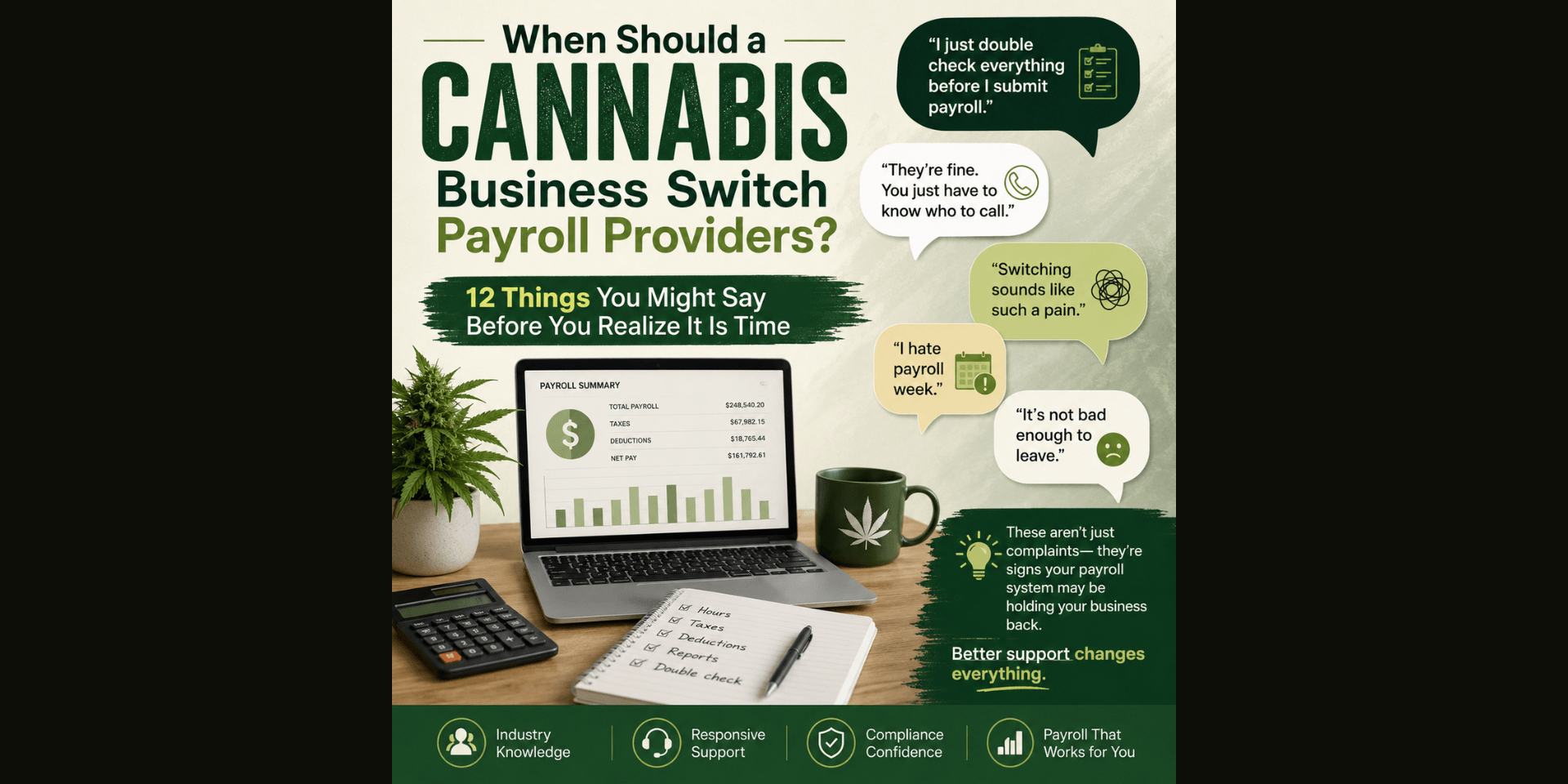
So instead of giving you another generic checklist of reasons to switch payroll companies, let us listen to what cannabis operators actually say.
If several of these sentences sound familiar, it may be worth asking a harder question:
Are you staying because your payroll provider is actually good for your business, or because leaving feels harder than staying?
1. “I Just Double Check Everything Before I Submit Payroll.”
This sounds responsible.
And to a degree, it is.
You absolutely should review payroll.
But there is a difference between reviewing payroll because you are a responsible operator and reviewing payroll because you do not trust what is going to happen if you do not catch something.
That distinction matters.
Maybe you have experienced incorrect deductions.
Maybe hours have imported strangely.
Maybe taxes have been confusing.
Maybe an employee was paid incorrectly before and now you have developed your own unofficial quality control process.
So every payroll run comes with a ritual.
Open the reports.
Check the hours.
Check them again.
Compare something against the previous payroll.
Maybe pull out your calculator.
Maybe send a message to your HR person.
Then finally hit submit.
At some point, ask yourself:
Am I verifying payroll, or am I babysitting my payroll provider?
Your payroll system should reduce administrative anxiety, not quietly create another job for you.

2. “They Are Fine. You Just Have to Know Who to Call.”
This one is sneaky.
Because what you may actually be saying is:
The system only works because we have figured out how to work around the system.
Maybe your normal support channel takes too long, so you learned to email someone directly.
Maybe one representative understands cannabis payroll and the others do not.
Maybe your account technically has support, but your team has figured out that if something is urgent, there is only one person who can actually solve it.
That creates dependency.
And dependency becomes especially dangerous when that employee leaves, gets promoted, goes on vacation, or gets reassigned.
Good service should not require insider knowledge.
You should not need a cheat code to get help.
3. “Our Payroll Person Knows How to Fix It.”
That sounds reassuring until you ask:
Why do they have to keep fixing it?
Cannabis businesses frequently have incredibly resourceful HR professionals, controllers, office managers, and payroll administrators.
Resourcefulness is great.
But sometimes talented employees become human duct tape.
They create spreadsheets.
They maintain separate calendars.
They manually reconcile information.
They memorize workarounds.
They know which fields cannot be trusted.
They know which reports need to be exported and manipulated before leadership can actually use them.
Eventually, everyone begins thinking:
That is just how payroll works.
Maybe it is not.
If one employee leaving would expose a maze of undocumented workarounds, that is not simply institutional knowledge.
That is operational risk.
4. “They Don't Really Understand Cannabis, But Payroll Is Payroll.”
This might be one of the biggest warning signs.
Because cannabis payroll is payroll.
Until it isn't.
Cannabis businesses still have to deal with the normal complexities every employer faces, including wages, taxes, classifications, overtime, deductions, onboarding, reporting, and employee records.
But you are doing all of that inside an industry with unusual banking relationships, evolving regulations, complicated tax considerations, licensing requirements, high employee turnover in certain roles, multistate complexity for some operators, and vendors that may have very different levels of comfort with cannabis.
So yes, your provider can understand payroll.
But do they understand your environment?
There is a difference.
You should not have to educate the company you are paying every time an industry specific situation appears.
5. “Support Usually Gets Back to Me Eventually.”
Eventually is an interesting word.
If you are asking how to change an employee's address, eventually might be perfectly acceptable.
If payroll closes in two hours?
Different story.
When employees' money is involved, response time suddenly matters a lot more.
Think about your last three urgent payroll issues.
How quickly did you get a human?
Did that human understand the problem?
Could they solve it?
Did you have to explain everything again after being transferred?
And most importantly:
Did their support lower your stress or add to it?
Customer service should not simply exist.
It should work when the stakes are high.
6. “We Have Had a Few Payroll Mistakes, But Nothing Huge.”
This is where normalization can get expensive.
A few mistakes.
A couple corrections.
One tax notice.
An employee who did not get paid correctly.
A deduction that had to be fixed.
An issue that was technically resolved.
Individually, these may feel manageable.
But instead of asking whether any single mistake was catastrophic, ask:
What pattern are these mistakes creating?
Payroll problems rarely announce themselves with flashing lights.
Sometimes the bigger warning is repetition.
Mistake.
Correction.
Apology.
Workaround.
Repeat.
Your standard should not simply be:
Did they eventually fix it?
It should also be:
Why does this keep happening?
7. “We Still Track That in a Spreadsheet.”
There is nothing inherently wrong with spreadsheets.
Sometimes they are incredibly useful.
The problem is when your payroll or HR technology supposedly handles something, but your team does not trust it enough to stop maintaining a separate version.
PTO.
Hours.
Employee information.
Onboarding.
Tips.
Scheduling.
Training.
Compliance documentation.
Payroll changes.
If your business has developed an entire shadow operating system outside your actual system, investigate why.
Sometimes the spreadsheet is the best tool.
Sometimes it is evidence that your technology stack is not doing what you are paying it to do.
Ask your team:
If we stopped using our side spreadsheets tomorrow, what would break?
That answer could tell you quite a bit.
8. “I Hate Payroll Week.”
Pay attention to this one.
Not because payroll is supposed to be fun.
But because recurring dread is information.
If every payroll cycle creates anxiety, late nights, Slack messages, emergency emails, manual corrections, or that familiar knot in someone's stomach, something deserves examination.
And leadership may never see it.
The CEO sees:
Payroll processed successfully.
The person actually processing it remembers:
I spent four hours fixing everything so payroll processed successfully.
Those are two very different versions of the same story.
Talk to the person closest to payroll.
Ask them what happens behind the scenes.
You may discover that your “working” system only works because someone is exhausting themselves to keep it working.
9. “Our Employees Ask HR Because They Cannot Figure Out the App.”
That is not just an employee inconvenience.
It becomes an HR workload problem.
Every password reset, missing paystub, confusing PTO balance, inaccessible tax document, and difficult mobile experience has somewhere to go.
Usually HR.
One question does not seem significant.
Multiply it across dozens or hundreds of employees over an entire year.
Now you are paying HR professionals to function as technical support for software you are already paying for.
Employee self service should actually create self service.
If it does not, include that hidden labor when evaluating the real cost of your provider.
10. “We Have Outgrown Them, But They Are Cheap.”
This is where price and cost get confused.
Your provider might charge less.
But what does the relationship actually cost?
Add the hours spent correcting errors.
Add manual administrative work.
Add employee frustration.
Add inefficient onboarding.
Add disconnected systems.
Add support delays.
Add whatever your leadership team cannot see because HR quietly handles it.
A cheaper invoice does not necessarily mean a cheaper solution.
The better question is:
What does payroll cost us after we include the human labor required to make it work?
That is your more meaningful number.
11. “I Know We Should Probably Look Around. I Just Don't Want to Deal With Switching.”
There it is.
This may be the most important sentence in this entire article.
Because sometimes businesses are not choosing their payroll provider anymore.
They are avoiding implementation.
That is understandable.
Switching payroll providers can involve employee data, tax information, banking, deductions, historical payroll records, integrations, training, timing, and a lot of coordination.
Nobody wants unnecessary disruption.
But fear of switching and satisfaction with your current provider are not the same thing.
Try this thought experiment:
If switching payroll providers required zero effort tomorrow, would you still choose your current company?
Do not answer quickly.
If the answer is an immediate yes, great.
If you hesitate, investigate that hesitation.
Because switching has a temporary cost.
Staying with the wrong system can have a recurring one.
12. “It's Not Bad Enough to Leave.”
This might actually be the clearest sign of all.
Notice the standard.
Not:
They are excellent.
Not:
They make our jobs easier.
Not:
I trust them.
Not:
They understand our business.
Instead:
It is not bad enough to leave.
That is a remarkably low bar for a company responsible for paying your people.
You do not necessarily need to switch because something is imperfect.
Every vendor relationship has occasional problems.
But there is a difference between experiencing a problem and maintaining a relationship that has slowly trained you to accept problems as normal.
So, When Should You Actually Switch Payroll Providers?
Not every frustration warrants migration.
Sometimes the right answer is to stay and fix the relationship.
Before switching, document what is not working and bring those concerns directly to your provider. Ask what can be changed. Request clearer support expectations. Review features you may not be using. Determine whether additional training could solve the problem.
Give a good partner the opportunity to be a good partner.
But if the same problems continue, the conversation changes.
Especially if your team no longer trusts the system, support repeatedly fails when you need it, your employees struggle to use the technology, manual workarounds have become standard operating procedure, your provider does not understand cannabis, or your business has simply outgrown what the platform can support.
Then switching is not about chasing shiny new software.
It is about removing friction from something your business has to get right every single pay period.
Before You Switch, Ask These Five Questions
Do not start by scheduling five demos.
Start internally.
Ask your payroll administrator:
“What part of payroll makes you the most nervous?”
Ask HR:
“What payroll related questions are employees constantly bringing to you?”
Ask leadership:
“What information do we wish we could get more easily?”
Ask your team:
“What manual processes have we accepted as normal?”
And finally:
“If we were choosing a payroll provider today, knowing everything we know now, would we choose this one again?”
That last answer matters.
A lot.
You Do Not Need a Payroll Emergency to Give Yourself Permission to Look
Cannabis operators have enough fires to put out.
Payroll does not need to become one before you reconsider the relationship.
You can explore alternatives while things are still functioning.
You can ask competitors uncomfortable questions.
You can compare pricing.
You can request references.
You can ask exactly what implementation would involve before committing to anything.
You can even decide your current provider is still the best option.
Researching your alternatives does not obligate you to leave.
It simply gives you enough information to make the decision intentionally.
At Paragon Payroll, we obviously have a horse in this race. We provide payroll and HR solutions for cannabis businesses.
So we are not going to pretend we are an unbiased observer.
And we do not think every cannabis company reading this should automatically switch to Paragon.
You should choose the provider that makes the most sense for your employees, your operation, your risk tolerance, and where you are trying to grow.
But whether that is us or someone else, you deserve something better than:
“It's not bad enough to leave.”
Your employees are trusting you with their paychecks.
Your HR team is carrying the responsibility of getting them right.
And your business has enough complicated things to worry about already.
Payroll should not quietly become another one.
FAQ: Switching Payroll Providers for a Cannabis Business
How do I know if my payroll provider is actually bad or if I am just frustrated?
Start by looking for patterns rather than isolated incidents.
Every payroll provider can have a support delay, software glitch, or human error occasionally. The bigger concern is when those exceptions become your normal experience.
Ask yourself whether your team regularly double checks work because they do not trust the system, maintains manual workarounds, waits too long for support, repeatedly corrects similar mistakes, or spends significant time helping employees navigate technology that is supposed to make their lives easier.
Then ask one brutally useful question:
If we were choosing a payroll provider today, knowing everything we know now, would we choose this company again?
If the answer is no, your frustration might be telling you something.
Is one payroll mistake enough reason to switch providers?
Usually, no.
Mistakes happen.
What matters is what caused the mistake, how the provider responded, and whether it keeps happening.
A good provider should take ownership, explain what happened, correct the issue, communicate clearly, and help prevent it from happening again.
A bigger warning sign is when mistakes become a cycle:
Problem. Correction. Apology. Temporary fix. Same problem again.
At that point, you are no longer evaluating one mistake. You are evaluating a pattern.
What are the biggest warning signs that we have outgrown our payroll provider?
Sometimes growth exposes problems that were invisible when your cannabis business was smaller.
You might notice that adding locations creates significantly more manual work. Reporting becomes harder. Scheduling becomes messy. HR starts maintaining more spreadsheets. Managers struggle to access the information they need. Employee questions increase. Integrations become more important. Your provider's support model may no longer match the complexity of your organization.
The provider may not have gotten worse.
Your business may simply have gotten bigger than the solution you originally purchased.
That is an important distinction.
Should my payroll provider have cannabis industry experience?
We believe cannabis experience matters, but you should understand why it matters rather than simply looking for a cannabis logo on someone's website.
Cannabis businesses still deal with the fundamentals of payroll, including wages, taxes, overtime, deductions, employee classification, onboarding, timekeeping, and reporting.
But those responsibilities exist inside an unusually complicated operating environment.
Your provider should understand the questions cannabis employers are likely to encounter and, equally importantly, know when something requires specialized legal, tax, accounting, banking, or compliance expertise beyond the payroll provider's role.
Ask potential providers for specifics.
How many cannabis businesses do you serve?
What kinds of cannabis businesses do you work with?
What happens if one of your banking or technology partners changes its cannabis policy?
What cannabis specific problems has your team actually helped clients navigate?
Specific answers are much more valuable than a webpage saying, “We proudly support cannabis.”
What if our payroll provider suddenly decides they no longer support cannabis?
This is one of the questions cannabis operators should ask before there is a problem.
Find out how dependent your payroll relationship is on outside banking, technology, underwriting, or processing partners. Ask what happens if one of those relationships changes its cannabis policy.
You may not be able to eliminate every external risk.
But you can evaluate whether your provider has thought seriously about it.
Ask:
What is your contingency plan?
That question can reveal much more than another feature demonstration.
Is switching payroll providers difficult?
It can be.
A responsible provider should not pretend otherwise.
Payroll implementation may involve employee information, historical payroll records, tax information, banking details, deductions, benefits, timekeeping, integrations, permissions, reporting requirements, and employee training.
The complexity depends heavily on your business.
But there is another side to the equation.
How difficult is staying?
If your HR team loses several hours every pay period fixing problems, those hours repeat.
If switching takes temporary effort but eliminates recurring administrative work, the short term inconvenience may create a long term operational benefit.
Compare both costs.
Not just the inconvenience of implementation.
When is the best time of year to switch payroll providers?
Many businesses like the cleanliness of transitioning at the beginning of a quarter or calendar year, particularly because payroll history and tax reporting can become easier to manage.
But that does not automatically mean you should wait.
If your current situation is creating serious payroll, employee, tax, support, or operational problems, delaying a switch simply because January feels cleaner may create additional risk.
Ask potential providers what switching during your particular point in the year would involve.
A good implementation team should be able to explain the tradeoffs clearly rather than simply telling you, “Anytime is a great time to switch.”
How long does switching payroll providers take?
There is no responsible universal answer.
A small dispensary with straightforward payroll may have a very different implementation than a vertically integrated or multistate cannabis operator with multiple locations, different employee groups, timekeeping requirements, benefits, integrations, and historical data.
Instead of accepting a generic timeline, ask the provider to explain:
What do you need from us? Who owns each step? What could delay implementation? What gets tested before our first live payroll?
You want an implementation plan, not just an implementation date.
Will employees notice when we switch payroll companies?
Probably.
And that is not necessarily bad.
Employees may need to create new accounts, download another app, update information, learn a new self service portal, access paystubs differently, or change how they request time off or clock in.
The bigger question is whether the provider helps you manage that transition.
Ask what employee communication, training materials, onboarding resources, and support will be available.
Your HR team should not receive a login link and suddenly become responsible for teaching the entire company how the new platform works.
How much does switching payroll providers cost?
There are potentially two different costs to consider.
The first is the obvious one: implementation fees, monthly or per payroll pricing, add on services, integrations, tax services, HR tools, timekeeping, and other platform costs.
The second is harder to see:
The cost of staying where you are.
Calculate the hours your team spends correcting payroll, maintaining spreadsheets, answering preventable employee questions, manually transferring information, chasing support, and performing tasks your technology was supposed to simplify.
Multiply those hours across 26 biweekly payrolls.
Suddenly, “cheap payroll” can look very different.
What should I ask a new payroll provider before switching?
Skip some of the softball questions.
Most providers can show you dashboards and feature lists.
Ask questions that expose how the relationship actually works.
What happens when payroll is wrong and I need help immediately?
Who specifically supports my account?
How many cannabis businesses does your team currently support?
What parts of cannabis payroll create the most problems for your clients?
What does implementation require from my team?
What happens if we discover historical payroll issues during implementation?
Which services cost extra?
What does your pricing look like after the introductory period?
What functionality requires another vendor or integration?
What happens if one of your partners changes its cannabis policy?
And one of our favorites:
Tell me about a cannabis client you were not a good fit for.
Pay attention to how they answer that last one.
A provider willing to explain who they cannot serve well may be more trustworthy than one claiming they are perfect for everyone.
Should we tell our current payroll provider that we are considering leaving?
In many situations, yes.
Give them the opportunity to address your concerns.
Tell them specifically what is not working and what would need to change for you to stay.
You might discover features you were not using, training your team never received, a different service model, or another solution to your problem.
Or their response might confirm why you started looking.
Either outcome gives you useful information.
What if I like my payroll representative but dislike the payroll company?
This happens more than businesses sometimes admit.
A fantastic representative can compensate for a frustrating system.
That person learns your business, fixes problems, answers texts, knows the workarounds, and becomes someone your team trusts.
That relationship has real value.
But ask yourself:
Are we loyal to the provider or dependent on one exceptional employee?
Imagine that person leaves tomorrow.
Would you still feel confident about the company?
If not, your relationship may be more fragile than it appears.
What if our payroll provider is cheap and switching would cost more?
Do not compare invoices alone.
Compare outcomes.
Suppose Provider A costs less but requires five additional administrative hours every pay period.
Those hours have a cost.
So do payroll corrections, unnecessary employee questions, manual reporting, duplicate data entry, support delays, and leadership time spent resolving preventable issues.
A more expensive provider is not automatically better.
A cheaper provider is not automatically cheaper.
Evaluate total operational cost, not simply subscription price.
Can I shop for another payroll provider without committing to switch?
Absolutely.
In fact, this is probably one of the healthiest things you can do.
Request demonstrations.
Ask for pricing.
Talk to other cannabis operators.
Read reviews critically.
Ask providers difficult questions.
Compare implementation requirements.
Find out what alternatives actually exist.
Then you might decide your current provider is still the best choice.
That is valuable information too.
Looking does not mean leaving.
It means making sure staying is still an intentional decision.
What is the biggest sign that it is probably time to look at other payroll providers?
Listen to how your team talks about payroll.
If you repeatedly hear:
“That's just how the system works.”
“I have a spreadsheet for that.”
“Don't call support. Email this person.”
“Let me double-check everything first.”
“We have had a couple of issues, but nothing major.”
“They don't understand cannabis, but we make it work.”
“I hate payroll week.”
“Switching would just be too much work.”
Or:
“It's not bad enough to leave.”
You do not necessarily need to switch tomorrow.
But you probably have enough evidence to start asking questions.
Because the goal is not to find a payroll provider you can tolerate.
It is to find one your team can trust.
