

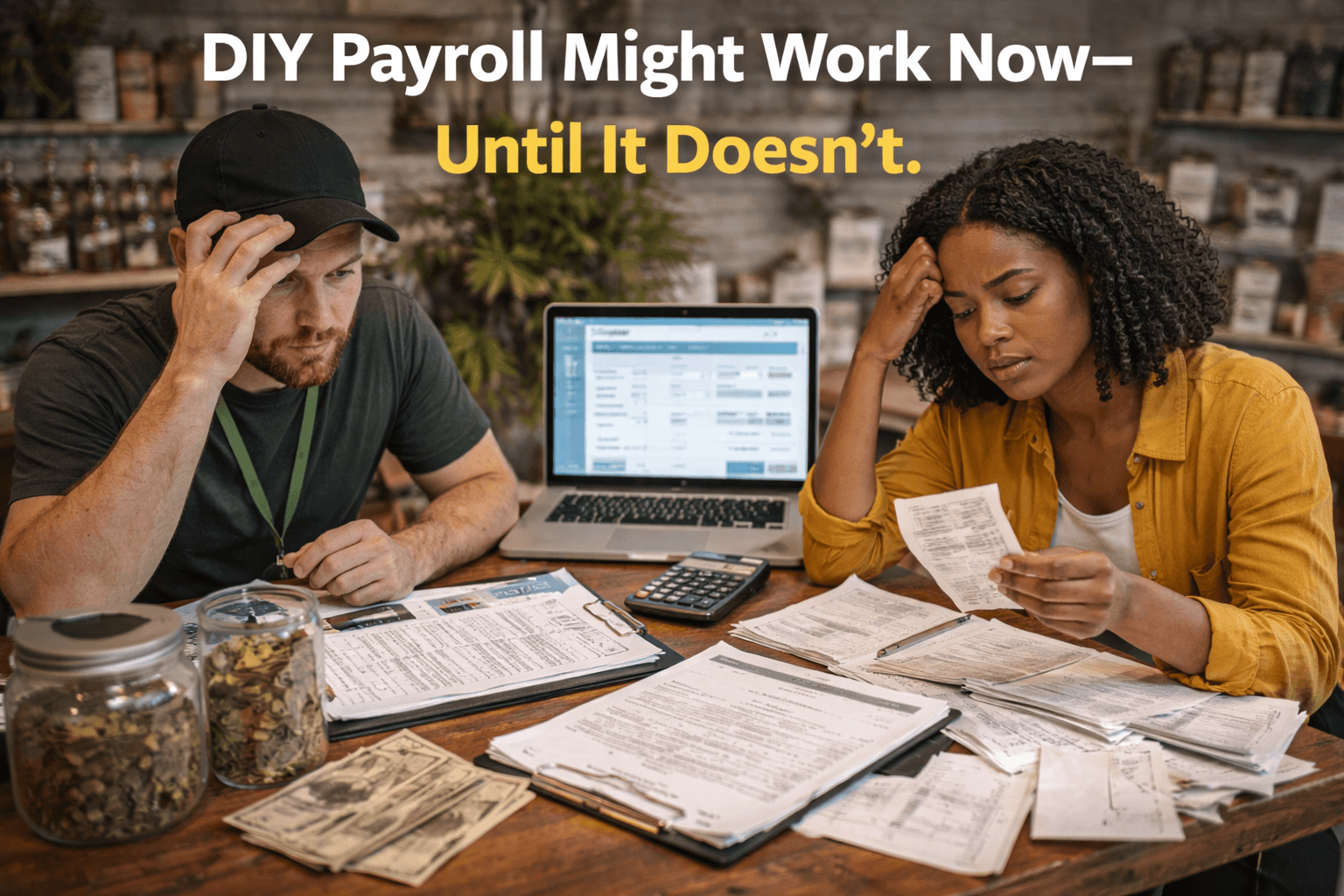
It was fine when it was just me and one other person—then it blew up.
That’s the story we hear again and again. In early stages, cannabis founders often run payroll themselves using spreadsheets, banking apps, or generic tools meant for freelancers. It works—until it doesn’t. Until someone gets hurt, quits, asks for a W-2, or your bank asks for records.
This guide unpacks what DIY payroll really means in cannabis: where it works, where it breaks, and how to avoid becoming the cautionary tale.
What You’ll Learn
-
When DIY payroll is manageable—and when it’s not
Know the tipping points: DIY might work for one-person operations, but the moment you onboard, file taxes, or get audited, gaps become liabilities. -
The five most common breaking points for DIY setups
These real-world failure points are where most cannabis founders hit a wall. As you read, keep asking: Have I already hit one of these? -
Why cannabis regulations add extra pressure
Cannabis is not like other industries—state, local, and even tribal rules overlap. DIY systems often miss critical compliance checkpoints that traditional businesses never have to worry about. -
How to build something better before you’re forced to
We’ll walk through how to recognize the signs, when to switch, and what “clean” looks like—so you’re not scrambling later. Look for the “Best Next Steps” at the end if you're unsure where to start.
When DIY Payroll Can Work (Temporarily)
Let’s be fair—there are scenarios where DIY payroll makes sense. If you’re a sole owner-operator and not paying yourself through a W-2 yet, or you have a single team member and your CPA is doing quarterly filings, it may be fine for a while.
But even then, it’s risky. Most banks, insurers, and regulators want to see formal records, consistent filings, and classification clarity—even for small teams. DIY might buy you time, but it won’t buy you trust.
Breaking Point #1: You Start Hiring
Industry Examples:
-
Cultivator: You onboard seasonal trimmers without I-9s and now face licensing scrutiny during a state visit.
-
Dispensary: You skip W-4s to save time. A former employee requests tax documents, and your missing data triggers an internal HR review.
-
Tribal/Indigenous Operator: Your workforce spans multiple jurisdictions, and a lack of onboarding consistency creates tension with state regulators.
Imagine if you’re…
-
An HR coordinator in Massachusetts: You hire a part-time budtender, but skip formal onboarding to save time. That person later applies for unemployment, and your documentation gaps delay your license renewal.
-
A Tribal retail operator: Your hires span multiple jurisdictions. Without clear onboarding flows, a single misstep creates tension with both state regulators and internal governance.
-
A solo founder in Arizona: You’re paying a friend to help manage the shop. You think you’re safe—until you’re asked to provide payroll tax history and can’t.
Once you bring on your first W-2 employee, the rules change. You need I-9s, withholding forms, onboarding packets, and a schedule of payroll tax filings that align with your state’s cannabis licensing board.
In states like California, Massachusetts, and New York, we’ve seen licenses delayed or flagged because a single hire wasn’t onboarded correctly. One mistake at this stage starts a paper trail of noncompliance.
Breaking Point #2: A Worker Gets Hurt or Quits
Industry Examples:
-
Caregiver Model: An informal caregiver quits and files a claim. You can't prove compensation or duties performed—now you're being reviewed.
-
Manufacturer/Processor: A line worker suffers an injury but was never documented formally. You're now exposed to workers' comp claims without coverage.
-
Lab/Testing Facility: A technician files for unemployment. The state reviews your documentation—and discovers gaps in onboarding and classification.
This gets even more serious for Tribal operators or social equity licensees, where funding and oversight bodies often request full employment documentation. Informal records won’t cut it.
Breaking Point #3: You Miss a Filing
Industry Examples:
-
Vertically Integrated Operator: You assumed your bookkeeper filed payroll taxes, but missed filings across retail, grow, and processing—putting all licenses at risk.
-
Distributor/Transporter: You delay filing quarterly returns, unaware your operating license is linked to payroll compliance.
-
Hemp/CBD: You file under outdated tax codes, triggering a mismatch in IRS records, delaying business deductions.
Many DIY operators don’t know when filings are due until it’s too late. We’ve worked with teams that thought their CPA “was handling it” only to discover nothing had been filed for two quarters.
Breaking Point #4: Your Bank Gets Involved
Industry Examples:
-
Cannabis Solutions Provider: Your non-plant-touching service still gets flagged because your clients are cannabis businesses—your payroll doesn’t show compliance segmentation.
-
Caregiver: Operating under a personal account, you’re flagged for high transaction volume. Your bank demands employment documentation you don’t have.
-
Retail Dispensary: You’re processing payroll manually. When the bank audits your transactions, inconsistencies lead to account suspension.
DIY payroll often lacks the paper trail banks require. We’ve helped operators in Arizona, Colorado, and New Mexico whose accounts were closed after a payroll-related inquiry exposed system gaps.
Breaking Point #5: You Try to Scale
Industry Examples:
-
Lab/Testing: You double headcount for a new contract, but payroll bottlenecks delay onboarding and tax filings—losing critical trust with clients.
-
Manufacturer: You expand to multi-state ops, but can’t manage wage compliance variations or reporting cadence across locations.
-
Tribal/Indigenous: Your program scales with grant support, but a single compliance misstep in payroll causes a contract delay or audit freeze.
Scaling without payroll infrastructure creates chaos: late payments, classification errors, and overtaxed owners doing admin at midnight. It also limits your ability to grow with confidence.
How to Know If You’ve Outgrown DIY Payroll
Ask yourself:
-
Are you onboarding anyone this quarter?
-
Can you generate pay stubs and W-2s within 24 hours?
-
Do you know your next state and federal filing deadlines?
-
Do you have workers’ comp and compliant time-tracking?
-
Would you feel confident submitting your records to a regulator or lender?
If the answer to any of these is “no” or “I’m not sure,” it’s time to upgrade.
What It Looks Like to Get It Right
You don’t need a massive team to justify clean payroll—you just need to care about your future. The best time to set up systems is before things get complicated. That way, you grow into infrastructure instead of reacting to problems.
Clean cannabis payroll means:
-
Automated tax filings: Your system files on time at the local, state, and federal level—no calendar reminders, no guesswork, and no missed deadlines that could trigger penalties.
-
Proper onboarding flows: Every employee gets set up with I-9s, W-4s, offer letters, and digital acknowledgment of policies—ensuring full compliance from day one.
-
Classification clarity: Your workers are classified correctly as W-2 or 1099 based on their actual duties and control—so you’re protected from reclassification audits and surprise liabilities.
-
Audit-proof records: All payroll documents, tax forms, and employee data are stored securely and accessible in a centralized system—making it easy to respond to regulators or investors when they request proof.
-
Peace of mind: You can focus on building your business, not worrying about backend breakdowns. You know your team is protected, your license is safer, and your operation is scalable.
It’s not about bells and whistles. It’s about protecting what you’re building.
FAQs
Can I legally run payroll myself as a cannabis operator?
Technically yes, but it comes with risk. Many cannabis operators don’t realize how fast compliance issues pile up—especially if you misclassify workers, miss a filing, or lack formal onboarding. Regulators don’t make exceptions for “doing your best.”
Is using a spreadsheet still considered compliant?
Not if you can’t produce clean records when asked. Compliance requires documented filings, wage tracking, I-9s, W-2s/1099s, and audit trails. Spreadsheets rarely meet that bar—especially in states like California, Illinois, and Michigan.
Do I need payroll if I’m the only person working in my business?
If you’re a sole proprietor paying yourself without employees, maybe not—but if you’ve incorporated and take a salary, yes. And as soon as you pay anyone else for ongoing work, payroll compliance applies.
What happens if I messed up past payroll?
You’re not alone. We help operators clean up retroactive filings, reclassify workers, and document past employment properly. The sooner you get ahead of it, the easier it is to correct without penalty.
How much does clean payroll actually cost?
Less than you’d think—and way less than a fine, lost license, or frozen bank account. Most operators see ROI in peace of mind and growth-readiness within the first cycle.
Best Next Steps (If This, Then That)
If you're unsure about compliance…
→ Start with a simple self-audit. Can you access pay stubs, W-2s, I-9s, and tax filings within 24 hours? If not, prioritize system cleanup.
If you’ve been running payroll manually…
→ Migrate to a cannabis-compliant provider before your next hire, raise, or renewal. Don’t wait for a surprise request.
If you’re onboarding your first employee…
→ Set up formal onboarding tools now (I-9, W-4, workers’ comp, time-tracking). It’s easier to build the system than backfill it.
If you’re growing quickly…
→ Review classification, payroll tax calendars, and multi-entity structure before expanding to a second location or state.
If your current provider isn’t cannabis-specific…
→ Ask them to confirm in writing that they support licensed cannabis operators. If they hesitate, it’s time to talk.
Worst-Case Scenario: What Happens If You Don’t
Many operators think they’ll “get to it later.” But here’s what we’ve seen firsthand:
You grow. You add a few team members. You’re doing okay, but everything’s still informal—no onboarding docs, no clean payroll records. Then one thing happens: a worker files a complaint, an investor asks for diligence docs, or your bank requests clarification.
Suddenly you’re scrambling. Your account is frozen. You miss a pay period. Your state board flags you. You’re late filing taxes. You try to backfill documents, but the gaps show. The investigation drags on, your team gets nervous, and your reputation takes a hit.
Worst of all? It’s often the founder’s credibility that suffers most. Regulators stop trusting you. Banks close your file. Even if you recover, the time, money, and stress it takes to fix what could have been prevented can derail your business—or cost you your license.
Don’t Wait for a Wake-Up Call
If this sounds familiar—it’s because it is. We help teams every week who “meant to fix it later.” DIY payroll is fine… until it isn’t. And by then, it’s usually urgent.
If you’re ready to build something that grows with you—not against you—let’s talk.
Topics:
