

If we’d done this earlier, we could’ve avoided so many headaches.
We hear this almost weekly—from founders who started with good intentions but had to backtrack after a payroll issue, banking freeze, or compliance misstep.
Most weren’t trying to cut corners—they were just overwhelmed, wearing too many hats, and unsure of when the back office really mattered. This blog is for them—and for you, if you're in that same spot now.
What You’ll Learn
-
The #1 mistake new cannabis operators make when scaling their team
-
Why early-stage payroll and compliance setup is critical
-
How to structure your payroll from day one—even if you’re not fully live yet
-
The risks of doing it yourself (or ignoring it entirely)
-
A simple, scalable roadmap for compliant cannabis payroll
The Silent Mistake Most Cannabis Founders Make
Hiring your first employee is a huge milestone. It means your operation is real, growing, and ready to level up. But for cannabis operators, especially those with small teams or early-stage licenses, it’s also where the most avoidable risk begins. Founders are often focused on product, permits, or facility build-outs—and back-office compliance becomes an afterthought.
What we hear constantly is some version of “I figured I’d deal with payroll later,” or “It’s just a couple people, we’re not official yet.” That’s where things go sideways. From misclassified workers to missing onboarding documents to overlooked tax filings, these small oversights become costly fixes when the business matures—or worse, when regulators or banks come knocking.
Why This Matters More in Cannabis Than Anywhere Else
In other industries, payroll mistakes are usually fixable with a few emails or late filings. In cannabis, the consequences are amplified. That’s because cannabis operators already face enhanced scrutiny from state regulators, IRS limitations like 280E, and fragile banking relationships. When something doesn’t line up—like payroll data that looks off—it invites more attention than you want.
Many platforms and providers that serve the general business world simply aren’t built to handle this. They may flag your account, pause your access, or terminate service altogether when they discover you’re in cannabis. That unpredictability is why clean, cannabis-ready infrastructure from day one is not a luxury—it’s a defensive move.

What Clean Payroll Signals to Everyone Who Matters
You might think of payroll as just “cutting checks.” But in reality, it’s a trust signal. To banks, inspectors, and investors, your payroll system is one of the first places they look to determine if you’re serious, compliant, and ready to scale. It’s the paper trail that shows you’re operating above board.
Well-documented payroll tells the outside world: we know what we’re doing. We’re not hiding compensation. We’re thinking about compliance. This single system becomes your credibility engine—helping you open accounts, win permits, retain staff, and pass diligence. It’s foundational, and skipping it is a short-term strategy with long-term cost.
What Happens When You Wait Too Long
Let’s walk through a common scenario. A founder hires a couple of team members, pays them through informal channels, and figures they’ll “clean it up later.” Then something goes wrong—someone gets injured, needs a pay stub, or files for unemployment. Suddenly, the business owner is scrambling for documentation they never set up.
We’ve helped clients in exactly this spot. They call us stressed, unsure if they’ve already violated labor laws, and worried about retroactive taxes. The cost to clean it up—both financially and emotionally—is often greater than what it would have taken to do it right from day one. Waiting almost always makes things messier.
What to Set Up Before Hiring Employee #1
Here’s a simplified checklist to help you build payroll right—even if you only have one or two hires in the pipeline. Start with your EIN and make sure your entity is properly registered with the state and city. From there, ensure your cannabis license is current and covers employment provisions.
Next comes infrastructure: choose a payroll platform that is built for cannabis, not just one that tolerates it. Set up your employee classifications carefully—understand the difference between W-2 and 1099. Secure workers’ comp, create your onboarding flow (with I-9 and tax forms), and map out your tax deadlines. You don’t need to overbuild—but these are the essentials.
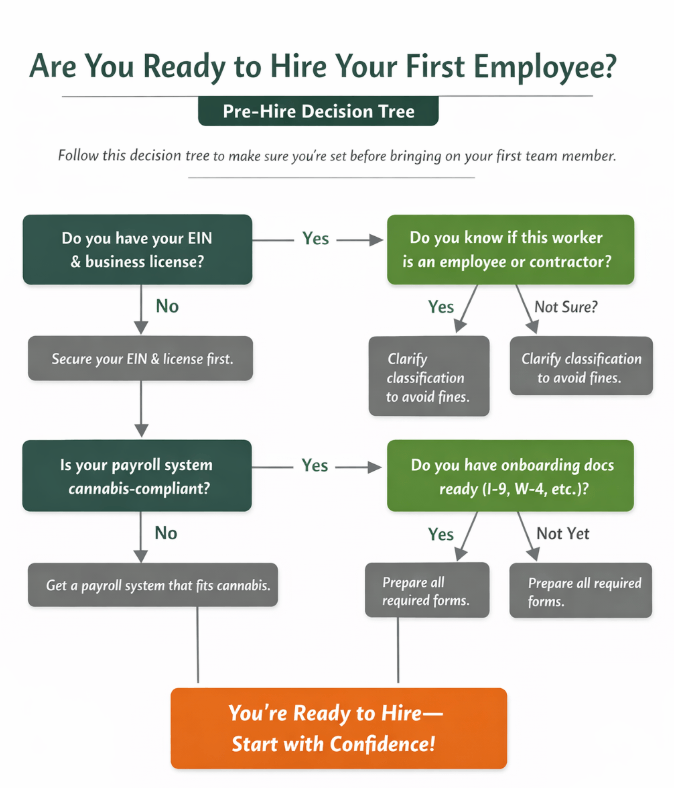
Pre-Hire Decision Tree: Should You Hire Now?
Here's a visual guide to help you decide if you're ready to hire your first (or next) employee:
-
Do you have a valid cannabis license? → Yes → Do you have an EIN and business entity structure in place?
-
Do you understand your state’s employment and payroll tax requirements?
-
Are you paying someone consistently over 30+ days? → If yes → You likely need to classify them as a W-2 employee.
-
Do you have worker’s comp coverage set up? → If no → Do not proceed until resolved.
-
Are you using a payroll provider that supports cannabis? → If no → Evaluate cannabis-compliant platforms.
This decision tree gives founders clarity before they take a step that might trigger risk.
The Payroll Setup Options (and Why Most Don’t Work)
Founders often gravitate toward general-purpose platforms because they’re cheap, familiar, and advertised heavily. But many of these systems were built for traditional businesses and offer little to no cannabis-specific support. Some will even quietly drop your account once they review your NAICS code or state license info.
Others try to manage payroll using spreadsheets or with help from a family friend who “knows taxes.” These approaches might work in the beginning, but they come with high risk: missing filings, no audit trail, no automated compliance updates. A truly cannabis-ready solution accounts for your industry’s nuances, offers proper filing support, and won’t disappear when your name shows up in a compliance database.
What a Real Example Looks Like
A three-person infused product startup came to us after losing access to their payment platform mid-pay cycle. Their provider flagged them for cannabis activity and froze all outgoing transfers. They had no backup system in place and were suddenly at risk of missing payroll entirely.
Paragon was able to step in and transition them in less than a week. We issued clean W-2s, rebuilt their onboarding flow, and restored confidence with their bank by showing a compliant payroll trail. Today, they run lean but clean, with full documentation, predictable pay cycles, and no operational stress.
The Emotional Side: What No One Talks About
This isn’t just about compliance—it’s about confidence. When founders know payroll is handled, they show up better in investor meetings, sleep easier at night, and hire with less hesitation. There’s clarity and calm when you know your people are paid right and your records are solid.
We’ve seen it time and again: once this system is in place, everything else gets easier. Operations feel smoother. Hiring conversations shift from "What if I get it wrong?" to "We’ve got that covered." This kind of back-office stability isn’t just practical—it’s powerful.
First-Time Founder Traps (A Sidebar Guide)
Avoid these common missteps:
-
Assuming you can pay anyone as a contractor to avoid taxes
-
Thinking you need a big team before setting up payroll
-
Using your personal account or Venmo to pay staff
-
Believing your CPA or bookkeeper can run full payroll
-
Ignoring workers’ comp until someone gets hurt
You don’t have to know it all, but skipping these steps invites unnecessary risk. Set the foundation early.
FAQs
Do I need to run payroll if I’m the only one on the team?
If you’re incorporated and taking a salary, yes. Otherwise, you still need a record of how and when you’re paying yourself, especially if you plan to seek banking or raise capital.
Can I pay people as contractors to keep it simple?
Only if they meet strict contractor criteria. Most early-stage cannabis team members don’t, and misclassifying workers is one of the most common (and costly) compliance mistakes we see.
What happens if I already made payroll mistakes?
You’re not alone. We help operators clean up missteps all the time—from reclassifying past workers to retroactively filing taxes and documentation. The sooner you address it, the easier it is to fix.
Is this overkill for a team of 2 or 3?
Not if you plan to grow, raise money, or protect your license. Even small teams need structure. Clean systems scale. Messy ones get in the way.
What’s Changing in 2026
Regulatory scrutiny is increasing in most states, and even early-stage businesses are being audited sooner. Tax authorities and cannabis boards are tightening enforcement, particularly in areas such as wage tracking and employment classification. If you’re not prepared, you may get caught up in a sweep.
At the same time, federal rescheduling conversations are accelerating. That means new rules, new tax implications, and new visibility for businesses that once operated in a gray zone. Early compliance will be rewarded. Being late will cost more than just money.
If You’re Feeling Unsure, Here’s a Place to Start
You don’t have to get this perfect today. But setting the foundation early will save you time, stress, and money later. If you’re unsure where to begin—or worried you might already be off track—now is the time to get clarity.
If this raised questions you weren’t expecting, or if you’d rather walk through this with someone who’s done it before, we’re here to help.
Let’s talk. No pressure—just practical steps, built for where you are now.
