

How CPAs Can Use a Connected Cannabis Tech Stack to Become Better Advisors
October 5th, 2026
11 min read
By Paragon
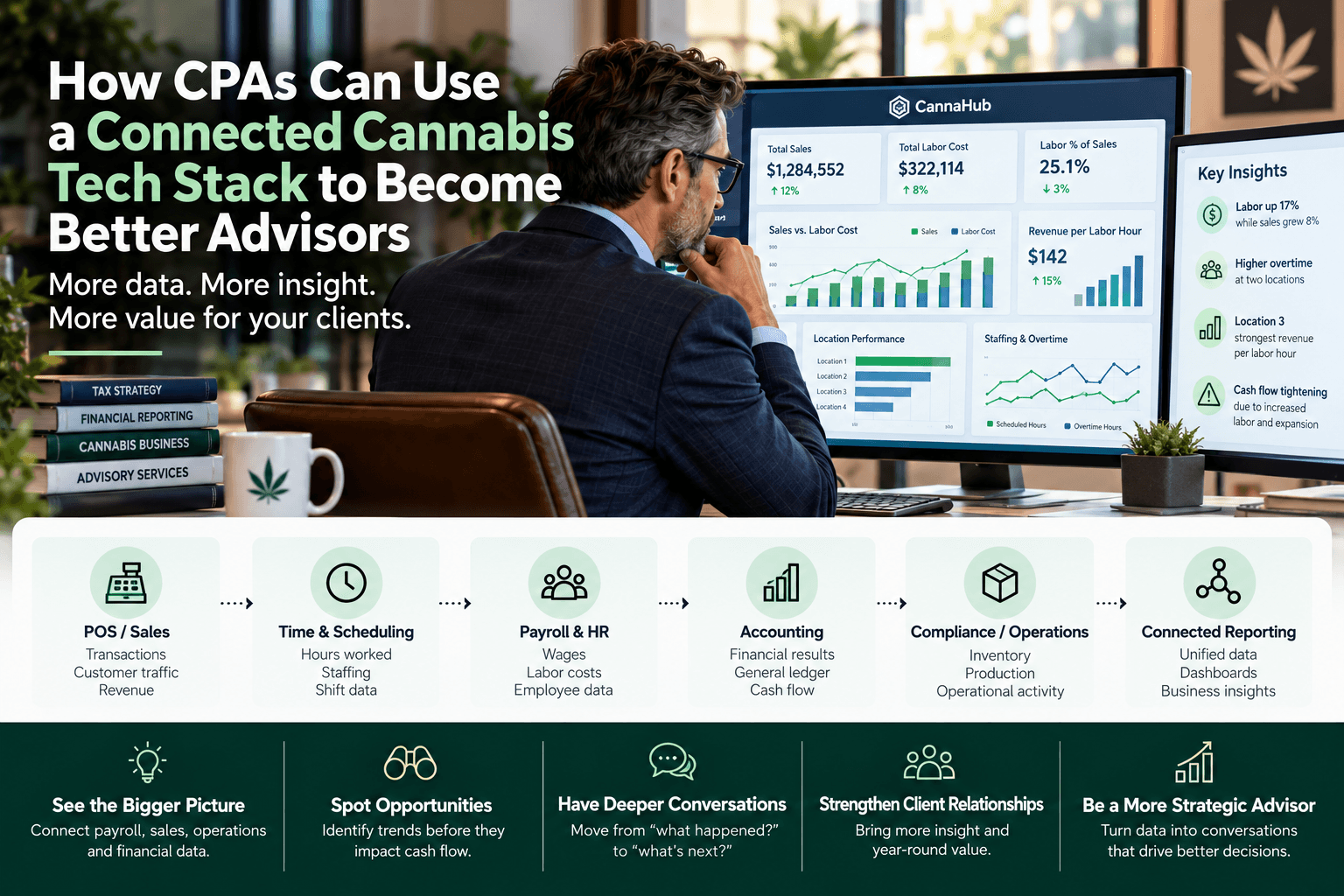
Learn how CPAs can use connected payroll, accounting, POS, workforce, and operational data to better understand cannabis clients' cash flow, labor costs, and business performance.
Your cannabis client probably has more business data than they know what to do with.
Payroll knows what they spend on labor.
The POS knows what they sell.
Timekeeping knows when employees actually worked.
Accounting knows where the money went.
Banking knows what cash is available.
Compliance systems know what happened to the product.
Inventory and operational systems know what is moving through the business.
The problem isn't necessarily a lack of information.
It's that the information often lives in different places.
For a CPA, that creates an opportunity.
When payroll, accounting, sales, workforce, and operational data can be viewed together, you gain more context around the financial statements you're already responsible for interpreting.
Instead of only helping a client answer “What happened?”, connected data can help you start asking:
“Why did it happen?”
And eventually:
“What should we be watching next?”
That is where technology can become an advisory tool.
How can connected cannabis data help CPAs become better advisors?
Connected cannabis data can help CPAs understand relationships between revenue, labor costs, staffing, cash flow, inventory, operations, and financial performance.
Rather than reviewing each data source separately, accountants can use information across the client's technology stack to identify trends, investigate unusual changes, and have more informed conversations about what is actually happening inside the business.
For example:
If payroll costs increase, did revenue increase with them?
If overtime spikes, was the business busier or was scheduling inefficient?
If one location generates more revenue, is it also more profitable?
If sales are growing but cash is tightening, where is the money going?
If labor costs are rising faster than sales, what changed operationally?
The CPA doesn't need to manage the client's POS, payroll, scheduling, or compliance software to ask those questions.
But having access to reliable information from those systems can make the financial picture much clearer.
Why is fragmented data a problem for cannabis businesses?
Cannabis businesses rarely operate from one system.
A typical technology environment may include:
- Accounting or ERP software
- Payroll and HR
- Timekeeping and scheduling
- Point-of-sale systems
- Banking
- Seed-to-sale or compliance tracking
- Inventory management
- Benefits
- Workers' compensation
- Retirement
- Applicant tracking
- Learning and training systems
- Operational technology
- Spreadsheets filling whatever gaps remain
Each platform may perform its individual job well.
The problem begins when the business needs to answer a question that requires information from more than one of them.
CannaHub describes this as the “Frankenstein stack” problem: cannabis operators can have multiple functional systems without having one clean operational and financial picture because different teams rely on different sources of information.
For a CPA, that fragmentation can mean spending more time gathering and reconciling information before you can even begin analyzing it.
What should a CPA look for in a cannabis client's technology stack?
A CPA does not need to become the client's IT consultant.
But you should understand enough about the client's technology environment to determine whether it supports reliable financial information and decision-making.
Here are seven questions worth asking.
1. Where does the client's financial data originate?
Start with the systems that eventually feed the financial statements.
Where does revenue originate?
Where does payroll originate?
Where are labor hours recorded?
Where is inventory tracked?
Where are transactions recorded?
Where are compliance records maintained?
Which information moves automatically?
Which information is manually entered?
If your team receives a number in the accounting system, you should have some understanding of where that number came from.
2. Do the systems communicate with each other?
A company can own excellent software and still have a poor technology stack.
Why?
Because good individual systems do not automatically create a good connected system.
Ask whether the client's payroll, accounting, timekeeping, POS, compliance, and operational systems can exchange information.
Paragon, for example, supports QuickBooks Online synchronization, customizable general ledger exports, time and attendance connectivity, and payroll reporting designed to reduce manual movement of workforce information.
Connected systems can reduce duplicate entry and make it easier to keep information consistent.
3. How much of the process depends on spreadsheets?
Spreadsheets are not inherently bad.
But they can become a warning sign when they are repeatedly being used to rebuild information that already exists somewhere else.
Ask:
How many exports are required to close the books?
Is someone manually combining payroll and sales reports?
Are labor allocations reconstructed after payroll?
Are location reports manually assembled?
Does someone have to copy information between systems every week?
If the answer is yes repeatedly, the technology stack may technically work while still creating unnecessary administrative burden.
4. Can the business see information by location, department, entity, or job?
As cannabis businesses grow, consolidated totals become less useful.
A CPA may need to understand:
- Labor cost by location
- Revenue by store
- Overtime by department
- Payroll by entity
- Staffing trends
- Cost by operational function
- Location-level profitability
If the technology stack cannot preserve those dimensions as information moves between systems, useful details can disappear before they reach accounting.
5. Can you trace important numbers back to their source?
Good reporting shouldn't only provide a number.
You should be able to understand where it came from.
That becomes especially important when payroll, inventory, sales, and accounting information are being combined.
Connected data is only valuable when the underlying data is trustworthy.
6. Can the systems grow with the client?
The technology that worked for one dispensary and 15 employees may not work the same way when the company has four locations, multiple entities, manufacturing operations, and 100 employees.
Ask whether the current stack can accommodate:
- Additional locations
- Additional entities
- New departments
- More employees
- Different license types
- New states
- More complex reporting
Technology decisions should account for where the client is going, not only where they are today.
7. Can the technology answer cross-system business questions?
This might be the most important question.
Your client's systems may individually tell them:
How much did we sell?
How much did payroll cost?
How many hours did employees work?
But can they answer:
How much revenue did each labor hour generate?
That question requires more than one system.
And those are often the questions that create the most interesting advisory conversations.
What can payroll data tell a CPA beyond payroll?
Payroll is more than a record of who got paid.
It can contain information about:
- Wages
- Payroll taxes
- Overtime
- Hours
- Locations
- Departments
- Job roles
- Headcount
- Labor allocation
- Employee changes
Paragon's Reporting & Analytics tools, for example, include payroll analytics, customizable reporting, executive dashboards, and reporting around workforce and labor information.
On its own, that information helps explain workforce costs.
But its value increases when it can be viewed alongside other business information.
What happens when payroll and sales data are connected?
Imagine a dispensary generated $80,000 in sales last week.
Payroll reports show $16,000 in labor.
Those numbers are useful.
But there is more to ask.
When did those sales occur?
When did the labor occur?
Were the busiest hours properly staffed?
Were employees standing around during slow periods?
Did overtime occur during periods when customer traffic did not justify it?
Did one location produce significantly more revenue per labor hour than another?
Now you're no longer looking at payroll as an isolated expense.
You're looking at the relationship between labor and revenue.
That is exactly the type of cross-system analysis that the Paragon and CannaHub relationship can support.
CannaHub describes a model where Dutchie POS provides sales, traffic, and transaction information while Paragon provides labor costs, scheduling, hours, and payroll information. Bringing those sources together can produce metrics such as labor cost as a percentage of sales, revenue per employee hour, and transactions per labor hour.
For the CPA, those metrics add context to a line item that otherwise just says payroll expense.
How can connected data improve cannabis cash-flow conversations?
Cash flow is one of the places where this visibility becomes particularly valuable.
A financial statement may tell you cash declined.
Connected operational information can help you investigate why.
Maybe labor increased faster than revenue.
Maybe overtime climbed.
Maybe inventory is moving slowly.
Maybe one location requires significantly more staffing to generate the same sales.
Maybe the company expanded headcount before revenue caught up.
Maybe discounting increased sales but compressed margin.
Maybe the business looks busy operationally without becoming more profitable.
The accountant's role isn't necessarily to make the client's scheduling decisions.
But you can help leadership understand the financial consequences of those decisions.
That changes the conversation from:
“Payroll increased this month.”
to:
“Payroll increased 14% while revenue increased 4%. Let's understand what changed.”
That's a very different advisory conversation.
How can connected payroll and operational data improve labor decisions?
Labor is a major controllable expense for many cannabis operators.
But looking only at total payroll tells you what was already spent.
Combining workforce information with operational data can provide context around whether that labor was deployed effectively.
For example:
POS / Sales Data
Revenue, transactions, customer traffic
↓
Scheduling / Time Data
Who was scheduled and when employees actually worked
↓
Payroll Data
Wages, taxes, overtime, labor cost
↓
Accounting Data
Financial results and cash impact
↓
Connected Reporting Layer
Relationships between sales, labor, costs, locations, and operations
↓
CPA + Operator Conversation
What happened? Why? What should we watch next?
CannaHub's published Paragon use case illustrates this with hourly sales and labor information. The combined reporting can surface periods of overstaffing, understaffing, overtime pressure, and changes in revenue generated per employee hour.
This isn't about automatically telling the operator to cut staff.
It's about giving the business and its advisors enough context to ask better questions.
Why should CPAs care about workflow as much as cash flow?
Because workflow eventually affects cash flow.
Consider what happens when:
Timekeeping is inaccurate.
↓
Payroll requires corrections.
↓
Payroll reports require adjustments.
↓
The general ledger needs manual entries.
↓
The accountant spends time reconciling.
↓
Management receives financial information later.
↓
Decisions are made using older information.
That's a workflow problem that eventually becomes a financial problem.
The reverse can also happen.
Connected time and scheduling can automate calculations, flag discrepancies, monitor overtime, support job costing, and flow workforce information into payroll.
Cleaner workflow can lead to cleaner data.
Cleaner data can lead to better reporting.
And better reporting gives the CPA more time to interpret instead of reconstruct.
What does a connected cannabis tech stack look like?
There is no single perfect cannabis technology stack.
The right systems depend on the client's license type, size, states, operations, and growth plans.
But conceptually, a connected stack should allow information to move between the systems responsible for:
Money
Accounting
Banking
Payments
Payroll
People
Payroll
HR
Timekeeping
Scheduling
Benefits
Training
Sales
POS
Ecommerce
Wholesale
Product and Operations
Inventory
Cultivation
Manufacturing
Distribution
Compliance
Seed-to-sale tracking
Licensing
Workforce compliance
Intelligence
Reporting
Dashboards
Analytics
Data warehouse
The objective isn't necessarily to replace every system with one enormous platform.
Sometimes the better answer is connecting specialized systems so the business can see the relationships between them.
CannaHub takes that approach by bringing data from systems such as POS, payroll, accounting, compliance, and operational platforms into a centralized reporting layer while allowing the original systems of record to remain in place.
Does a cannabis business need one system for everything?
Not necessarily.
A single system can simplify some environments, but cannabis businesses often need specialized technology for different functions.
The state may dictate the compliance platform.
The retailer may prefer a particular POS.
Finance may rely on a specific accounting platform.
Payroll may live somewhere else.
Trying to replace every system can create an enormous technology project.
The more important question is:
Can the systems exchange enough reliable information to create a useful picture of the business?
A connected technology strategy can allow businesses to retain specialized systems while creating a common reporting layer across them.
How does connected data help CPAs move from reporting to advisory?
Think about three levels.
Level 1: What happened?
Revenue was $X.
Payroll was $Y.
Cash decreased by $Z.
This is reporting.
Level 2: Why did it happen?
Payroll increased because overtime increased at two locations.
Labor increased faster than sales.
One location required more employee hours to generate the same revenue.
This is analysis.
Level 3: What should we watch next?
If the current labor trend continues, what happens to cash?
Do staffing patterns need to be examined?
Is expansion increasing overhead faster than revenue?
Which location deserves a deeper operational review?
What metrics should management monitor before the next financial review?
This is where the CPA's advisory value becomes much more visible.
The technology doesn't replace the advisor.
It gives the advisor better context.
What should CPAs ask clients about their technology stack?
You don't need a technical audit.
Start with practical questions:
What systems run your business today?
Which system is the source of truth for sales?
Where are employee hours recorded?
Where does payroll information go after payroll is processed?
How does payroll reach the general ledger?
Can we report labor by location, entity, and department?
How many reports are manually combined every month?
Are there spreadsheets your business couldn't operate without?
Can we compare labor costs with sales?
Can we see fully burdened labor costs?
Can we understand performance by location?
Can we trace important numbers back to their source?
What happens to reporting if you add another location?
Which business questions do you wish your systems could answer but can't today?
That last question may tell you more than all the others.
What are the warning signs of a disconnected cannabis tech stack?
A CPA should take a closer look when:
- The same data is entered into multiple systems
- Finance relies heavily on manual exports
- Payroll and accounting frequently require reconciliation
- Different departments report different versions of the same metric
- Labor cannot easily be analyzed by location or department
- Management cannot compare labor with sales
- Multi-location reporting requires separate spreadsheets
- Reports are already stale by the time they are assembled
- Growth requires increasingly complicated workarounds
- Nobody can clearly explain where an important number originated
None of those automatically mean the client needs entirely new software.
Sometimes the systems are fine.
The connections are what's missing.
Where does Paragon fit into a connected cannabis technology stack?
Paragon's role starts with people and payroll.
Payroll.
HR.
Time.
Scheduling.
Workforce reporting.
Employee data.
From there, integrations and partnerships can connect workforce information with the other systems cannabis businesses rely on.
For CPAs specifically, Paragon's CPA Partner Program highlights accounting connectivity, customizable general ledger mapping, workforce system connectivity, and CannaHub as a featured partner for bringing operational, compliance, payroll, and financial information together.
The goal isn't to make payroll the center of every business decision.
It's to make sure payroll data doesn't become an island.
How does Paragon + CannaHub help create a fuller picture?
This is where the partnership becomes especially useful for accountants.
Think of Paragon as one important source of workforce information:
Paragon
Payroll + Labor + Hours + Workforce
Other systems contribute their pieces:
POS
Sales + Transactions + Customer Activity
Accounting
Financial Results + Expenses + GL
Compliance / Operations
Inventory + Product + Operational Activity
Those sources can then feed a reporting layer such as CannaHub.
CannaHub describes its platform as a centralized data warehouse that combines information from systems including POS, accounting, payroll, compliance, and other operational sources into reporting and dashboards.
Now the CPA can look beyond individual reports and start examining relationships.
Sales vs. labor
Labor vs. location performance
Overtime vs. demand
Revenue vs. staffing
Operational activity vs. financial results
Costs vs. margins
That's the bird's-eye view.
Not because every piece of the business lives in one software platform.
Because the information can finally be viewed together.
Why does Paragon's broader ecosystem matter to CPAs?
Technology is only part of the picture.
A cannabis client's financial health may also depend on banking, insurance, HR, retirement, compliance, benefits, and other specialized providers.
Paragon's Partner Ecosystem includes organizations across banking, accounting, insurance, HR, technology, retirement, compliance, and other cannabis business services.
For a CPA, that creates another advantage.
When the data tells you there is a problem outside your area of expertise, you don't necessarily have to start searching for someone who can solve it.
You have a network to tap.
That's how technology and partnerships start reinforcing each other.
See the problem.
Understand the financial impact.
Bring in the right person to help solve it.
And remain the advisor at the center of the conversation.
Frequently Asked Questions About Cannabis Technology Stacks for CPAs
What is a cannabis technology stack?
A cannabis technology stack is the collection of software and systems a cannabis business uses to manage functions such as accounting, payroll, HR, timekeeping, POS transactions, inventory, compliance, banking, benefits, and operations.
Why should CPAs understand a cannabis client's technology stack?
Understanding the technology stack helps CPAs understand where financial information originates, how it moves between systems, where manual processes may introduce risk, and what additional operational context may help explain changes in financial performance.
What systems should connect with cannabis payroll?
Depending on the business, payroll may benefit from connections with accounting, timekeeping, scheduling, HR, benefits, workers' compensation, retirement, and reporting systems. Operational data can also be combined with payroll information through analytics or data platforms to provide broader business insights.
How can payroll data help with cash-flow analysis?
Payroll data can show wages, taxes, overtime, hours, departments, locations, and other labor costs. Comparing those costs with revenue, staffing, and operational trends can help accountants understand how workforce decisions are affecting cash requirements and business performance.
How can POS and payroll data work together?
POS data can show sales, transactions, and customer activity while payroll and time data show hours and labor costs. Combining them can help businesses examine metrics such as labor cost relative to sales, revenue per employee hour, and staffing patterns.
Does connected technology replace the CPA's analysis?
No. Technology organizes and presents information. The CPA still provides the professional judgment needed to interpret financial results, understand the client's circumstances, ask the right questions, and advise management.
What is the benefit of a centralized cannabis data platform?
A centralized data platform can bring information from separate operational systems into a common reporting environment. This can reduce manual report assembly and allow businesses and advisors to analyze relationships that individual systems cannot show on their own.
What should a CPA do if a client's systems don't communicate?
Start by identifying which manual processes create the most work or obscure the most important information. The solution may be an integration, better configuration, improved reporting, or a centralized data layer rather than replacing every system.
The best advisors don't just read the numbers. They understand what's behind them.
A financial statement tells a story.
But sometimes parts of that story are hiding in payroll.
Or the POS.
Or scheduling.
Or inventory.
Or operations.
Your value as a CPA isn't in becoming an expert in every piece of software your client uses.
It's in understanding the business well enough to know which questions to ask.
Why did labor increase?
Why is cash tightening?
Why is this location less profitable?
Why is overtime increasing?
Why aren't sales translating into margin?
What should we be watching before this becomes a bigger problem?
Connected technology gives you more context for answering those questions.
And the right ecosystem gives you somewhere to turn when the answer reveals a problem outside your expertise.
Give yourself a better view of the businesses you advise
The Paragon CPA Partner Program gives CPAs access to cannabis-specific payroll and HR expertise, connected workforce technology, and an ecosystem of industry partners designed to support the businesses you advise.
Because sometimes the most valuable thing you can give a client isn't another report.
It's the ability to see what the numbers are trying to tell them.
Explore the CPA Partner Program →
Explore Paragon Reporting & Analytics to learn more about workforce reporting and payroll insights.
Or visit the Paragon Partner Ecosystem to explore cannabis-focused resources across banking, technology, HR, insurance, compliance, accounting, and more.
Topics:
