

Your HR Data Is Trying to Tell You Something: How to Turn Employee Data Into Better Workforce Decisions
August 26th, 2026
11 min read
By Paragon
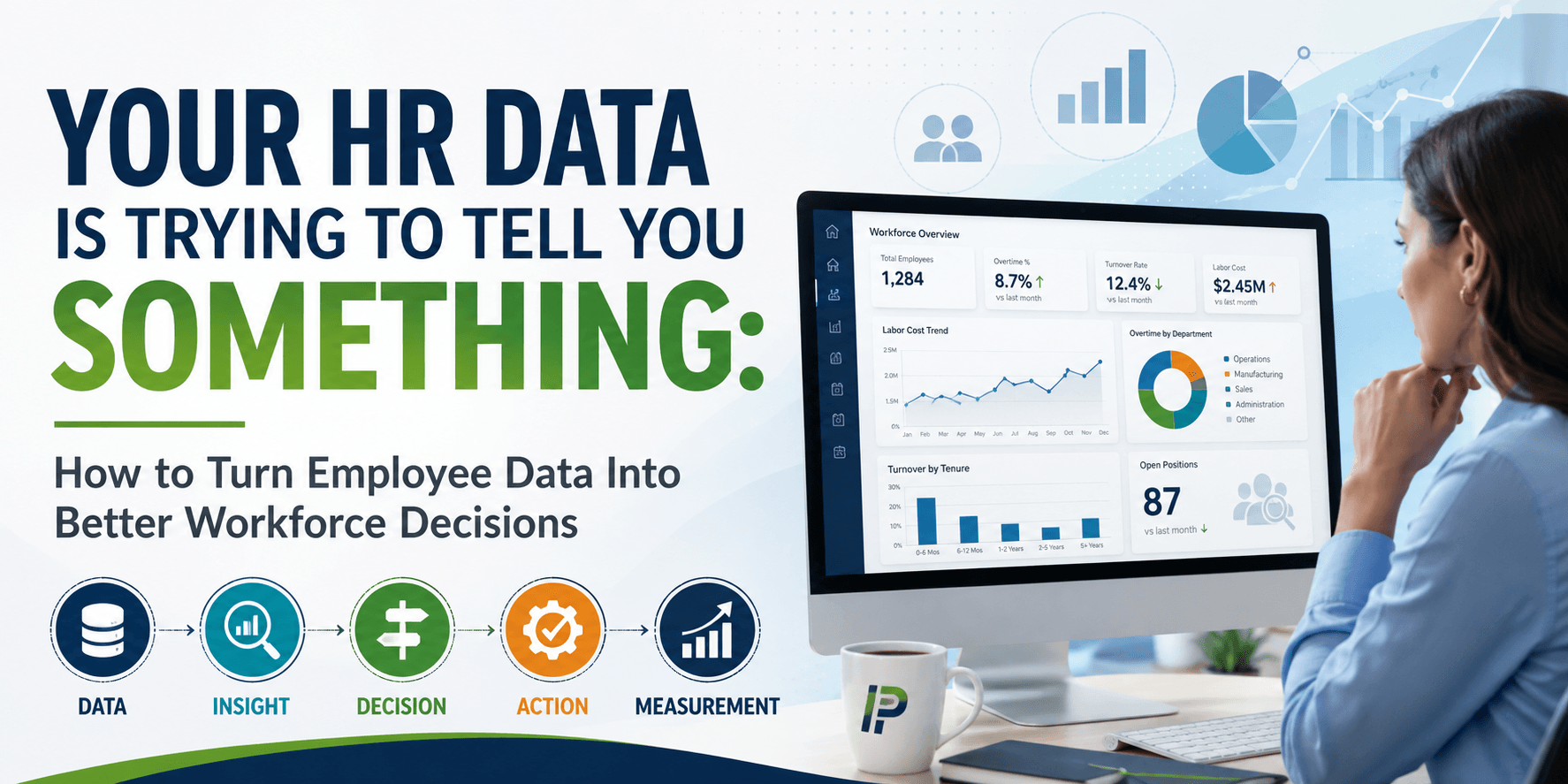
Your workforce is already telling you where the opportunities and problems are. The question is whether your HR technology is helping you hear it.
HR teams have access to more employee information than ever before.
Payroll data. Time and attendance records. Scheduling information. Recruiting metrics. Benefits participation. Performance reviews. Turnover. Compensation. Employee demographics. Training records.
The challenge is rarely a lack of data.
The challenge is turning all of that information into something useful.
That is where HR technology for employee data analytics becomes valuable. The right technology does more than store employee records or generate reports. It helps HR leaders connect information across the employee lifecycle, identify patterns, understand what is changing, and make better workforce decisions.
Because the real value of HR data is not the dashboard.
It is what you decide to do after you see it.
What Is HR Technology for Employee Data Analytics?
HR technology for employee data analytics brings information from payroll, timekeeping, scheduling, benefits, recruiting, performance, and other workforce systems together so HR teams can identify patterns, understand what is happening across their workforce, and make more informed decisions.
Instead of looking at employee information as isolated records, HR analytics software helps organizations see the relationships between different parts of the workforce.
An increase in overtime might be connected to open positions.
Higher absenteeism at one location may be contributing to scheduling problems.
Turnover in a particular role might be tied to compensation, management, workload, or tenure.
Longer hiring times may eventually appear as higher labor costs for the employees covering vacant positions.
When employee data is connected, HR leaders can begin asking better questions.
And better questions usually lead to better decisions.
Reporting Tells You What Happened. People Analytics Helps You Understand Why.
There is an important distinction between HR reporting and people analytics.
Reporting typically tells you what happened.
You had 14 employees leave.
Overtime increased 18%.
Time to hire averaged 31 days.
Benefits participation reached 62%.
Those numbers are useful, but they are only the beginning.
People analytics asks the next question.
Why did turnover increase?
Where is overtime occurring?
Which positions are taking longest to fill?
Are certain departments experiencing different attendance patterns?
Did labor costs rise because of wage increases, overtime, additional headcount, scheduling inefficiencies, or something else?
Strong HR analytics software helps organizations move from simply observing workforce activity to understanding what may be driving it.
From Data to Decision
The easiest way to understand the value of workforce analytics is to think about it as a progression:
Data → Insight → Decision → Action → Measurement
Imagine that overtime increased 22% this month.
The number itself is data.
Your HR technology reveals that most of the increase came from two locations and three positions.
That is an insight.
Leadership investigates and discovers those locations have several open positions, forcing existing employees to cover additional shifts.
Now there is a decision to make.
The organization may choose to accelerate hiring, redistribute employees, adjust scheduling practices, or evaluate whether staffing levels are appropriate.
Then comes measurement.
Did overtime decline?
Did coverage improve?
Did hiring reduce the pressure?
Did labor costs actually improve?
That is when workforce information becomes operational intelligence.
Your Employee Data Is Already Answering Important Questions
Organizations often think they need entirely new datasets before they can start using analytics.
In reality, some of the most useful workforce insights are already hiding inside information HR teams collect every day.
| HR data | What it may reveal | Decision it can inform |
|---|---|---|
| Overtime | Staffing pressure or scheduling inefficiency | Hiring, scheduling, workload distribution |
| Turnover | Roles, managers, departments, or locations losing employees | Retention strategy |
| Absenteeism | Coverage challenges or attendance patterns | Staffing and attendance policies |
| Time to hire | Recruiting bottlenecks | Recruiting resources and process changes |
| Labor costs | Changes in workforce spending | Budget and headcount planning |
| Benefits participation | Employee utilization trends | Benefits strategy |
| Scheduling | Overstaffing or understaffing | Coverage optimization |
| Tenure | When employees are most likely to leave | Retention initiatives |
| Training completion | Skill or compliance gaps | Learning priorities |
| Compensation | Internal pay patterns | Compensation planning |
The goal is not to watch every possible metric.
It is to identify the information that helps answer the questions that matter most to your organization.
1. Use Workforce Data to Understand Labor Costs
Labor is one of the largest expenses for many organizations.
Yet HR leaders sometimes look at labor costs primarily through payroll totals.
That leaves a great deal of context unexplored.
Combining payroll, scheduling, timekeeping, and workforce data can help organizations understand what is actually driving labor expenses.
For example:
Is overtime concentrated in one department?
Are managers scheduling employees beyond budgeted hours?
Are vacancies forcing existing employees to work additional shifts?
Are certain locations consistently overstaffed?
Are labor costs rising faster than headcount?
Are premium hours becoming more common?
Instead of simply knowing that labor costs increased, HR leaders can begin identifying why.
That distinction matters.
You cannot solve a staffing problem with the same strategy you would use to solve a scheduling problem.
2. Look Beyond the Turnover Number
Knowing your turnover rate is useful.
Understanding your turnover patterns is much more useful.
HR technology can help organizations examine turnover by location, department, manager, role, tenure, compensation level, employment type, or other relevant factors.
Suppose your companywide turnover rate appears relatively stable.
At first glance, nothing seems unusual.
But workforce analytics reveals that employees in one particular position are leaving at twice the rate of everyone else, usually within their first six months.
Now HR has something actionable to investigate.
Is onboarding preparing those employees properly?
Is compensation competitive?
Are expectations different from the actual job?
Is one manager experiencing significantly more turnover than others?
Are schedules contributing to the problem?
The purpose of employee analytics is not to make assumptions based on the data.
It is to help HR teams know where to look.
3. Turn Scheduling Into a Workforce Intelligence Tool
A schedule contains much more information than who works Tuesday afternoon.
Scheduling data can reveal patterns around demand, staffing pressure, employee availability, overtime, attendance, and coverage.
When scheduling information connects with timekeeping and payroll data, HR leaders can begin evaluating whether planned labor and actual labor align.
You might discover that one location consistently schedules more hours than it ultimately needs.
Another may rely heavily on last minute coverage.
A particular position may repeatedly trigger overtime.
Certain days or shifts may experience unusually high absenteeism.
Those patterns can influence hiring, cross training, scheduling practices, staffing models, and labor budgets.
Your schedule is not just an administrative tool.
It is another source of workforce data.
4. Use Recruiting Data to Understand What Happens Before Day One
People analytics does not begin after someone becomes an employee.
Recruiting data can provide valuable information about how effectively an organization builds its workforce.
HR leaders can track metrics such as:
Time to fill
Time to hire
Candidate sources
Offer acceptance rates
Applicant conversion
Cost per hire
New hire retention
One metric becomes significantly more useful when you connect it to another.
For example, one recruiting source might generate the most applicants but produce employees with lower retention.
Another source may generate fewer candidates but result in employees who remain significantly longer.
Similarly, a long time to fill may not seem like an HR cost until you connect those vacancies to overtime, manager workload, productivity, or staffing gaps elsewhere in the business.
Connected employee data management creates context.
5. Measure Whether Onboarding Is Actually Working
Onboarding is another area where organizations frequently rely on completion rather than outcomes.
The employee completed the paperwork.
The employee finished training.
The employee attended orientation.
But did the onboarding process actually work?
HR analytics can help organizations compare onboarding information with later workforce outcomes.
Do employees who complete training earlier stay longer?
Are certain locations producing stronger new hire retention?
Where do new employees tend to leave during their first year?
How long does it take different positions to become fully productive?
Which onboarding tasks are regularly delayed?
The answers can help HR teams improve the experience rather than simply administer it.
6. Payroll Data Is Workforce Data
Payroll is often treated as an administrative endpoint.
Employees work.
Hours are submitted.
Payroll runs.
Employees get paid.
But payroll and timekeeping systems contain some of the richest workforce information an organization has.
Payroll data can help reveal:
Changes in total labor costs
Overtime trends
Pay differences
Headcount changes
Premium pay
Attendance patterns
Hours worked
Compensation changes
Location level labor trends
Department level workforce costs
When payroll information is connected with other human resources technology, organizations gain a much more complete view of what is happening inside the workforce.
That is one reason disconnected systems can become increasingly difficult as organizations grow.
When payroll lives in one place, timekeeping somewhere else, recruiting in another platform, and employee records in spreadsheets, workforce questions often require manual investigation.
Connected technology makes those relationships easier to see.
7. Find Workforce Problems Before They Become Bigger Problems
One of the most valuable uses of people analytics is identifying changes early.
Consider overtime.
A small increase one month may not appear significant.
But if overtime rises month after month in the same department while open positions also increase, HR may be seeing the beginning of a larger staffing problem.
The same principle applies to turnover, absenteeism, labor costs, scheduling gaps, and recruiting.
Individual events can seem insignificant.
Patterns tell a different story.
HR analytics software helps leaders identify those patterns sooner.
That gives organizations more time to respond.
What Makes Employee Data Useful?
More information does not automatically produce better decisions.
A dashboard containing 50 metrics can be less helpful than five metrics tied directly to business priorities.
Useful workforce data generally needs four things.
Context
A number by itself rarely explains enough.
HR leaders should be able to compare metrics across time periods, departments, locations, positions, or other relevant groups.
Consistency
Organizations need reliable definitions.
If departments calculate turnover differently, the organization does not truly have comparable turnover data.
Connection
Payroll, scheduling, recruiting, benefits, and employee information become more useful when organizations can examine them together.
Actionability
The most important question should always be:
What decision could this information help us make?
If nobody knows what they would do differently after seeing a metric, it may not deserve prominent space on the dashboard.
Questions HR Leaders Should Ask Their Workforce Data
HR analytics becomes significantly more valuable when leaders begin with questions instead of reports.
Consider asking:
Which positions generate the most overtime?
Where is turnover increasing?
When during employment are people most likely to leave?
Which locations have the highest labor costs relative to staffing?
Where do we rely most heavily on overtime?
Which roles take longest to fill?
Which recruiting sources produce our longest tenured employees?
Where are attendance problems increasing?
How does scheduled labor compare with actual labor?
Which benefits are employees actually using?
Are compensation changes affecting retention?
Where are managers spending the most time replacing employees?
These are not simply HR questions.
They are business questions informed by HR data.
What Should HR Leaders Look for in HR Analytics Software?
The best analytics platform is not necessarily the one with the most dashboards.
HR leaders should consider whether their technology makes workforce information easier to understand and act on.
Look for systems that help you:
Centralize employee information
Connect payroll and workforce data
Analyze labor costs
Track time and attendance
Monitor overtime
Understand turnover trends
Evaluate recruiting performance
Review scheduling patterns
Track benefits information
Compare locations or departments
Reduce manual reporting
Maintain accurate employee records
Control access to sensitive workforce information
Most importantly, technology should make answering important workforce questions easier.
HR teams should not need to spend hours exporting spreadsheets from several platforms before they can understand what is happening.
Better Workforce Decisions Start With Better Connections
The future of HR technology is not simply collecting more employee data.
Most organizations already have plenty of it.
The opportunity is connecting that information well enough to understand what the workforce is telling you.
Payroll can tell you something about staffing.
Scheduling can tell you something about labor costs.
Recruiting can tell you something about overtime.
Onboarding can tell you something about retention.
Attendance can tell you something about workforce planning.
Individually, each system contains information.
Together, they provide context.
And context is what turns employee data into workforce insight.
At Paragon Payroll, we believe payroll and HR technology should help organizations do more than complete administrative tasks. By bringing important workforce information together, businesses can better understand their people, their labor costs, and the decisions shaping their organization.
Because the goal is not more data.
It is knowing what to do with it.
Frequently Asked Questions About HR Technology for Employee Data Analytics
What is HR technology for employee data analytics?
HR technology for employee data analytics refers to software and systems that collect, organize, connect, and analyze employee information so HR leaders can make better workforce decisions. This can include data from payroll, time and attendance, scheduling, recruiting, onboarding, benefits, performance management, and other human resources technology.
Rather than keeping employee information in separate systems, HR analytics technology can help organizations turn workforce data into useful insights about labor costs, turnover, staffing, employee retention, recruiting, and workforce planning.
How do HR technology tools improve employee data analytics?
HR technology tools improve employee data analytics by centralizing workforce information, reducing manual reporting, identifying trends, and making it easier to compare data across departments, locations, positions, and time periods.
For example, HR analytics software can help an HR leader see that overtime is increasing, identify where the increase is occurring, compare it with staffing or scheduling data, and determine whether hiring or scheduling changes may be necessary.
The value is not simply having more employee data. It is being able to turn that data into actionable workforce insights.
What is HR analytics software?
HR analytics software is technology designed to help organizations analyze workforce and employee data. Depending on the platform, HR analytics software may provide reporting, dashboards, workforce metrics, trend analysis, and connections between payroll, timekeeping, recruiting, benefits, scheduling, and other HR functions.
HR analytics software can help organizations understand what is happening across their workforce and use that information to support decisions about staffing, retention, labor costs, recruiting, scheduling, and workforce planning.
What is the difference between HR reporting and people analytics?
HR reporting primarily describes what has already happened. People analytics goes further by helping HR teams investigate patterns, relationships, and potential drivers behind those results.
For example, an HR report might show that employee turnover increased. People analytics might help identify whether the increase is concentrated within a particular location, department, position, manager, or employee tenure range.
Both are important, but people analytics helps transform HR reporting into more actionable workforce intelligence.
What employee data should HR teams analyze?
The right employee data depends on the organization's goals, but common areas include payroll, labor costs, overtime, hours worked, attendance, scheduling, turnover, employee tenure, recruiting, time to hire, onboarding, compensation, benefits participation, training, and performance.
Effective employee data management is not about tracking every possible HR metric. HR leaders should prioritize data that helps answer specific workforce and business questions.
How can HR analytics software help reduce labor costs?
HR analytics software can help organizations understand what is driving labor costs instead of looking only at total payroll expenses.
By connecting payroll, scheduling, timekeeping, and employee data, organizations may identify overtime concentrations, staffing gaps, scheduling inefficiencies, absenteeism patterns, or changes in headcount.
Those workforce insights can help leaders make more informed decisions about hiring, scheduling, staffing levels, and labor budgets.
How can people analytics help improve employee retention?
People analytics can help HR teams identify patterns associated with employee turnover and retention.
Organizations may analyze turnover by department, location, job role, tenure, compensation, schedule, manager, or other relevant workforce factors. If employees in a particular role consistently leave during their first six months, for example, HR can investigate onboarding, compensation, scheduling, management, job expectations, or other potential causes.
People analytics does not automatically explain why employees leave. It helps HR leaders identify where deeper investigation may be valuable.
How can payroll data improve workforce analytics?
Payroll data can provide important workforce insights into labor costs, overtime, hours worked, compensation changes, headcount, premium pay, and other workforce trends.
When payroll information is connected with timekeeping, scheduling, recruiting, and other HR data, organizations can gain greater context around changes in workforce costs and employee activity.
For this reason, payroll should not be viewed only as an administrative function. It can also be an important source of employee data for workforce analytics.
Why is centralized employee data management important?
Centralized employee data management can make workforce information easier to access, analyze, and maintain.
When payroll, timekeeping, scheduling, recruiting, benefits, and employee records exist across disconnected systems and spreadsheets, HR teams may spend significant time exporting and reconciling information before they can answer basic workforce questions.
Connected human resources technology can reduce this fragmentation and give HR leaders a clearer view of workforce activity.
Can HR technology help with workforce planning?
Yes. HR technology can support workforce planning by helping organizations understand headcount, turnover, hiring activity, labor costs, overtime, scheduling, employee tenure, and other workforce trends.
These insights can help leaders determine where additional employees may be needed, where staffing levels may be too high or low, which positions are difficult to fill, and how workforce costs may change as the organization grows.
How does HR analytics improve workforce decision making?
HR analytics improves workforce decision making by providing leaders with evidence they can use to evaluate workforce challenges and opportunities.
Instead of relying exclusively on assumptions, HR leaders can use employee data analytics to identify trends, compare outcomes, investigate changes, and measure whether a decision produced the intended result.
The process can be summarized simply:
Employee data → workforce insights → better informed decisions → action → measurement.
What should businesses look for in HR technology for employee data analytics?
When evaluating HR technology for employee data analytics, businesses should look beyond the number of reports or dashboards a platform provides.
Consider whether the technology can centralize employee information, connect payroll and HR data, analyze labor costs, monitor overtime, track time and attendance, evaluate turnover, support recruiting analytics, review scheduling trends, and reduce manual reporting.
The best HR technology should make important workforce questions easier to answer, not simply give HR teams more data to manage.
How can HR leaders turn employee data into actionable workforce insights?
Start with the business question rather than the dashboard.
Identify what you want to understand, determine which employee data can help answer the question, look for meaningful patterns, decide what action those insights support, and then measure what happens next.
That approach helps organizations move beyond simply collecting HR metrics and toward using HR analytics software, people analytics, employee data management, and human resources technology as practical tools for better workforce decision-making.
Your Workforce Data Should Help You Make Decisions
If your employee information is scattered across disconnected systems, spreadsheets, or reports that tell you what happened without explaining why, it may be worth taking a closer look at your HR technology.
Paragon Payroll brings payroll and HR technology together to help businesses better manage their people, understand their workforce, and turn everyday employee data into more useful insights.
Not sure whether you need to change anything? Start with a conversation. Le'ts Talk!
Topics:
