


You Got the License. Now the Real Work Begins.
Getting a cannabis license in New York is a major accomplishment. After months, or even years, of applications, regulations, inspections, delays, and uncertainty, you've finally received approval to operate. For many business owners, it feels like crossing the finish line.
The reality is that you've actually arrived at the starting line.
The licensing process teaches you how to become a legal cannabis operator. It doesn't necessarily teach you how to build a company. It doesn't tell you how to hire employees, train managers, create payroll systems, maintain labor compliance, or build a culture that can withstand rapid growth.
Many operators spend enormous amounts of time preparing for compliance audits, tracking inventory, meeting packaging requirements, and managing operational workflows. Those systems are critical. In fact, if you're still evaluating the operational side of launching a cannabis business, Distru's guide to Building Your Cannabis Business in New York is an excellent overview of the compliance, inventory, ERP, and operational infrastructure needed to get started.
But once those systems are in place, another challenge emerges.
People.
Because licenses don't run businesses.
People do.
The operators who thrive in New York's cannabis market won't simply have the best products or the most sophisticated technology. They'll be the businesses that invest in workforce infrastructure as intentionally as they invest in operational infrastructure.
The People, Payroll, and Leadership Side Nobody Talks About: Are You Ready to Be an Employer?
Getting licensed in New York is a major accomplishment, but it's also the moment the conversation changes. Up until now, most of your focus has likely been on approvals, regulations, facility requirements, compliance obligations, inventory systems, and operational planning. The licensing process is designed to prepare you to operate legally, but it doesn't necessarily prepare you to become an employer.
Once that license arrives, your responsibilities expand beyond compliance and inventory management. Suddenly, you're hiring employees, onboarding new team members, training supervisors, managing labor costs, processing payroll, and building a culture that supports growth. That's where many operators discover that workforce challenges can become just as disruptive as operational challenges.
Nobody tells you that some of the most expensive mistakes new cannabis businesses make have nothing to do with inventory.
They're people problems.
A manager who was never trained. A new hire who leaves after two weeks because onboarding was disorganized. A payroll issue that damages trust. A communication problem that quietly becomes a turnover problem.
The strongest operators understand something early: workforce infrastructure isn't something you build after you've grown. It's something you build so growth doesn't break your business.
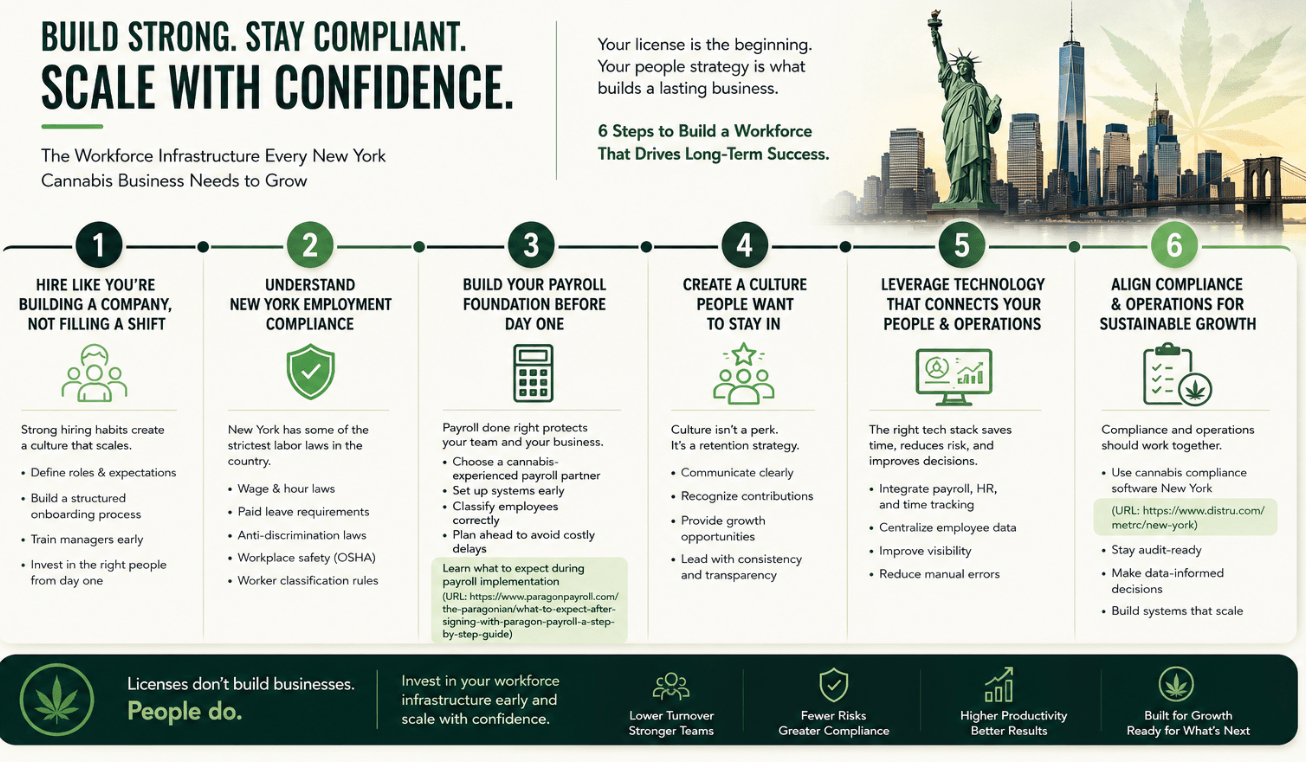
Step 1: Hire Like You're Building a Company, Not Filling a Shift
Many cannabis businesses make hiring decisions based on immediate need. Someone needs to trim flower. Someone needs to manage inventory. Someone needs to assist customers. Someone needs to help fulfill orders.
Those needs are real, but successful operators recognize that their first employees often shape the next stage of growth.
The habits your early team develops become the culture of your organization. The standards managers establish become expectations that future employees inherit. The onboarding experience new hires receive often determines how long they stay and how engaged they become.
That's why hiring should be viewed as infrastructure.
The businesses that scale most successfully establish clear job descriptions, compensation structures, onboarding processes, and training expectations long before they become absolutely necessary. While these systems may feel excessive when you have only a handful of employees, they're often the reason growth becomes manageable later.
The process that works for five employees rarely works for fifty. The sooner you recognize that, the easier growth becomes.
Step 2: Understand New York Employment Compliance Before It Becomes a Problem
Most cannabis operators didn't enter the industry because they wanted to become experts in labor law. They entered because they believe in the opportunity, the plant, or the industry's future.
Unfortunately, employment regulations don't care why you started your business.
New York is one of the most employee-protective states in the country. Employers must navigate wage notice requirements, overtime rules, recordkeeping obligations, payroll tax requirements, employee classifications, and workplace documentation standards.
One of the most common mistakes operators make is assuming these requirements can be addressed later. In reality, compliance becomes much easier when it's built directly into onboarding and daily operations.
The businesses that avoid employment-related problems aren't necessarily the ones that know every regulation. They're the ones who create repeatable systems that make compliance part of everyday business operations rather than a last-minute scramble.
Step 3: Don't Wait Until Payroll Becomes Urgent
Payroll has a funny way of becoming urgent the moment it's too late to fix easily.
Most operators spend months focused on licensing, compliance, facility buildouts, inventory systems, production planning, and operational readiness. Then the first employee starts, payday approaches, and payroll suddenly becomes the most important system in the company.
The challenge is that payroll implementation takes time.
Banking relationships need to be established. Tax registrations need to be configured. Employee information must be collected. Compliance settings need to be verified. Managers need to understand timekeeping and approval processes.
Waiting until employees have already been hired often creates unnecessary pressure.
Starting payroll conversations at least thirty days before your first planned payroll run provides time to build the system correctly, verify compliance requirements, and avoid preventable mistakes. If you're wondering what to expect during payroll implementation, planning ahead can eliminate many of the common delays new operators experience.
Employees can forgive a lot during a startup's early days.
Late or inaccurate paychecks usually aren't one of them.
Step 4: Common Payroll Mistakes New York Cannabis Businesses Make
Most payroll problems are preventable, yet many operators make the same mistakes repeatedly.
One of the most common is choosing a payroll provider that later exits the cannabis industry. Not every provider is committed to serving cannabis businesses long-term. Some enter the industry because they see growth opportunities, only to leave when compliance requirements become more complicated than expected. The result is often a disruptive transition that forces operators to migrate employee data, retrain managers, and rebuild processes unexpectedly.
Worker misclassification is another common issue. Cannabis businesses employ cultivators, processors, drivers, managers, sales teams, and administrative staff. Misclassifying workers as independent contractors when they should be employees can create significant tax and labor law exposure. New York regulators take worker classification seriously, and mistakes can lead to audits, penalties, and back wages.
Many operators also overlook the requirements of New York's Wage Theft Prevention Act. Missing wage notices or incomplete documentation may seem like minor administrative issues until an employee complaint or audit uncovers them.
Another frequently overlooked challenge is failing to connect labor costs to broader business operations. Payroll doesn't exist in a vacuum. Labor expenses influence profitability, forecasting, accounting, and workforce planning. Businesses that treat payroll, accounting, and operations as separate functions often struggle to gain visibility into the true cost of growth.
And finally, many operators simply wait too long to start. This remains the most common payroll mistake of all.
Step 5: Build Leaders Before You Need Them
One of the most overlooked growth challenges in cannabis isn't compliance.
It's leadership.
Many businesses promote their strongest employees into management positions. The best cultivator becomes the cultivation manager. The most experienced budtender becomes the retail supervisor. The most dependable team member becomes the team lead.
The problem is that being great at the work doesn't automatically make someone great at leading people.
Leadership requires communication, coaching, accountability, conflict resolution, and decision-making skills that many first-time managers have never been taught.
As businesses grow, those gaps become increasingly visible. Communication breaks down. Expectations become inconsistent. Employees become frustrated. Turnover rises.
The businesses that scale successfully invest in leadership development before they desperately need it. They recognize that leadership training is every bit as important as technical training because strong leaders create stronger teams.
Step 6: You Got the License. Now, Build the Business Behind It
Getting licensed is an achievement.
Building a sustainable company is something else entirely.
Many New York operators invest heavily in operational infrastructure from day one, and rightly so. But there's an important distinction worth making: compliance reporting is not the same as running your business.
Metrc is a track-and-trace platform. It captures and reports data to the state. What it doesn't do is help you manage inventory, streamline production workflows, run wholesale operations, or create consistency across your team. That's a different problem entirely.
Solutions like Distru are built for exactly that gap. New York cannabis operators use Distru's cannabis compliance software not just to stay compliant, but to actually run their business, with visibility across inventory, seed-to-sale tracking, production, and wholesale operations all in one place. Compliance becomes a byproduct of good operations, not a separate burden.
But operational infrastructure is only half the equation.
Workforce infrastructure is what determines whether growth becomes sustainable.
The systems that govern hiring, onboarding, payroll, leadership, communication, accountability, and workforce planning are often the difference between a company that scales successfully and one that constantly feels overwhelmed.
Growth has a way of exposing whatever systems don't exist.
The spreadsheet that worked for five employees doesn't work for fifty. The informal onboarding process that worked during launch doesn't work across multiple departments. The founder who once handled everything personally eventually becomes a bottleneck.
The operators who thrive recognize this before it happens. They build the business behind the license while they're still small enough to do it intentionally.
The Operators Who Win Think Beyond Compliance
The businesses that thrive in New York's cannabis market won't simply have the best products. They won't simply have the best technology. And they won't simply have the most funding.
They'll have the strongest foundations.
The challenges that slow cannabis businesses down rarely stay contained. A payroll issue can quickly become an employee trust issue. A hiring mistake can evolve into a turnover problem. High turnover can weaken culture, and weak culture can make growth significantly more difficult than it needs to be.
The strongest operators understand something early.
Building a cannabis business isn't just about managing products.
It's about managing people.
And the businesses that invest in their people tend to be the ones still standing years later.
Ready to Build More Than a Cannabis Business?
New York's cannabis market is still being built in real time.
Some businesses will spend the next few years reacting to growth. Others will spend the next few years preparing for it.
The difference often comes down to infrastructure.
Not just the systems that track inventory, manage compliance, and support daily operations, but the systems that support the people responsible for making all of that work.
If you're still evaluating the operational side of your business, Distru's Building Your Cannabis Business in New York guide offers a practical look at the inventory, compliance, ERP, and workflow infrastructure many operators rely on to launch and scale successfully.
And if you're ready to strengthen the workforce side of the business, from New York cannabis payroll and HR to compliance, leadership, and employee management, Paragon Payroll can help you build the foundation needed to support long-term growth.
Because eventually, every cannabis company reaches the same point.
The startup phase ends.
The real company begins.
What happens next depends on the systems you've built and the people you've built them for.
To learn more about our cannabis payroll pricing, explore our solutions for building your workforce infrastructure before your first payroll.
