

Cannabis HR Software for Employee Data in 2026: A Smarter Way to Manage Your Workforce
October 28th, 2026
14 min read
By Paragon
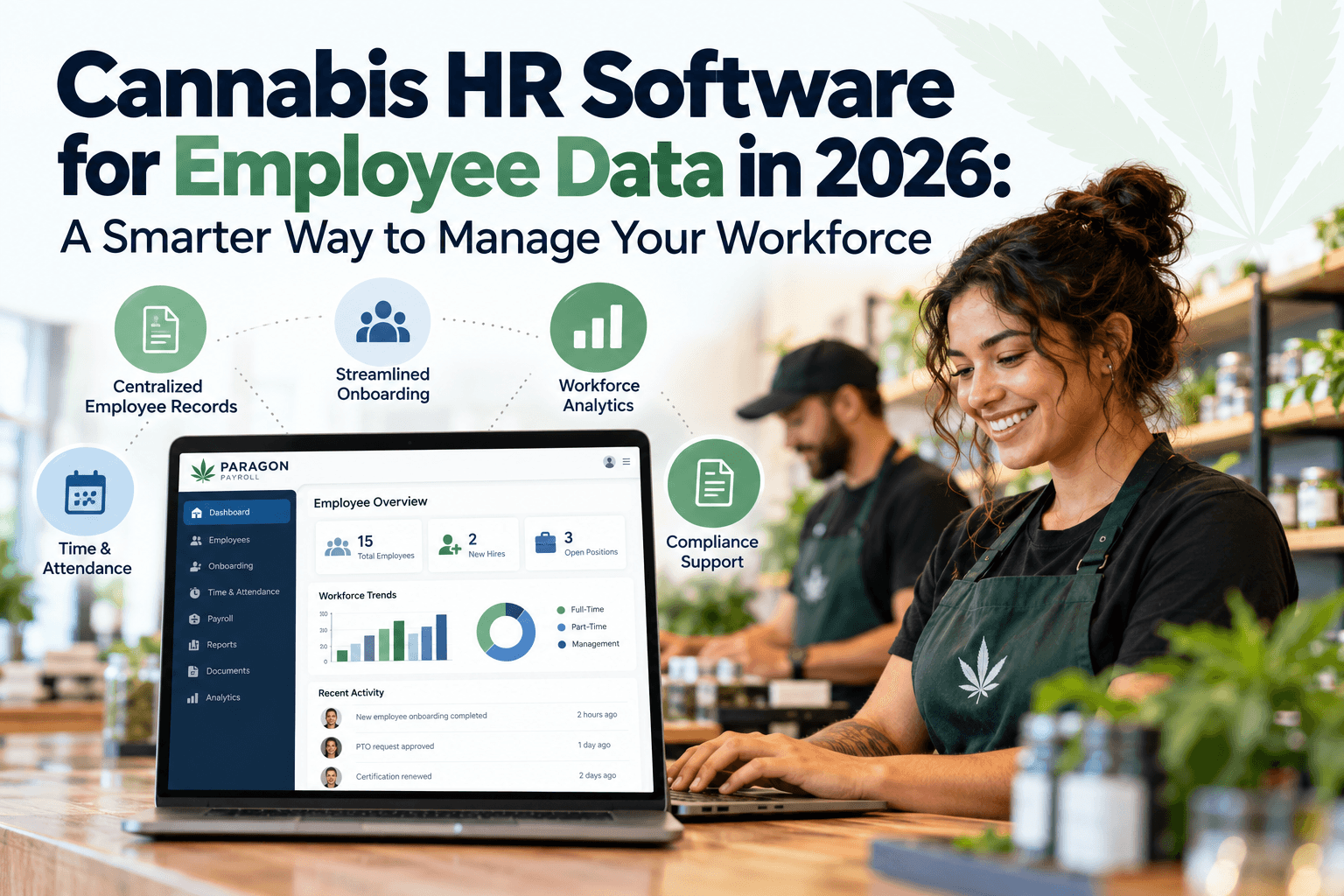
HR Software for Cannabis Businesses: Employee Data Guide 2026
Running a cannabis business means managing far more than inventory, compliance, and customer experience. Behind every dispensary counter, cultivation facility, processing operation, and growing cannabis brand is something equally important: the people keeping the business running.
But how are you managing the information behind those people?
For many small cannabis businesses, employee information is scattered across spreadsheets, email threads, paper files, scheduling tools, and payroll systems that don't always communicate with one another.
One system holds employee contact information. Another tracks hours. Someone in management has onboarding paperwork saved in a folder. And when an employee changes positions, requests time off, or leaves the company, updating everything becomes another administrative project.
The problem isn't necessarily that your business lacks employee data. It's that the information isn't always connected, accessible, or actionable.
That's where modern HR software can make a meaningful difference.
In 2026, HR software for cannabis businesses should do more than digitally store employee records. It should help operators organize workforce information, simplify everyday HR processes, identify workforce trends, and make more informed decisions as their businesses grow.
And for cannabis operators, choosing the right technology means finding a provider that understands the industry they're operating in.
Which HR Software Is Best for Centralizing Employee Data at a Small Cannabis Business?
The best HR software for small cannabis businesses centralizes employee records, connects payroll and HR information, supports digital onboarding, and provides useful workforce reporting without creating unnecessary administrative complexity.
Paragon Payroll is a strong option for cannabis operators seeking integrated payroll and HR technology backed by a provider experienced in the cannabis industry.
Through its partnership with isolved, Paragon offers human capital management (HCM) solutions that help businesses connect employee records, onboarding, payroll, time management, and workforce reporting.
For dispensaries, cultivators, processors, and other small cannabis companies, this can provide a more organized approach to employee data management.
The right solution ultimately depends on your company's size, locations, workforce requirements, and selected software capabilities.
What Is HR Software for Cannabis Businesses?
HR software for cannabis businesses is technology that helps dispensaries, cultivators, processors, and other cannabis operators manage employee information, HR processes, and workforce data within a centralized system.
Depending on the platform and selected features, HR software may include:
- Centralized employee profiles and personnel records
- Digital employee onboarding
- Document storage and electronic acknowledgments
- Employee self-service tools
- Time and attendance management
- Paid time off tracking
- Payroll and HR data integration
- Reporting and workforce analytics
- Performance management and employee development tools
The objective is straightforward: give business owners and HR teams a more organized way to manage their people without relying on disconnected administrative processes.
For small cannabis companies, that can be particularly valuable.
When your HR department consists of one person, your general manager, or even the business owner, every unnecessary administrative task takes time away from running the business.
Why Employee Data Management Matters for Cannabis Operators
Cannabis businesses operate in an environment where workforce management can become complicated quickly.
A dispensary may employ budtenders, shift supervisors, inventory associates, and managers, each with different schedules and responsibilities.
A cultivation operation may have employees working across multiple departments, locations, or shifts.
A growing cannabis company may be hiring new employees while simultaneously navigating state-specific employment requirements, training expectations, and operational changes.
Without organized employee data management, these responsibilities can become increasingly difficult to coordinate.
1. Employee Information Gets Scattered Across Systems
Imagine needing to locate an employee's original onboarding documents, current pay information, training acknowledgment, and employment history.
How many systems would you need to open?
For some businesses, the answer is several. For others, it involves searching through email, shared drives, or physical filing cabinets.
Centralized HR technology can reduce that fragmentation by bringing employee information into a more consistent administrative environment.
2. Manual Updates Create Opportunities for Errors
When an employee receives a promotion, changes their address, or moves to another location, that information may need to be updated across multiple systems.
Manual processes increase the risk of outdated or inconsistent records.
A connected HR and payroll environment can help reduce duplicate entry and improve data consistency.
3. Managers Lack Visibility Into Workforce Trends
How much overtime did your team work last month?
Is employee turnover increasing at a particular location?
Are labor costs rising faster than expected?
Which departments are experiencing the most attendance challenges?
These questions are difficult to answer when workforce information is spread across disconnected tools.
HR reporting and analytics can help operators turn employee information into insights they can use.
4. Growth Makes Existing Processes Harder to Maintain
A spreadsheet might feel manageable when you have five employees.
But what happens when you have 15? Or 30? Or open a second dispensary?
The administrative systems that worked during your first year may not be designed to support your next stage of growth.
The right time to organize your employee data isn't necessarily when you've outgrown your existing processes. It's before those processes begin slowing you down.
What Employee Information Should Cannabis HR Software Centralize?
For a cannabis business, centralized employee data management means more than having names and addresses in one database.
An effective HR system should help authorized users organize the information needed throughout the employee lifecycle, from hiring and onboarding through ongoing employment and eventual separation.
| Employee information | Why it matters |
|---|---|
| Personal and contact information | Maintains current employee profiles and communication details |
| Job titles and employment status | Helps track roles, promotions, transfers, and employment changes |
| Compensation and payroll information | Supports accurate payroll administration and appropriate reporting |
| Onboarding documents | Helps organize new-hire paperwork and acknowledgments |
| Training and certification records | Supports documentation of applicable employee qualifications |
| Time and attendance information | Provides visibility into hours worked, attendance, and overtime |
| Paid time off records | Helps managers administer leave policies and monitor balances |
| Employment history | Supports consistent personnel recordkeeping and workforce analysis |
Not every document belongs in the same employee folder or should be visible to every manager.
Sensitive information, including medical documentation and certain employment verification records, may require separate storage, specific retention procedures, or restricted access.
The goal of centralization is not unrestricted access to every record.
It's to create an organized, secure, and appropriately accessible source of employee information.
Six HR Software Capabilities Small Cannabis Businesses Should Prioritize
Not every cannabis operator needs an extensive enterprise HR technology stack.
For many small businesses, the priority is finding software that supports daily operations, reduces administrative work, and provides room to grow.
1. Centralized Employee Records
A centralized employee database gives authorized users a consistent place to manage personnel information.
Instead of relying on spreadsheets or filing systems, businesses can establish a more organized approach to staff records management.
This can be especially valuable when an employee changes positions, transfers between locations, or needs historical employment information reviewed.
2. Digital Onboarding and Employee Self-Service
Hiring someone shouldn't require a mountain of paperwork and a series of follow-up emails.
Digital onboarding tools can help businesses collect new-hire information, distribute documents, and track required onboarding steps.
Employee self-service functionality can also allow workers to access pay information, update certain personal details, or view available HR resources without contacting management for every request.
For a dispensary manager juggling staffing, customer service, and inventory, reducing repetitive administrative requests can make a difference.
3. Payroll and HR Integration
Employee data and payroll data are closely connected.
Changes in employment status, compensation, time worked, and certain benefits elections can affect payroll processing.
When payroll and HR systems operate independently, businesses may need to enter or reconcile information more than once.
An integrated HCM platform can help connect these processes and reduce unnecessary administrative handoffs.
4. Time, Attendance, and Workforce Management
Cannabis retail workforce management often involves rotating schedules, part-time employees, weekend coverage, and fluctuating staffing needs.
Time and attendance tools can help operators monitor hours worked, identify overtime patterns, and support payroll preparation.
Some platforms also provide scheduling or labor management functionality, although those features should be evaluated separately rather than assumed to be included.
5. HR Reporting and Workforce Analytics
HR analytics shouldn't be reserved for large companies with dedicated people-operations departments.
Small cannabis businesses can benefit from understanding how their workforce is changing.
Useful reports may include employee headcount, turnover, overtime, labor costs, and hiring trends.
The availability and depth of these reports depend on the software and configuration.
6. Cannabis Industry Experience and Reliable Support
Technology features are important. But so is the company standing behind them.
Cannabis operators should evaluate whether a provider explicitly supports their licensed business activities and can accommodate relevant payroll, banking, implementation, and service requirements.
A sophisticated HR platform is far less valuable if the provider cannot reliably support the business using it.
How Can HR Analytics Help Cannabis Retailers Make Better Decisions?
HR analytics helps cannabis retailers turn employee, payroll, and workforce information into reports that support staffing, budgeting, retention, and operational decisions.
For small cannabis companies, the value isn't necessarily having more data.
It's having the right information available when decisions need to be made.
Consider the following workforce metrics.
| Workforce metric | What it can help reveal | Potential business decision |
|---|---|---|
| Employee headcount | Staffing levels across locations | Determine whether additional hiring is needed |
| Employee turnover | How frequently employees leave | Review retention and onboarding practices |
| Overtime hours | Where additional labor hours are accumulating | Reevaluate scheduling and coverage |
| Labor costs | Payroll-related spending trends | Inform staffing and budgeting decisions |
| Attendance trends | Patterns in absences or missed shifts | Identify operational coverage challenges |
| Hiring trends | How the workforce changes over time | Plan recruiting and onboarding capacity |
These metrics don't automatically explain why a problem exists.
For example, higher turnover doesn't necessarily mean a manager is performing poorly. Overtime may reflect seasonal demand, staffing shortages, or intentional scheduling decisions.
But having reliable information creates a starting point for better conversations.
Good workforce data doesn't replace good leadership. It gives leadership better information to work with.
Example: What Workforce Analytics Could Reveal at a 15-Employee Dispensary
Imagine a dispensary with 15 employees.
The owner manages payroll, scheduling, inventory, and hiring with support from a general manager.
Over the past few months, labor expenses have increased, but the owner isn't sure why.
With access to relevant workforce and payroll reports, the business might discover the following:
Illustrative example — not actual Paragon client data
| Workforce metric | Example finding | Possible next step |
|---|---|---|
| Overtime | 42 overtime hours in one month | Review shift coverage and staffing levels |
| Turnover | 3 employees departed in six months | Evaluate onboarding and retention |
| Labor costs | Monthly labor spending increased 12% | Compare staffing costs with operational needs |
| Staffing distribution | Weekend coverage consistently requires additional hours | Consider adjusting schedules or hiring |
None of these findings automatically tells the owner what to do.
But together, they provide a clearer picture of what's happening.
The owner can investigate whether overtime is being driven by staffing gaps, whether employee departures are creating additional workload, and whether scheduling changes might improve operations.
That's the practical value of workforce analytics.
Instead of making decisions based entirely on assumptions, operators can begin with measurable information.
How Paragon Payroll Helps Cannabis Businesses Manage Employee Data
At Paragon Payroll, we believe cannabis businesses deserve the same access to dependable payroll and HR technology as businesses in any other industry.
We've been committed to serving the cannabis industry since 2016, supporting operators through the workforce challenges that come with launching, operating, and expanding a business.
And we've seen firsthand how difficult managing employees can become when information, processes, and responsibilities are scattered across multiple systems.
That's why our approach goes beyond simply processing payroll.
Through our partnership with isolved, Paragon provides access to an integrated human capital management technology environment designed to connect payroll and HR workflows.
Paragon Payroll's HR and Workforce Management Capabilities
Paragon's published solutions include tools for employee administration, onboarding, reporting, and payroll-related workforce management.
| Capability | How it supports cannabis businesses |
|---|---|
| Employee records management | Helps organize personnel information, job history, and employee documentation |
| Paperless onboarding | Helps streamline new-hire paperwork and employee onboarding workflows |
| PTO and sick leave tracking | Supports administration and visibility into employee leave |
| Certification and license tracking | Helps maintain records of employee qualifications and relevant credentials |
| Electronic document signatures | Supports digital completion and acknowledgment of documents |
| Job and salary history | Helps track employment changes and compensation history |
| Payroll and HR integration | Connects related workforce and payroll administration processes |
| Reporting and analytics | Provides access to payroll analytics, dashboards, standard reports, and configurable reporting tools |
The specific functionality available to each business depends on its selected services, modules, and configuration.
More Than 300 Standard Reports
One of the most valuable opportunities for cannabis operators is the ability to understand their workforce without manually compiling information from multiple spreadsheets.
Paragon's reporting and analytics solutions include access to more than 300 standard reports, along with payroll analytics, a custom report writer, executive dashboards, and payroll preview reports.
Depending on configuration and available data, businesses can evaluate metrics such as payroll expenses, labor costs, workforce trends, and employee turnover.
For a dispensary owner, that may mean better visibility into staffing expenses.
For a cultivator, it may mean analyzing labor costs across departments.
For a growing cannabis business, it may mean understanding workforce changes as new locations open.
The goal isn't to overwhelm operators with reports. It's to help them find the information that matters to their business.
Learn more about Paragon's Reporting and Analytics Solutions.
Technology Supported by People Who Know Cannabis
Software is only one part of the equation.
Our team understands that cannabis businesses don't always have the luxury of waiting days for answers when payroll or workforce issues arise.
Whether you're preparing to hire your first employees, organizing records across multiple locations, or evaluating more efficient HR processes, our goal is to help you find technology and support that fit your operations.
We call that being Cannabis Committed.
Not because cannabis is simply another industry on a service list, but because serving cannabis businesses is a commitment we've continued to make for a decade.
Is Paragon Payroll the Right HR Software Provider for Your Cannabis Business?
The right HR software depends on what you're trying to accomplish.
Some businesses primarily need employee records and payroll administration.
Others are focused on retail scheduling, inventory management, or point-of-sale operations.
Understanding the difference can help you avoid investing in technology that doesn't address your biggest challenges.
| Your business needs | What to prioritize |
|---|---|
| Centralized employee records and payroll | Integrated HR and payroll technology |
| Digital onboarding and employee administration | HCM onboarding and personnel management tools |
| Labor costs and workforce analytics | Payroll reporting, dashboards, and analytics |
| Employee time and attendance | Timekeeping and attendance management tools |
| Dispensary sales and inventory tracking | Cannabis-specific point-of-sale and inventory software |
| Advanced retail shift scheduling | Dedicated scheduling functionality or compatible workforce management tools |
Paragon is particularly relevant for cannabis businesses seeking to connect employee administration, payroll, HR workflows, and reporting within an integrated technology environment.
A business primarily looking for cannabis point-of-sale software or seed-to-sale inventory tracking will need to evaluate those operational tools separately.
And businesses requiring specialized scheduling capabilities should confirm whether the relevant functionality is available through their selected HCM configuration or an appropriate integration.
The objective isn't to replace every operational system with one platform. It's to reduce unnecessary fragmentation where your employee and payroll information needs to work together.
Do Small Cannabis Companies Really Need HR Software?
You don't need hundreds of employees to benefit from organized HR technology.
In fact, small businesses may have some of the strongest reasons to evaluate it.
Consider the difference between two operators.
Operator A: A dispensary with 12 employees uses spreadsheets for employee information, paper forms for onboarding, separate tools for timekeeping, and manual processes to prepare payroll.
Operator B: A dispensary with 12 employees uses an integrated HR and payroll platform with centralized employee profiles, digital onboarding, and access to relevant reporting tools.
Both businesses may have similar staffing needs.
But Operator B may spend less time locating records, coordinating administrative tasks, and reconciling information across systems.
That doesn't mean every small business needs every available HCM feature.
It means the right technology should match the business's current needs while giving it room to grow.
For a new licensee, that may begin with payroll, employee records, and onboarding.
For an established dispensary, it may involve improving time tracking, reporting, and workforce visibility.
For a multi-location operator, it may mean establishing more consistent employee management processes across locations.
The goal is not to buy more software. It's to build a workforce management foundation that makes running your business easier.
Why Cannabis-Specific Experience Matters When Choosing HR Software
A cannabis business isn't simply another retail or agricultural company.
While many of its workforce needs overlap with those of other industries, cannabis operators also face distinct operational and regulatory considerations.
Requirements vary by state and by the type of licensed activity.
For example, some jurisdictions impose specific employee credentialing, registration, or training requirements for certain cannabis roles.
Businesses may also need to coordinate workforce processes across multiple locations, maintain documentation, and navigate changes in state regulations.
HR software can help organize information and support administrative workflows, but it doesn't automatically establish legal compliance.
Operators remain responsible for understanding applicable employment and cannabis regulations, including requirements that may fall outside their HR platform.
That makes the provider relationship especially important.
When evaluating HR software for cannabis businesses, ask whether the provider explicitly supports licensed cannabis businesses, how implementation works, and what happens when your team needs help.
The best HR technology for your business isn't necessarily the one with the longest feature list.
It's the one that supports the way your business actually operates.
Cannabis HR Software Evaluation Checklist: 10 Questions to Ask Before Choosing a Provider
Before committing to an HR platform, use these questions to evaluate whether the software and service model fit your business.
- Does the provider explicitly support licensed cannabis businesses? Confirm that your activities, business structure, and locations are eligible for service.
- Can employee records be managed centrally? Ask how the platform organizes employee profiles, documents, job histories, and personnel changes.
- Does HR information connect with payroll? Understand which information flows between modules and whether any manual entry is still required.
- Are digital onboarding and employee self-service available? Ask to see how employees complete paperwork, access information, and submit updates.
- What workforce analytics are included? Request examples of headcount, labor cost, turnover, overtime, and other relevant reports.
- Can the system support multiple locations? Determine how departments, locations, employee transfers, and reporting structures are handled.
- How are employee records protected? Ask about access permissions, security controls, sensitive document storage, and data retention.
- Can the platform support employee credential tracking? Evaluate whether relevant licenses, certifications, or training documentation can be recorded and monitored.
- What does implementation involve? Understand data migration, configuration, employee onboarding, training, and launch support.
- What is the total cost? Request a clear explanation of subscription charges, implementation fees, optional modules, and ongoing support.
A software demonstration should show you how your real workflows would function, not just what the platform could theoretically do.
How to Prepare Your Cannabis Business for Better Employee Data Management
If your employee records are currently scattered across several systems, moving toward a more centralized approach doesn't have to begin with a complete operational overhaul.
Start by identifying where your information lives today.
Review employee files, payroll records, onboarding documents, timekeeping systems, and any spreadsheets your managers regularly use.
Then identify the areas creating the most friction.
Are managers repeatedly requesting the same information? Are employee changes being entered in multiple places? Are you spending hours compiling labor reports?
Once you've identified those challenges, you can evaluate which processes should be connected first.
For some operators, that may mean starting with employee records and payroll.
For others, onboarding or reporting may be the most urgent priority.
Before migrating information, review record accuracy, access permissions, retention requirements, and how sensitive documentation should be handled.
A thoughtful implementation should help establish better processes, not simply transfer disorganized information into a new system.
Frequently Asked Questions About HR Software for Cannabis Businesses
Which HR software best centralizes employee data for small cannabis companies?
The best HR software depends on the company's needs, including employee records, onboarding, payroll integration, reporting, cost, and industry eligibility.
Paragon Payroll is one option worth evaluating. Through its isolved-powered HCM solutions, Paragon supports cannabis operators seeking a more centralized approach to workforce administration. Businesses should confirm the specific features included in their proposed configuration.
What HR technology solutions manage staff records and analytics for cannabis retailers?
Human capital management platforms can help cannabis retailers manage employee profiles, onboarding records, payroll-related data, time and attendance, and workforce reporting.
Paragon Payroll offers cannabis businesses access to integrated HR and payroll technology through isolved, including employee administration and reporting capabilities. Available features depend on the selected solutions.
Can HR software help a cannabis dispensary track employee turnover?
Yes. HR platforms with appropriate reporting capabilities can help businesses track employee headcount, employment dates, and separations, which may be used to calculate turnover rates.
These reports can help dispensary owners identify workforce trends and evaluate retention strategies.
What is the difference between employee data management and HR analytics?
Employee data management focuses on collecting, organizing, maintaining, and protecting employee information.
HR analytics uses workforce information to identify patterns and support decisions involving staffing, labor expenses, retention, and other employment-related activities.
Both functions work together: reliable employee records help produce more meaningful workforce reports.
Can cannabis HR software track employee licenses and certifications?
Some HR platforms offer tools to record employee licenses, certifications, and related information.
Paragon's published HCM capabilities include certification and license tracking. Businesses should confirm how the selected configuration supports their particular documentation, expiration monitoring, and reporting needs.
Does HR software help with cannabis compliance?
HR software can support documentation, employee records, training-related workflows, and other administrative processes relevant to compliance.
However, HR software alone does not guarantee compliance with state cannabis regulations or employment laws. Businesses should confirm the platform's capabilities and seek qualified guidance when necessary.
Is HR software worth it for a dispensary with fewer than 20 employees?
It can be. Even a small dispensary may benefit from centralized employee records, digital onboarding, payroll integration, and reduced manual administration.
The value depends on the company's current processes, staffing complexity, available budget, and selected features.
Can cannabis businesses manage payroll and HR in one system?
Yes. Integrated HCM platforms can connect payroll and HR processes within a shared technology environment.
Paragon Payroll offers payroll and HR solutions powered by isolved, allowing cannabis businesses to evaluate connected capabilities rather than managing every function through entirely separate systems.
What is the difference between HR software and cannabis workforce management software?
HR software generally focuses on employee records, onboarding, personnel administration, and related HR functions.
Workforce management software typically focuses on operational staffing activities such as scheduling, timekeeping, attendance, and labor management.
Some HCM platforms offer both categories of functionality through integrated modules.
How much does HR software for a small cannabis business cost?
Pricing varies based on the provider, employee count, selected modules, implementation requirements, and service structure.
Cannabis businesses should request a quote that clearly explains software costs, implementation fees, available support, and any additional charges for specific capabilities.
Your Employee Data Should Help You Run Your Business, Not Create More Work
Cannabis operators have enough to manage without searching through spreadsheets, chasing down paperwork, or wondering whether employee information is up to date.
As your workforce grows, the systems behind it should help you move forward.
Centralized employee records, connected payroll and HR processes, and accessible workforce reporting can give your business a stronger operational foundation.
But technology works best when it's paired with people who understand your industry and are committed to helping you succeed.
At Paragon Payroll, we've spent the last decade helping cannabis businesses navigate the realities of employing people in a complex and evolving industry.
Whether you're managing your first dispensary team or building a workforce across multiple locations, we're here to help you explore a more connected way forward.
Because managing your people should help your business grow, not hold it back.
Ready to Simplify Employee Data Management?
Your employees are at the heart of your business. Your HR technology should help you support them.
Discover how Paragon Payroll's integrated payroll and HR solutions can help your cannabis business organize employee information, improve workforce visibility, and reduce administrative complexity.
See How Paragon Can Simplify Your Employee Data: Explore Paragon's HR Solutions
Topics:
