

What Happens to Payroll When a Cannabis Business Lays Off Employees or Closes?
October 28th, 2026
17 min read
By Paragon
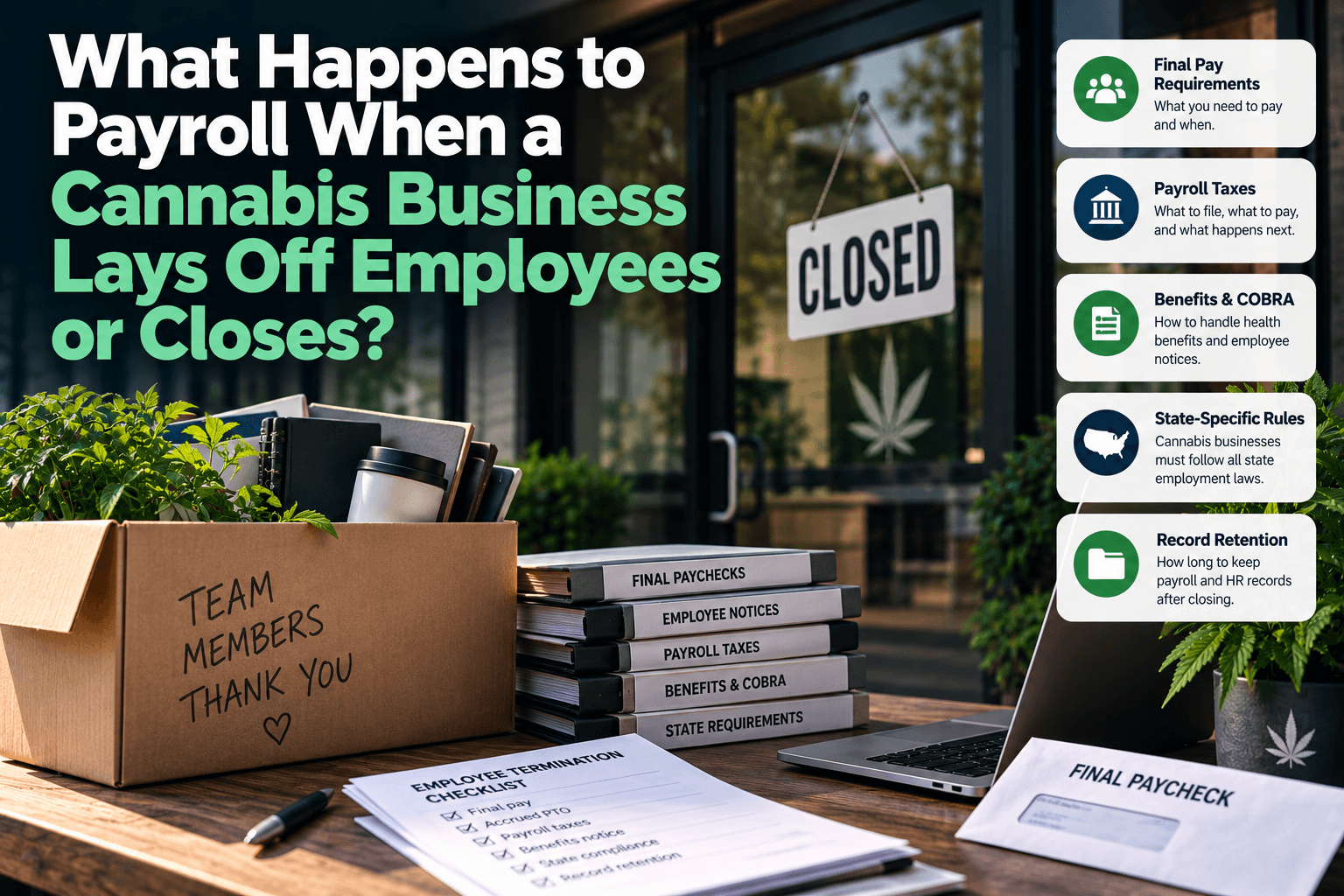
What Cannabis Employers Will Learn About Payroll During Layoffs or Business Closure
When a cannabis business closes a location, reduces its workforce, or shuts down entirely, payroll does not simply stop.
In many ways, payroll becomes more important during the final weeks of employment.
Employers may need to determine:
- when final paychecks are due
- which wages employees are still owed
- whether unused PTO must be paid
- how commissions and bonuses should be handled
- which payroll deductions should continue
- what happens to garnishments
- how employee benefits are affected
- whether terminated employees can still access pay statements
- how W-2s will be delivered
- which payroll tax filings still need to be completed
- what payroll records should be preserved
- what additional steps apply if the entire business is closing
For cannabis businesses, those questions may arrive while leadership is simultaneously managing inventory, licensing, banking, landlords, creditors, vendors, regulators, and employees.
That is exactly why payroll planning should happen before the final day of operations.
Quick Takeaway for Cannabis Employers
If your cannabis business is considering layoffs or closure, involve payroll, HR, benefits, accounting, and qualified employment counsel before employee termination dates are finalized.
At minimum, confirm:
- who is affected
- where each employee works
- when final wages must be paid
- what each employee is still owed
- how PTO, commissions, bonuses, and deductions will be handled
- when benefits end
- how former employees will access pay records and W-2s
- which payroll tax filings remain
- who will retain payroll records
- who employees can contact after termination
Important: This guide provides general educational information and is not legal or tax advice. Final wage, PTO, commission, termination, and recordkeeping requirements can vary by state and circumstance. Employers should consult qualified employment counsel, tax professionals, and their payroll provider before completing a workforce reduction or business closure.
What Happens to Payroll When a Cannabis Business Lays Off Employees?
The short answer is that employers still need to account for wages and other compensation employees have earned through their final employment date.
Depending on the employee and applicable law, that could include:
- regular wages
- overtime
- commissions
- bonuses
- shift differentials
- eligible PTO payouts
- expense reimbursements
- other earned compensation
Employers also need to determine when those amounts must be paid.
There is not one universal final-paycheck deadline for every employee in every state. That makes employee work location an important part of final payroll planning.
Is a Cannabis Employee's Final Paycheck Due Immediately After a Layoff?
Not necessarily.
Final-paycheck timing can depend on:
- where the employee works
- whether the employee was laid off, terminated, or resigned
- state wage-payment law
- the employer's normal payroll schedule
- the type of compensation owed
Do not assume that your normal Friday payday automatically becomes the final-pay deadline.
What Does Final Paycheck Mean?
A final paycheck is the last wage payment an employee receives after employment ends.
It may include more than normal hourly wages or salary.
Depending on the circumstances, final pay could include:
- hours worked during the final pay period
- overtime
- commissions
- bonuses
- eligible PTO payouts
- other earned wages
- reimbursements
Employers should calculate final pay based on applicable law and compensation agreements rather than assuming the final check will look exactly like a normal paycheck.
Example: A Dispensary Closes Before Its Normal Payday
Imagine a dispensary permanently closes on a Friday.
Its normal payroll isn't scheduled until the following Wednesday.
Leadership might assume:
"Everyone will just get paid Wednesday like usual."
But the employees' work locations and applicable state laws may affect when their final wages are actually due.
That question should be answered before employees are told when they will receive their final checks.
Helpful resource: Review the U.S. Department of Labor's guidance on final paychecks and then confirm applicable state requirements with qualified counsel.
Why Employee Work Location Matters for Cannabis Final Payroll
A cannabis company may operate dispensaries in three states but process payroll centrally.
That does not necessarily mean all three locations follow the same rules.
Employee work location can affect requirements involving:
- final paycheck timing
- PTO payout
- wage deductions
- commissions
- minimum wage
- overtime
- sick leave
- payroll recordkeeping
This is why employee location should be maintained accurately in your HR system.
Example: One Cannabis Company, Three Different States
Imagine an MSO closes three underperforming dispensaries.
Twenty employees work in State A.
Fourteen work in State B.
Nine work in State C.
Leadership may think of this as one company-wide restructuring.
Payroll may need to think about it as three groups of employees working under potentially different state requirements.
When leadership asks:
"Who is affected, where do they work, and which rules apply?"
that information should already be available.
What Wages Should Cannabis Employers Review Before Issuing Final Paychecks?
Start with all compensation employees may have earned through their final date of employment.
What Are Regular Wages?
Regular wages include an employee's normal hourly earnings or salary earned through the final employment date.
For hourly employees, employers should confirm that all hours worked have been entered and approved.
What Happens to Overtime During Final Payroll?
If a nonexempt employee earned overtime during the final workweek, that compensation still needs to be reviewed and properly calculated.
Example: A cultivation employee works extra hours helping prepare a facility for closure. Their last week ends up being longer than a typical week.
The fact that the location is closing does not mean those additional hours should disappear from payroll.
What Are Shift Differentials?
A shift differential is additional compensation paid to employees for working certain shifts.
For example, a cannabis cultivation facility might pay:
- $1.00 extra per hour for overnight work
- $2.00 extra per hour for weekend production shifts
If the employee earned that differential before termination, payroll should account for it.
What Are Employee Expense Reimbursements?
Employee reimbursements are amounts an employer pays back to employees for approved business expenses they personally covered.
These could include:
- mileage
- travel
- parking
- business supplies
- phone expenses
- other authorized purchases
Example: A regional dispensary manager spends $240 personally traveling between locations during the company's final month.
The fact that their employment ends before the expense report is processed does not mean the company should simply forget about the reimbursement.
Outstanding approved expenses should be reviewed before offboarding is complete.
What Happens to Unused PTO When a Cannabis Employee Is Laid Off?
It depends.
PTO, or paid time off, generally refers to paid vacation, personal time, or other employer-provided leave employees accumulate or receive under company policy.
Whether unused PTO must be paid after termination can depend on:
- state law
- the employer's written policy
- the type of leave
- how the PTO was earned
- the circumstances of termination
Example: An Employee Has 72 Hours of Unused PTO
Suppose a dispensary employee has 72 hours of unused vacation time when their location closes.
Leadership should not automatically assume:
"They're terminated, so those 72 hours disappear."
Instead, determine:
- What does applicable state law require?
- What does the employee handbook say?
- What type of leave is in the balance?
- What has the employer's policy promised employees?
- How should any required payout appear in final payroll?
That analysis should happen before final payroll is calculated.
For employers managing PTO and employee information across the workforce, Paragon's HR Solutions provide a more centralized place to maintain workforce information.
What Happens to Cannabis Employee Commissions After a Layoff?
Commissioned employees require another layer of review.
Cannabis companies may use commissions for employees involved in:
- wholesale sales
- business development
- account management
- certain retail management positions
- partnership development
Before terminating a commissioned employee, determine whether they have already earned compensation that has not yet been paid.
What Is a Commission Plan?
A commission plan is the written agreement or policy explaining how and when an employee earns variable compensation tied to sales or other performance.
Questions can include:
- Was the underlying sale completed?
- Has the customer paid?
- When does the plan say a commission becomes earned?
- Must the employee still be employed on the payment date?
- What does applicable state law require?
Example: A Cannabis Sales Representative Closes a Large Account Before Layoffs
Imagine a wholesale sales representative closes a $75,000 order two days before the company announces layoffs.
The customer will not pay the invoice for another 30 days.
Is the salesperson still entitled to the commission?
That answer may depend on the company's commission agreement and applicable law.
This is exactly the type of question leadership should resolve before final payroll rather than after the former employee asks where their commission went.
What Happens to Employee Bonuses During a Cannabis Business Closure?
Bonuses can also require review.
Some bonuses are discretionary.
Others may already have been earned under a compensation plan.
Example: A Dispensary Manager Earned a Quarterly Performance Bonus
Suppose a retail manager was promised a bonus if their dispensary reached specific quarterly performance targets.
The location reaches those targets.
Two weeks later, the company announces the location will close.
Leadership should determine whether the employee has already satisfied the requirements for the bonus rather than assuming the closure automatically eliminates it.
The important distinction is between:
"We were thinking about giving employees a bonus."
and:
"Employees already satisfied the conditions required to earn the bonus."
Those can be very different compensation situations.
What Payroll Deductions Should Cannabis Employers Review Before Final Payroll?
Final payroll should not simply copy every deduction from the employee's previous paycheck.
Review deductions individually.
They may include:
- health insurance premiums
- dental or vision premiums
- 401(k) contributions
- HSA or FSA contributions
- wage garnishments
- child support
- tax levies
- employee loans
- voluntary deductions
- other authorized deductions
Example: One Employee Has Four Different Payroll Deductions
Imagine an employee normally has money deducted for:
- health insurance
- their 401(k)
- child support
- an employee loan
Payroll should not assume all four deductions are handled identically on the final check.
Some may continue.
Some may stop.
Some may require instructions from a plan provider, court, government agency, or other administrator.
What Happens to Wage Garnishments When a Cannabis Employee Is Laid Off?
A wage garnishment is a legally required deduction from an employee's wages.
Examples can include:
- child support orders
- tax levies
- creditor garnishments
- other court-ordered withholding
If an employee is terminated, employers should follow the instructions associated with the order and determine whether notice to the issuing agency is required.
Example: An employee has child-support withholding deducted from every paycheck. The employee is laid off when a cultivation facility closes.
Payroll should not simply click "terminate" and forget about the withholding order.
The company should determine what the order requires when employment ends and maintain documentation showing how it was handled.
What Happens to Employee Benefits When a Cannabis Business Lays Off Workers?
Termination can affect employee eligibility for:
- medical insurance
- dental insurance
- vision insurance
- life insurance
- disability coverage
- health savings accounts
- flexible spending accounts
- voluntary benefits
- retirement plans
A connected Benefits Enrollment & Administration solution can help employers maintain benefit and eligibility information alongside employee data.
Does Health Insurance End on an Employee's Last Day?
Not always.
A health plan may specify that coverage ends:
- on the employee's termination date
- at the end of the month
- on another plan-defined date
Employers should verify the actual plan terms.
Example: The Employee Assumes Coverage Ends Friday
An employee's final workday is Friday.
They ask HR:
"Does my family's health insurance end tonight?"
HR should be able to answer that question accurately.
The plan may continue coverage through the end of the month, or another rule may apply.
Employees making decisions about prescriptions, appointments, or family coverage need more than "I think so."
What Is COBRA and Could It Apply After a Cannabis Layoff?
COBRA stands for the Consolidated Omnibus Budget Reconciliation Act.
It can allow certain employees and family members to temporarily continue employer-sponsored group health coverage after qualifying events such as job loss or reduction in hours when applicable requirements are met.
Employers should coordinate with their benefits administrator to understand:
- whether COBRA applies
- who sends required notices
- when notices are sent
- when coverage ends
- how employees elect continuation coverage
- whether state continuation requirements also apply
What Happens to a 401(k) When a Cannabis Business Lays Off Employees?
Employees do not simply lose vested retirement assets because employment ends.
Depending on the plan, a former employee may potentially be able to:
- leave eligible funds in the existing plan
- roll eligible funds into another employer's plan
- roll funds into an IRA
- take a distribution
What Is a Retirement Plan Rollover?
A rollover generally means moving eligible retirement funds from one qualified retirement account to another.
Example: A laid-off employee starts a new job three months later and wants to move their previous 401(k) balance into the new employer's plan.
Whether and how they can do that depends on the plans involved.
Employers should direct employees to the appropriate retirement-plan administrator rather than improvising financial advice.
What Happens to Payroll Records After a Cannabis Employee Is Terminated?
Payroll records still matter after employment ends.
A former employee may later need:
- a pay stub
- a W-2
- wage history
- tax information
- proof of employment
- compensation records
The company may need historical payroll data for:
- tax audits
- unemployment claims
- wage disputes
- legal matters
- regulatory requests
- accounting
- business transactions
Paragon's Reporting & Analytics includes payroll analytics, standard reporting, custom reporting, and payroll preview reporting that can give employers greater visibility into workforce information.
Example: A Former Employee Questions Their Pay Six Months Later
A former cultivation employee contacts the company six months after termination and says:
"I think I wasn't paid correctly for overtime during my last two pay periods."
Can HR still retrieve:
- the employee's pay statements
- wage history
- payroll calculations
- relevant dates
- historical payroll reports
Or did that information effectively disappear when the employee was terminated?
That is something employers should know before a workforce reduction.
Can Terminated Cannabis Employees Still Access Their Pay Stubs?
That depends on the payroll system and employer configuration.
It is an important question to ask before terminating employee access.
Employers should determine:
- whether terminated employees retain employee self-service access
- how long access remains available
- whether historical pay statements remain visible
- how employees update their mailing address
- how employees obtain future W-2s
- who former employees contact for payroll questions
Example: A Former Employee Needs Pay Stubs for an Apartment
Three weeks after being laid off, a former employee applies for an apartment.
The property manager asks for their last three pay stubs.
If the employee's payroll portal disappeared the moment HR terminated them, they may have to track down someone at their former employer just to retrieve basic documents.
Your offboarding process should account for situations like this.
Do Cannabis Employers Still Have to Provide W-2s to Laid-Off Employees?
Yes, when W-2 reporting requirements otherwise apply.
Ending employment does not eliminate the employer's wage-reporting responsibilities.
What Is Form W-2?
Form W-2, Wage and Tax Statement, reports employee wages and certain taxes withheld during the year.
Employees use the information when preparing their individual tax returns.
Example: A Dispensary Closes in July
A dispensary permanently closes in July.
Its employees may scatter across the country before tax season arrives.
The employer still needs accurate employee information and a process for handling W-2s.
That is why collecting updated contact information before employees leave is so important.
Helpful resource: The IRS publishes current Form W-2 and W-3 instructions explaining employer reporting responsibilities.
How Can Former Cannabis Employees Update Their Mailing Addresses?
Employers should establish this process before workers lose access to company systems.
Depending on the payroll and HR setup, former employees might:
- update their address through employee self-service
- contact HR
- submit a secure address-change request
- contact an authorized payroll representative
Example: An Employee Moves Before W-2 Season
An employee leaves a cannabis manufacturer in September.
They move from Colorado to Arizona in November.
Their W-2 will not be issued until later.
If their company email no longer works and they cannot access employee self-service, how do they tell their former employer where they live?
There should already be an answer.
What Happens to W-2s and Payroll Taxes if the Entire Cannabis Business Closes?
A complete business closure creates additional responsibilities.
Closing the doors does not automatically end payroll reporting.
Employers may still need to address:
- final wages
- federal payroll tax deposits
- state payroll taxes
- unemployment taxes
- final employment tax returns
- W-2 reporting
- payroll records
The IRS specifically instructs closing employers with employees to pay final wages and compensation, make final federal tax deposits, report employment taxes, provide W-2s, and maintain required records.
Helpful resource: Review the IRS Closing a Business guide with your accountant or tax advisor.
What Is a Final Payroll Tax Return?
A final payroll tax return tells the appropriate tax authority that an employer has stopped paying wages and does not expect to continue filing that particular employment-tax return.
Example: A Cannabis Manufacturer Permanently Stops Operations
A cannabis manufacturer pays its final employees in August.
That does not mean the owner should simply stop filing payroll tax returns and assume government agencies will figure out that the company closed.
The IRS requires closing employers to appropriately identify final employment-tax returns and provide information about who will maintain payroll records.
Your payroll provider and accountant should establish who is responsible for each remaining filing.
What Happens to Payroll if a Cannabis Business Is Sold Instead of Closed?
A sale can create a different set of payroll questions.
For example:
- Are employees being terminated by the seller?
- Are they immediately becoming employees of the buyer?
- Who reports their wages?
- Will employees receive one W-2 or more than one?
- How are year-to-date wages handled?
- What happens to benefits?
- Are payroll tax accounts changing?
- Is the buyer treated as a successor employer?
What Is a Successor Employer?
In general terms, a successor employer is a business that takes over another business or its operations under circumstances where special employment-tax rules may apply.
Example: One cannabis company buys three dispensaries from another operator and retains nearly all of the existing employees.
From the employees' perspective, they may simply show up Monday wearing the same badge and working in the same store.
Behind the scenes, payroll may need to determine how the ownership change affects wage reporting, tax accounts, employee records, and year-to-date information.
That should be planned before the transaction closes.
What Employee Information Should Cannabis Employers Confirm Before Final Payroll?
Before processing final payroll, verify each affected employee's:
- legal name
- current mailing address
- personal email address where appropriate
- employee ID
- work location
- termination date
- pay rate
- employment classification
- hours worked
- overtime
- PTO balance
- outstanding commissions
- outstanding bonuses
- approved reimbursements
- payroll deductions
- benefits status
Why Should Cannabis Employers Verify Employee Mailing Addresses?
A terminated employee may move.
If your records contain an old address, future tax documents can go to the wrong place.
Before offboarding an employee, give them an opportunity to confirm:
- mailing address
- phone number
- personal email address
- process for future payroll communication
Avoid relying solely on a company email address that may stop working immediately after termination.
Cannabis Final Payroll Checklist
Employee Information
- Confirm affected employees
- Confirm final employment dates
- Confirm work locations
- Confirm employee classifications
- Confirm mailing addresses
- Confirm personal contact information where appropriate
Wage and Compensation Review
- Calculate regular wages
- Calculate overtime
- Review shift differentials
- Review commissions
- Review bonuses
- Review approved reimbursements
- Identify other earned compensation
PTO Review
- Confirm current PTO balance
- Review state requirements
- Review company policy
- Determine whether unused PTO is payable
- Calculate any required payout
Final Paycheck Review
- Determine applicable final-pay deadline
- Confirm payment date
- Confirm payment method
- Review deductions
- Review garnishments
- Confirm final payroll calculation
Benefits Review
- Confirm health coverage end date
- Review COBRA or other continuation requirements
- Review retirement plan status
- Review voluntary benefits
- Coordinate with benefits administrator
Former Employee Access
- Confirm access to historical pay stubs
- Confirm access to tax documents
- Explain how W-2s will be delivered
- Explain how employees can update addresses
- Provide a payroll or HR contact
Payroll Tax and Record Review
- Confirm payroll tax deposits
- Confirm required state filings
- Confirm federal employment-tax filings
- Maintain payroll records
- Confirm W-2 responsibilities
- Determine whether final returns are required
Complete Business Closure
- Tell the payroll provider the business is closing
- Coordinate final employment-tax returns
- Confirm W-2 requirements
- Preserve payroll records
- Maintain former employee contact information
- Coordinate with accountant or tax advisor
- Determine who handles employee questions after closure
What Should Cannabis Businesses Ask Their Payroll Provider Before Layoffs or Closure?
The following questions help uncover whether your payroll provider is actually prepared to support a major workforce change.
How Do We Process Final Payroll?
Ask exactly how your provider handles the last paycheck, including regular wages, overtime, PTO, commissions, reimbursements, and other compensation.
Example: Your dispensary closes Friday, but payroll normally runs Wednesday. If employees need to receive final wages sooner, can your provider process a special payroll?
Can You Help Us Identify Employees by Work Location?
Make sure your provider can quickly identify employees by dispensary, cultivation facility, manufacturing site, office, or state.
Example: You are closing one location but keeping four others open. Can you immediately identify everyone assigned to the closing store, including employees who split time between locations?
Can We Report Current PTO Balances?
Ask whether your system can show each employee's current PTO balance before final payroll.
Example: A cultivation manager has 84 hours of unused vacation. Can you see that balance immediately, or does HR need to rebuild it from spreadsheets?
Can We Retrieve Payroll History for Terminated Employees?
Confirm records remain available after termination.
Example: Six months later, a former employee disputes their overtime. Can HR retrieve the employee's historical wages, pay statements, deductions, and payroll calculations?
Will Former Employees Retain Access to Their Pay Statements?
Determine what happens to employee self-service after termination.
Example: A former employee needs three recent pay stubs for an apartment application. Can they retrieve them independently, or must HR manually send them?
How Will W-2s Be Delivered?
Determine whether W-2s are delivered through employee self-service, electronically, by mail, or through another process.
Example: Your dispensary closes in June and five former employees move before January. How will their W-2s reach them?
How Can Former Employees Update Their Mailing Addresses?
There should be a defined process.
Example: An employee moves three months after termination but no longer has a company email address. Can they securely update their information without tracking down their former manager?
What Happens to Payroll Deductions During Final Payroll?
Determine which deductions continue, stop, or require special handling.
Example: One employee has health insurance, a 401(k), child-support withholding, and an employee loan. Do all four deductions behave the same way on the final paycheck?
Do not assume they do.
How Will Our Final Payroll Tax Filings Be Handled?
Ask exactly who handles remaining federal, state, and local payroll-tax responsibilities.
Example: The company shuts down in August. Who files the final Form 941? Who handles unemployment filings? Who marks accounts as final? Who handles W-2 reporting?
The answer should not be:
"We assumed someone else was doing it."
What Do We Need to Do if the Entire Business Closes?
Ask for a clear division of responsibilities.
Example: A hemp manufacturer permanently stops operating.
Leadership may need to:
- process final payroll
- terminate active employees
- complete final employment-tax filings
- address state payroll accounts
- preserve payroll records
- prepare W-2s
- manage former employee access
- coordinate benefits
- establish who answers future employee questions
Your provider should explain which responsibilities it handles and which remain with the employer or its advisors.
Who Can We Call if Something Changes Unexpectedly?
Find out whether you can reach a real person who understands your account.
Example: You expect to close a dispensary at the end of the month, but a banking, licensing, or operational issue forces the location to close a week earlier.
Suddenly you may need to change:
- termination dates
- payroll dates
- final wage calculations
- employee counts
- benefit dates
- tax reporting
That is not the moment you want to discover that your only option is opening a general support ticket.
Cannabis businesses already operate in an environment where circumstances can change quickly.
You should know who will pick up the phone when they do.
Frequently Asked Questions About Cannabis Final Payroll, Layoffs, and Business Closure
Does a Cannabis Company Have to Pay Employees if the Business Closes?
Yes. Closing a business does not erase wages and compensation employees have already earned.
The employer should determine what each employee is owed and when payment must be made under applicable law.
When Is a Cannabis Employee's Final Paycheck Due?
It depends on the employee's work location and applicable state law.
Do not assume the company's normal payday automatically applies after termination.
Does a Cannabis Employer Have to Pay Out Unused PTO?
It depends on state law, the type of leave, and employer policy.
Employers should review PTO obligations before processing final payroll.
What Happens to Commissions if a Cannabis Sales Employee Is Laid Off?
It depends on when the commission becomes earned under the compensation plan and applicable law.
Review outstanding sales and commissions before termination.
Do Cannabis Employees Still Receive W-2s After Being Laid Off?
Yes, when W-2 reporting requirements apply.
Employment ending during the year does not eliminate the employer's wage-reporting responsibilities.
Can Former Employees Still Access Their Pay Stubs?
That depends on the payroll platform and employer configuration.
Employers should determine this before employee accounts are disabled.
What Happens to Health Insurance After a Cannabis Layoff?
Coverage termination depends on the employer's benefit plan. COBRA or state continuation rights may also apply in qualifying circumstances.
Employers should give employees clear information about when coverage ends and where to get continuation information.
What Happens to a 401(k) After a Cannabis Employee Is Laid Off?
Employees generally retain their vested retirement assets, but available options depend on the plan.
The retirement-plan administrator should explain options such as leaving eligible funds in the plan, completing a rollover, or taking a distribution.
What Happens to Payroll Taxes When a Cannabis Business Closes?
Payroll-tax responsibilities do not disappear when operations stop.
Employers may still have final deposits, employment-tax returns, unemployment filings, W-2 reporting, and other federal, state, or local requirements.
Does a Small Dispensary Need a Final Payroll Plan?
Yes.
A business does not need hundreds of employees for final-payroll obligations to matter.
Even a 10-person dispensary can have final wages, PTO, deductions, benefits, W-2s, payroll taxes, and state wage requirements to address.
Should Payroll Be Involved Before Cannabis Layoffs Are Announced?
Yes.
Payroll should generally be involved early enough to review compensation, employee locations, PTO, deductions, final-pay timing, tax requirements, and employee records before termination dates are finalized.
What if We Are Not Closing but Need to Reduce Employee Hours?
A reduction in hours can create different payroll and benefits questions than a termination.
Employers may need to consider:
- overtime
- benefit eligibility
- scheduling
- PTO
- employee classification
- state predictive-scheduling requirements where applicable
- unemployment or partial-unemployment considerations
If the goal is reducing labor costs rather than eliminating positions, review those consequences before changing schedules.
Can We Turn Laid-Off Cannabis Employees Into 1099 Contractors?
Changing the tax form does not automatically change the worker's legal status.
If someone continues doing substantially the same job under substantially the same control, employers should carefully review whether independent-contractor classification is appropriate.
Helpful Resources for Cannabis Employers Planning Layoffs or Closure
If you are researching a workforce reduction, do not rely on a single article.
Use this guide as a starting point and involve the appropriate professionals for your situation.
For payroll and employee pay: Explore Paragon's Payroll Solutions.
For employee records and workforce management: Explore Paragon's HR Solutions.
For workforce and payroll reporting: Explore Reporting & Analytics.
For employee benefit administration: Explore Benefits Enrollment & Administration.
For compliance infrastructure: Explore Paragon's Compliance Solutions.
For federal business-closure requirements: Review the IRS Closing a Business guide.
For W-2 requirements: Review the IRS General Instructions for Forms W-2 and W-3.
Not Closing? Compare Your Payroll Provider Before You Need an Emergency Plan
You do not need to be facing layoffs to ask whether your payroll provider could handle them.
In fact, the better time to ask is before something goes wrong.
Could your current provider quickly tell you:
- who works at each location?
- what each employee's PTO balance is?
- which employees are enrolled in benefits?
- where historical payroll records are stored?
- how former employees access W-2s?
- what happens during final payroll?
- who you call when something urgent changes?
If you do not know the answers, use Paragon's 2026 Cannabis Payroll Provider Comparison Guide to compare providers based on technology, service, cannabis commitment, integrations, pricing, and the broader business ecosystem.
Need Help Understanding Your Current Payroll Setup?
You do not have to wait until a closure, layoff, or payroll emergency to find gaps in your process.
Paragon Payroll works with cannabis businesses across retail, cultivation, manufacturing, and other parts of the industry to connect payroll, HR, benefits, compliance, and workforce reporting.
If you're unsure whether your current system could handle a sudden workforce change, compare before you change.
Review your current setup.
Identify the gaps.
Understand what your provider would actually do if something went wrong.
Then decide whether you need to make a change.
Why Cannabis Businesses Need a Final Payroll Plan Before a Workforce Reduction
When a cannabis company closes or downsizes, leadership naturally focuses on the big decisions.
Which locations remain open?
What happens to inventory?
Can the company afford to survive?
What happens to licenses?
Which positions can be retained?
But every employee affected by those decisions eventually arrives at a much more personal question:
"What happens to my paycheck?"
The employer needs to be able to answer it.
Accurate final payroll requires more than clicking "terminate" inside a payroll system.
It requires accurate workforce data, documented policies, coordinated benefits, reliable reporting, and people who understand what happens next.
And you should not have to discover whether your payroll provider can handle those things during an emergency.
Paragon Payroll helps cannabis businesses connect Payroll Solutions, HR Solutions, Compliance Solutions, Benefits Enrollment & Administration, and Reporting & Analytics so employers have better access to workforce information when circumstances change.
Your final payroll should be planned with the same care as your first.
