

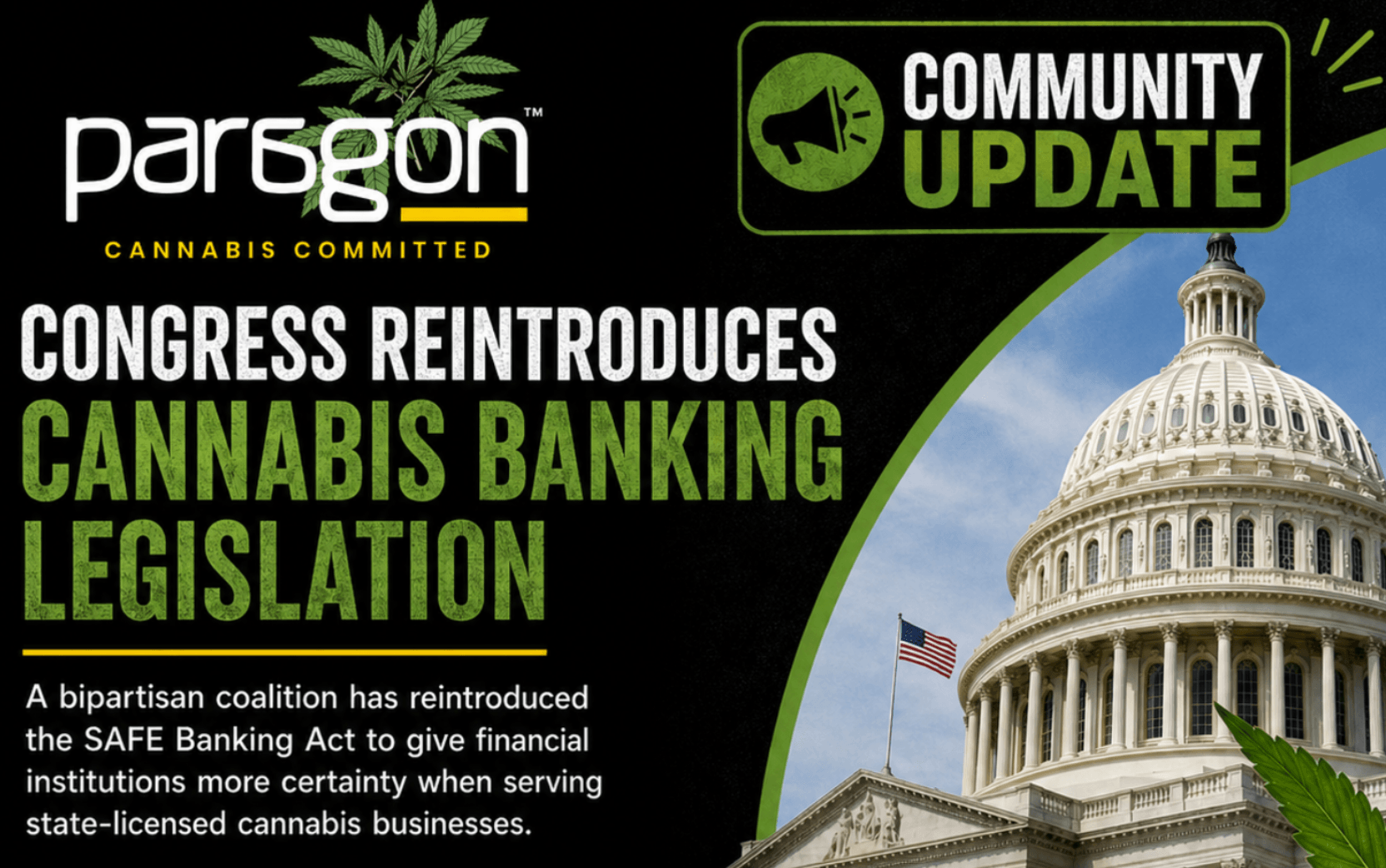
SAFE BANKING POLICY UPDATE: JUNE 25, 2026
Federal cannabis policy is back in the headlines.
Again.
A bipartisan group of lawmakers has reintroduced the Secure and Fair Enforcement (SAFE) Banking Act, legislation intended to address one of the cannabis industry's longest-running operational challenges: access to financial services.
If you've been following cannabis policy for several years, you may have had the same reaction many business owners did when this news broke:
"Haven't we heard this before?"
The honest answer is yes.
Previous versions of cannabis banking legislation have been introduced before. Some advanced further than others. None ultimately became federal law.
So what makes this announcement worth paying attention to?
Not because your business needs to change anything today.
It doesn't.
But because the reintroduction of the SAFE Banking Act signals that Congress continues to revisit one of the industry's most persistent challenges—one that affects banking relationships, operational planning, employee safety, payroll logistics, and long-term business growth.
The key is understanding what has happened, what hasn't happened, and what this news actually means for your business today.
That's exactly what this article is designed to explain.
🚨 Breaking News Notice
As of the publication date of this article, the SAFE Banking Act has been introduced in Congress but has not become law.
Proposed legislation may be amended, delayed, or fail to advance during the legislative process. This article reflects publicly available information available at the time of publication and is intended for educational purposes only.
We'll update this article if significant legislative developments occur.
SAFE Banking Act At a Glance
| Question | Current Status (June 2026) |
|---|---|
| Has Congress introduced the SAFE Banking Act? | ✅ Yes |
| Has it become law? | ❌ No |
| Does this legalize marijuana? | ❌ No |
| Does this change marijuana's federal classification? | ❌ No |
| Is this the same as marijuana rescheduling? | ❌ No. These are separate federal processes. |
| Should businesses change operations today? | ❌ No. Continue following current laws and regulations. |
| Why is this important? | If enacted, the legislation could provide greater legal certainty for qualifying financial institutions serving state-licensed cannabis businesses. |
Executive Summary of What's Going on As of June 25, 2026
If you're looking for the short version, here it is.
Congress has reintroduced the SAFE Banking Act.
The bill is intended to provide certain federal protections for qualifying financial institutions that choose to provide financial services to state-licensed cannabis businesses.
Nothing changes today.
Current banking regulations remain in effect.
Current payroll requirements remain in effect.
Current employment laws remain in effect.
Current state cannabis regulations remain in effect.
That doesn't make this development unimportant.
It simply means this is the beginning of another legislative process, not the end of one.
Understanding the distinction can help cannabis businesses make informed decisions without reacting prematurely to breaking headlines.
Current Legislative Status
As of June 2026:
✔ The SAFE Banking Act has been introduced in both the U.S. Senate and the U.S. House of Representatives.
✔ The bill is proposed legislation.
✔ Congress has not passed the bill.
✔ The legislation has not been signed into law.
✔ Existing federal banking rules remain in effect.
✔ Federal marijuana rescheduling proceedings continue separately and are not determined by the SAFE Banking Act.
Who Should Read This?
This article is written for anyone responsible for operating, supporting, or advising a licensed cannabis business, including:
- Cannabis business owners
- Dispensary operators
- Cultivators
- Manufacturers
- Cannabis HR professionals
- Payroll administrators
- Finance leaders
- Cannabis employees
- Ancillary businesses
- Investors monitoring federal cannabis policy
Whether you're opening your first dispensary or managing operations across multiple states, understanding the broader policy landscape can help you make more informed decisions.

Why This Matters
At first glance, a banking bill may sound like something that only banks care about.
In reality, banking affects nearly every aspect of operating a regulated cannabis business.
Access to financial services can influence how businesses:
- Manage day-to-day operations.
- Pay vendors.
- Process payroll.
- Handle cash.
- Plan for expansion.
- Build relationships with lenders and financial institutions.
While some banks and credit unions already serve state-licensed cannabis businesses, access varies considerably depending on the institution, state, regulatory requirements, and each institution's risk tolerance.
Supporters of the SAFE Banking Act argue that the legislation could reduce legal uncertainty for financial institutions that choose to serve licensed cannabis businesses.
Whether the bill ultimately becomes law remains to be seen.
For now, understanding the proposal—and separating confirmed facts from speculation—is the most valuable thing business owners can do.
What This Means
The SAFE Banking Act is important news.
It is not a change in current law.
If you're running a cannabis business today, your compliance responsibilities remain the same as they were yesterday.
That's why the smartest approach is to stay informed while continuing to operate in accordance with current federal, state, and local requirements.
How We Researched This Article
Cannabis legislation evolves quickly.
To prepare this educational update, we reviewed publicly available legislative information, official government resources where available, public statements from lawmakers, and reporting from established cannabis policy journalists.
Throughout this article, we've intentionally distinguished between:
- Confirmed facts
- What the bill proposes
- Potential business implications if enacted
- Areas that remain uncertain
Our goal isn't to predict what Congress will do.
Our goal is to help cannabis businesses understand what today's news actually means.
What Happened?
On June 25, 2026, a bipartisan group of lawmakers reintroduced the Secure and Fair Enforcement (SAFE) Banking Act in both the U.S. Senate and the U.S. House of Representatives.
The legislation is intended to address one of the cannabis industry's most persistent challenges: limited access to traditional financial services for businesses operating legally under state law but within a federal legal framework where marijuana remains prohibited.
The bill is led in the Senate by Sen. Jeff Merkley (D-OR) with bipartisan support from lawmakers including Sens. Lisa Murkowski (R-AK), Elizabeth Warren (D-MA), and Steve Daines (R-MT). A bipartisan companion bill has also been introduced in the House of Representatives.
It's important to understand what this announcement represents.
Congress has introduced legislation, not enacted it.
Like any federal bill, it must still move through the legislative process before any provisions possibly could take effect.
What This Means
This announcement is a meaningful policy development, but it is not an operational change.
If you're running a cannabis business today:
- Your payroll obligations have not changed.
- Your banking relationship has not automatically changed.
- Your tax obligations have not changed.
- Your state licensing requirements have not changed.
Think of this announcement as the beginning of another chapter in the federal legislative process, not the final chapter.
What Is the SAFE Banking Act?
The SAFE Banking Act is proposed federal legislation designed to provide certain legal protections for qualifying financial institutions that choose to provide financial services to state-licensed cannabis businesses.
Today, marijuana remains federally prohibited under the Controlled Substances Act, even though many states have legalized medical cannabis, adult-use cannabis, or both.
That difference between state law and federal law has contributed to a banking environment where some financial institutions choose to serve cannabis businesses while others determine the regulatory risks, compliance obligations, or business considerations are too significant.
If enacted, the SAFE Banking Act would generally prohibit federal banking regulators from taking certain adverse actions against qualifying financial institutions solely for providing financial services to legitimate, state-licensed cannabis businesses. It would also preserve existing anti-money laundering and Bank Secrecy Act compliance obligations rather than eliminating them.
In other words, the bill is focused on banking protections—not federal legalization.
What This Means
One of the biggest misconceptions surrounding the SAFE Banking Act is that it would "legalize cannabis."
It would not.
Even if enacted, the bill would not:
- Federally legalize marijuana.
- Automatically reschedule marijuana.
- Eliminate IRS Section 280E.
- Require every bank or credit union to serve cannabis businesses.
- Remove state licensing requirements.
Instead, it is designed to address one specific issue: reducing certain federal regulatory barriers for financial institutions that choose to work with state-licensed cannabis businesses.
Why Is Cannabis Banking Still So Complicated?
This is one of the questions we hear most often.
Many people assume cannabis businesses simply "can't get a bank account."
The reality is more nuanced.
Today, some banks and credit unions already provide financial services to state-licensed cannabis businesses. Others choose not to.
Why?
Because financial institutions operate under federal banking laws and regulations. Since marijuana remains federally prohibited, institutions that choose to serve cannabis businesses often face additional compliance obligations, enhanced due diligence, ongoing monitoring requirements, and business risk considerations.
That means access to banking can vary depending on:
- The financial institution.
- The state where the business operates.
- The institution's compliance program.
- The services being requested.
- The institution's overall risk tolerance.
Some businesses maintain long-standing banking relationships.
Others experience account closures, limited service options, higher fees, or difficulty finding institutions willing to serve the industry.
Supporters of the SAFE Banking Act argue that greater legal certainty could encourage broader participation by financial institutions, but participation would still remain a business decision for each institution.
Federal Law vs. State Law
One reason cannabis banking continues to generate confusion is that two legal systems are operating at the same time.
Under State Law
Many states have established regulated cannabis markets that authorize licensed businesses to cultivate, manufacture, distribute, test, transport, or sell cannabis.
Under Federal Law
Marijuana remains federally prohibited under the Controlled Substances Act.
That difference creates additional legal and compliance considerations for federally regulated financial institutions.
The SAFE Banking Act does not eliminate that distinction.
Instead, if enacted, it would create certain protections for financial institutions that choose to serve businesses operating legally under applicable state cannabis laws.
What This Means
Understanding the difference between state legality and federal legality is essential.
Many cannabis businesses are operating legally under state law today.
At the same time, federal law continues to shape how banks, credit unions, insurers, lenders, and regulators approach the industry.
That's why proposed federal banking legislation receives so much attention; it addresses one piece of a much larger regulatory landscape.
What We Know Today
Based on publicly available information and the bill as introduced, we know the following:
- Congress has reintroduced the SAFE Banking Act.
- The legislation has bipartisan sponsorship.
- The bill is intended to provide protections for qualifying financial institutions serving state-licensed cannabis businesses.
- Existing banking compliance requirements under laws such as the Bank Secrecy Act would continue to apply.
- The legislation has not become law.
- Existing federal banking rules remain in effect today.
- Marijuana rescheduling remains a separate federal administrative process.
What We Don't Know Yet
Because the legislative process is ongoing, several important questions remain unanswered.
At the time of publication, no one can accurately predict:
- Whether the bill will advance through committee.
- Whether lawmakers will amend the bill.
- Whether both chambers will pass the same version.
- Whether the legislation will be signed into law.
- When any enacted provisions would take effect.
- Whether federal banking regulators would issue additional implementation guidance following enactment.
That's why businesses should continue to make operational decisions based on current law, not on proposed legislation.
What Does This Mean for Cannabis Businesses?
If you've made it this far, you probably understand the biggest takeaway:
The SAFE Banking Act has been reintroduced—but it hasn't changed the law.
The next question most business owners ask is:
"So...does this affect my business?"
The answer depends on what you're asking.
Let's break it down.
Does This Change Payroll?
Short answer: No.
One of the biggest misconceptions surrounding federal cannabis banking legislation is that it somehow changes how employers process payroll.
It doesn't.
Whether the SAFE Banking Act becomes law this year, next year, or not at all, employers are still responsible for complying with existing payroll and employment laws.
That includes:
- Paying employees accurately and on time.
- Withholding and remitting payroll taxes.
- Complying with federal, state, and local wage-and-hour laws.
- Calculating overtime correctly.
- Maintaining payroll records.
- Filing required payroll tax forms.
- Administering benefits in accordance with applicable laws.
These responsibilities exist regardless of federal banking legislation.
What This Means
Waiting for Congress is not a payroll strategy.
Cannabis employers should continue to operate in accordance with current payroll requirements while monitoring legislative developments.
If banking laws eventually change, they may influence certain operational workflows—but they won't replace an employer's core payroll obligations.
Does This Change HR?
Again—
No. Not as it stands.
The SAFE Banking Act is focused on financial institutions—not employment law.
That means employers still need to comply with:
- Hiring requirements.
- Employee onboarding.
- Timekeeping.
- Wage compliance.
- Paid leave laws.
- Workplace policies.
- Recordkeeping.
- Employee classifications.
If you're an HR professional, tomorrow should look very similar to yesterday from a compliance perspective.
What This Means
While policy headlines can be distracting, HR teams should continue focusing on the things they can control:
- Supporting employees.
- Maintaining documentation.
- Training managers.
- Staying compliant.
- Building scalable HR processes.
Federal banking legislation doesn't change those priorities.
Does This Affect IRS Section 280E?
No.
This is one of the most common misconceptions we see online.
The SAFE Banking Act and Internal Revenue Code Section 280E are separate areas of federal law.
Section 280E affects how certain cannabis businesses calculate federal taxable income.
The SAFE Banking Act addresses protections for qualifying financial institutions serving state-licensed cannabis businesses.
The introduced legislation does not repeal or amend Section 280E.
What This Means
Businesses should continue planning for existing federal tax obligations unless Congress separately changes federal tax law.
Should Cannabis Businesses Change Banks?
Probably not—
At least not because this bill was introduced.
Every cannabis business has different operational needs.
Some companies already have strong banking relationships.
Others continue searching for institutions that understand the cannabis industry.
The reintroduction of the SAFE Banking Act does not automatically change your existing banking relationship.
Instead, businesses should continue evaluating financial partners based on:
- Current services.
- Compliance experience.
- Fees.
- Customer support.
- Operational needs.
- Guidance from qualified legal and financial professionals.
Questions to Ask Your Financial Institution
Rather than assuming anything has changed, consider asking your bank or credit union:
- Do you currently serve state-licensed cannabis businesses?
- Has anything changed regarding your cannabis banking program?
- Are there additional compliance requirements?
- How often are cannabis accounts reviewed?
- Do you support ACH payroll processing?
- Are there restrictions I should know about?
Having these conversations can provide more practical insight than relying on headlines alone.
What Hasn't Changed?
Sometimes understanding what didn't happen is just as important as understanding what did.
As of today:
✅ Marijuana remains federally prohibited.
✅ Existing federal banking rules remain in effect.
✅ Existing payroll laws remain in effect.
✅ Existing HR compliance requirements remain in effect.
✅ State cannabis licensing requirements remain in effect.
✅ Federal tax obligations remain in effect.
In other words:
Businesses should continue operating according to today's laws, not tomorrow's possibilities.
Myth vs. Fact
Myth
"The SAFE Banking Act legalizes marijuana."
Fact
No.
The bill focuses on banking protections for qualifying financial institutions.
It does not federally legalize cannabis.
Myth
"Every cannabis business will automatically get a bank account."
Fact
No.
Financial institutions would still make independent business decisions regarding which customers they serve.
Myth
"The SAFE Banking Act eliminates IRS Section 280E."
Fact
No.
The bill does not amend or repeal Section 280E.
Myth
"This changes payroll requirements."
Fact
No.
Payroll laws remain the same regardless of the bill's status.
Myth
"This is the same thing as marijuana rescheduling."
Fact
No.
Rescheduling and banking reform are two separate federal processes.
Practical Next Steps for Cannabis Businesses
Legislation may change over time.
Running your business can't wait.
Here are a few practical steps businesses can take today.
Review Your Payroll Processes
Ensure payroll remains accurate, compliant, and well-documented.
Review Your Banking Relationship
Understand your institution's current cannabis banking policies and ask questions if anything is unclear.
Stay Informed
Follow reputable sources rather than relying on social media speculation.
Review Internal Controls
Evaluate cash-handling procedures, recordkeeping, and compliance documentation on a regular basis.
Talk With Qualified Professionals
If proposed legislation could affect your business strategy, discuss it with your attorney, CPA, financial institution, or other qualified advisors before making significant decisions.
Paragon Payroll's Perspective
At Paragon Payroll, we know headlines can create both excitement and uncertainty.
That's why we believe our responsibility extends beyond processing payroll.
Our job is to help cannabis businesses understand how policy changes, or proposed policy changes, intersect with the day-to-day realities of running a compliant business.
We'll never tell you to panic because of a headline.
We'll never tell you legislation is guaranteed to pass.
And we'll never present proposed changes as settled law.
Instead, we'll continue doing what we've always believed in:
Helping cannabis businesses separate signal from noise, understand what today's developments actually mean, and make informed decisions based on current law, not speculation.
The cannabis industry has never lacked resilience. Businesses have continued hiring, serving patients and consumers, paying employees, and navigating complex regulations through years of policy uncertainty. While we believe it's important to stay informed about proposed legislation like the SAFE Banking Act, we also believe it's equally important not to lose sight of the work that continues today. Our commitment is to help cannabis employers succeed under the laws that exist now while preparing thoughtfully for the laws that may come next.
SAFE Banking Act: What Changes Today?
| Changes Today | Doesn't Change Today |
|---|---|
| Congress has introduced the bill | Payroll laws |
| Federal discussion continues | HR compliance |
| Businesses should stay informed | Tax obligations (including 280E) |
| Industry monitoring increases | State licensing requirements |
| Potential future policy conversations | Current banking relationships |
Know the facts. Plan for today. Stay ready for tomorrow. Let's Talk!
Frequently Asked Questions
Is the SAFE Banking Act Law?
No.
As of the publication date of this article, the SAFE Banking Act has been introduced in Congress but has not become law. Businesses should continue complying with existing federal, state, and local laws until any legislation is enacted.
Does the SAFE Banking Act legalize marijuana?
No.
The SAFE Banking Act is banking legislation. It does not federally legalize marijuana or change its classification under the Controlled Substances Act.
Is the SAFE Banking Act the same as marijuana rescheduling?
No.
These are two separate federal processes.
- SAFE Banking Act: Proposed legislation considered by Congress.
- Marijuana Rescheduling: An administrative process involving federal agencies.
Progress in one process does not automatically determine the outcome of the other.
Does this bill change payroll requirements?
No.
Employers remain responsible for payroll taxes, wage compliance, employee classification, recordkeeping, and other employment obligations regardless of the bill's status.
Does the SAFE Banking Act eliminate IRS Section 280E?
No.
The legislation does not amend or repeal Internal Revenue Code Section 280E.
Should I change banks because of this news?
Not solely because the legislation has been introduced.
Businesses should evaluate financial institutions based on current services, compliance experience, operational needs, and advice from qualified professionals.
Do cannabis businesses already have access to banking?
Some do.
Several banks and credit unions currently provide financial services to licensed cannabis businesses.
However, access varies considerably depending on the institution, jurisdiction, and compliance requirements.
Will every bank have to serve cannabis businesses if this passes?
No.
If enacted, the legislation would provide protections for qualifying financial institutions that choose to serve state-licensed cannabis businesses. It would not require every bank or credit union to participate.
Does this affect cannabis employees?
The introduced legislation includes proposed provisions related to certain federally backed mortgage programs for eligible cannabis industry workers. However, those provisions would only take effect if the legislation becomes law.
Where can I track the bill?
The most reliable source is Congress.gov, which provides official legislative status, bill text, and congressional activity.
Glossary: Fast Facts Cannabis Terms
ACH (Automated Clearing House)
An electronic network used by financial institutions to transfer funds between bank accounts.
Cannabis Banking
Financial services provided to businesses operating within the regulated cannabis industry, including deposit accounts, payment processing, lending, and treasury services.
FinCEN
The Financial Crimes Enforcement Network, a bureau of the U.S. Department of the Treasury responsible for administering and enforcing anti-money laundering regulations.
SAFE Banking Act
Proposed federal legislation intended to provide protections for qualifying financial institutions that choose to serve state-licensed cannabis businesses.
Section 280E
A section of the Internal Revenue Code that limits certain federal tax deductions for businesses trafficking Schedule I or II controlled substances.
State-Licensed Cannabis Business
A cannabis business authorized to operate under applicable state law.
Helpful Resources
For readers who want to follow developments directly, we recommend starting with these authoritative sources:
Government Resources
- Congress.gov (Track the SAFE Banking Act): https://www.congress.gov
- Financial Crimes Enforcement Network (FinCEN): https://www.fincen.gov
- U.S. Department of the Treasury: https://home.treasury.gov
- National Conference of State Legislatures (NCSL): https://www.ncsl.org
Industry Resources
- Marijuana Moment (Original reporting on the June 2026 announcement): https://www.marijuanamoment.net
- National Cannabis Industry Association (NCIA): https://thecannabisindustry.org
- Cannabis Regulators Association (CANNRA): https://www.cann-ra.org
Where Paragon Payroll Fits
Legislation changes.
Compliance doesn't.
Whether Congress passes the SAFE Banking Act this year, next year, or not at all, cannabis employers still have employees to pay, payroll taxes to file, labor laws to follow, and HR responsibilities to manage.
At Paragon Payroll, our role isn't to predict legislation or provide legal advice.
Our role is to help licensed cannabis businesses confidently navigate payroll, HR, workforce management, and compliance under today's laws while staying informed about tomorrow's changes.
We believe education is part of good service.
When important policy developments occur, we'll continue translating complex legislative updates into practical guidance designed to help cannabis businesses make informed decisions, not fearful ones.
Best Next Steps
While Congress continues debating federal cannabis banking legislation, here's what you can do today:
✔ Continue operating according to current federal, state, and local laws.
✔ Review your payroll and HR processes to ensure they remain compliant.
✔ Maintain open communication with your financial institution about your banking relationship.
✔ Consult qualified legal, tax, or financial professionals before making business decisions based on proposed legislation.
✔ Stay informed using reputable government and industry sources—not social media rumors.
About This Guide
Our goal is simple:
Help cannabis businesses understand complex policy developments in plain language while distinguishing between current law, proposed legislation, and industry speculation.
We'll update this guide as significant developments occur.
Educational & Legislative Disclaimer
This article is provided for general educational and informational purposes only.
It summarizes publicly available information regarding proposed federal legislation as of the publication date and should not be interpreted as legal, tax, accounting, banking, employment, or regulatory advice.
Legislation may be amended, delayed, or fail to become law. Any discussion of potential impacts reflects publicly available information and the bill as introduced. Businesses should consult qualified legal counsel, tax professionals, financial advisors, banking professionals, or other appropriate experts before making decisions based on pending legislation.
Paragon Payroll provides payroll, HR, and workforce management solutions. We do not provide legal representation, tax advice, banking services, or regulatory determinations.
We'll Continue Watching This Story
Cannabis policy doesn't stand still—and neither do we.
As Congress considers the SAFE Banking Act and other federal cannabis legislation, we'll continue to monitor developments and update this article as meaningful changes occur.
If you're looking for practical cannabis payroll, HR, compliance, and workforce insights—not just headlines—subscribe to The Paragonian and follow Paragon Payroll on LinkedIn for future Cannabis Policy Updates.
What's Next for the SAFE Banking Act?
Bill Introduced │ ▼ Committee Consideration │ ▼ Possible Amendments │ ▼ House & Senate Votes │ ▼ Presidential Action │ ▼ If Enacted → Implementation Key Message: Today's announcement marks the beginning of the legislative process—not the end. We'll continue updating this guide as the story develops.
Editor's Note
Source Attribution: This article is an original educational analysis by Paragon Payroll based on publicly available legislative information and reporting available as of June 2026. Primary reporting on the bill's reintroduction was published by Marijuana Moment. We encourage readers to review the original reporting and official legislative materials alongside this summary.
