

Can QuickBooks Drop Your Cannabis Business? What Its Payroll Restrictions Really Mean?
October 28th, 2026
12 min read
By Paragon
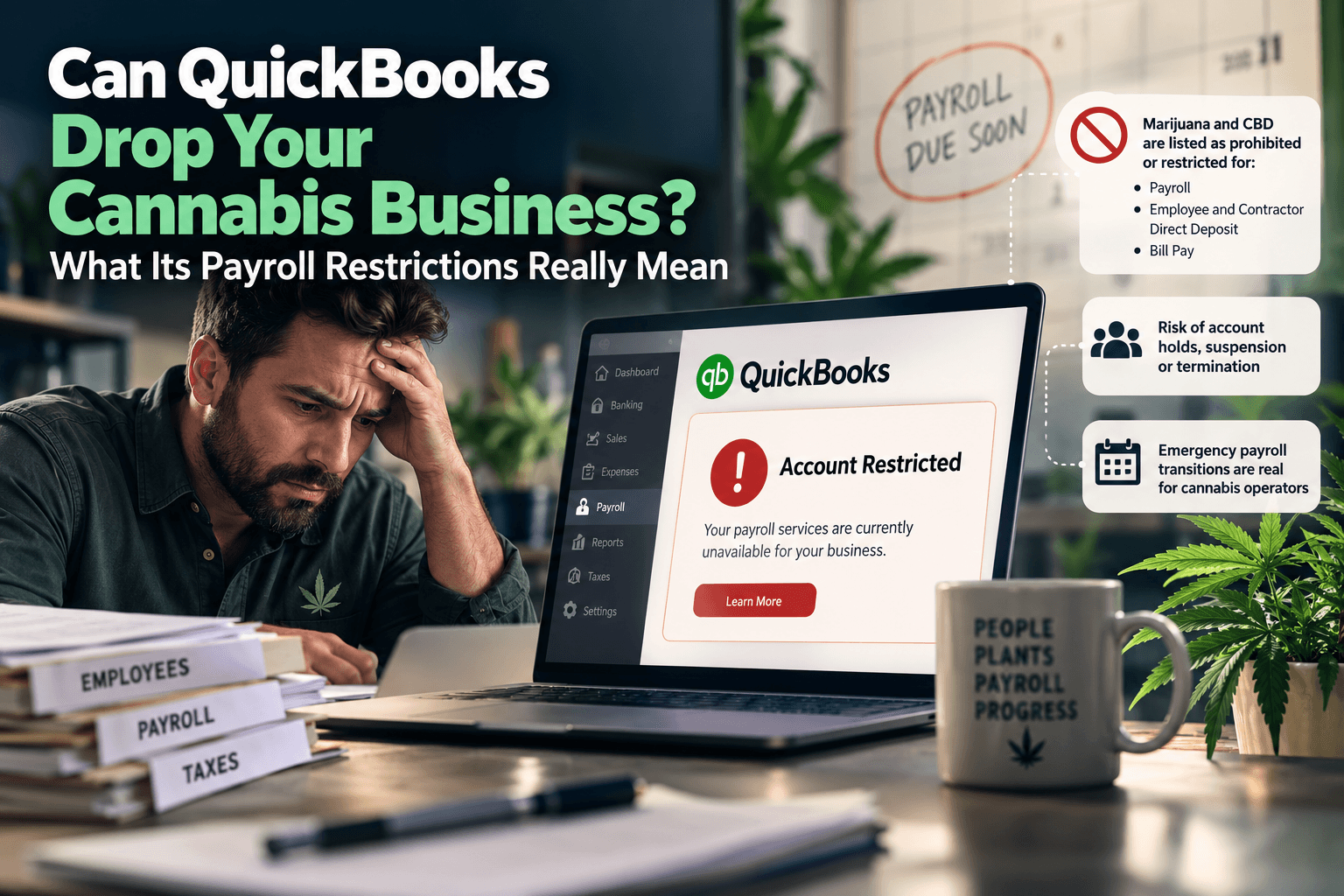
Using QuickBooks Payroll for your cannabis business? Intuit's own policies identify marijuana and CBD as prohibited or restricted categories for certain financial services. Here's what that means, why cannabis operators are seeking emergency payroll relief, and what you can do before your next payday becomes a crisis.
Imagine running a cannabis business where everything is going according to plan.
Your employees are scheduled. Your payroll is approved. Your dispensary is open, your cultivation team is working, and your next payday is approaching.
Then comes an email you weren't expecting.
Your payroll account is under review. Your services are restricted. Or worse, you're being told that your payroll provider can no longer support your business.
Suddenly, the question isn't whether you like your payroll software.
It's whether your employees are going to get paid.
At Paragon Payroll, we've had conversations with cannabis operators who came to us needing urgent assistance after losing access to their previous payroll provider, including QuickBooks.
And while the circumstances behind individual account decisions can vary, there's something we believe every cannabis employer deserves to know:
Intuit's own published policy identifies marijuana and CBD as prohibited or restricted business categories for certain payroll-related services.
That's not speculation. It's information Intuit makes publicly available.
So why are cannabis businesses still relying on these services? What happens when an account is restricted? And what does cannabis rescheduling actually change?
Let's talk about it.
Does QuickBooks Allow Cannabis Businesses to Use Payroll?
The answer requires understanding an important distinction.
QuickBooks offers several different products and services, including accounting software, payroll, direct deposit, bill payments, and merchant payment processing.
Those services aren't necessarily governed by identical eligibility requirements.
A cannabis business using QuickBooks to maintain its books is not necessarily in the same position as a cannabis business relying on QuickBooks to move money for employee payroll.
That's where Intuit's Acceptable Use Policy becomes particularly important.
What Intuit's Own Policy Says About Marijuana and CBD
Intuit publishes a list of prohibited and restricted business types or activities, identifying which financial services the restrictions apply to.
The policy, displaying an effective date of June 27, 2024, includes the following entry:
| Prohibited or restricted business category | Payroll, Employee and Contractor Direct Deposit, Bill Pay | Merchant Payment Processing |
|---|---|---|
| Marijuana and CBD | ✓ | ✓ |
Source: Intuit Acceptable Use Policy — Prohibited and Restricted Business Types or Activities
Take a moment to consider what those two checkmarks mean.
The first identifies marijuana and CBD in connection with payroll-related financial services, including employee and contractor direct deposit and Bill Pay.
The second identifies marijuana and CBD in connection with merchant payment processing.
In other words, this isn't simply about whether a dispensary can accept credit card payments.
Intuit's published restrictions also extend to the financial services cannabis employers may rely on to pay their employees.
That distinction deserves attention.
Does This Mean Every Cannabis Business Using QuickBooks Will Be Dropped?
Not necessarily.
The policy does not establish that every cannabis business currently using QuickBooks Payroll will automatically be terminated.
It also doesn't tell us whether a particular operator has received an exception, been approved for certain services, or is subject to additional account-specific requirements.
What it does establish is that marijuana and CBD are explicitly identified within Intuit's prohibited or restricted categories for the listed services.
And that creates a question every cannabis employer should be asking:
If your business falls within a category your payroll provider publicly identifies as prohibited or restricted, what assurances do you actually have about continued service?
It's a question worth answering before an unexpected payroll deadline forces the issue.
Can QuickBooks Suspend or Terminate Payroll Services?
Yes. Intuit's published terms and support documentation describe circumstances in which covered services may be restricted, suspended, or terminated.
Its QuickBooks Online terms explain that access to payroll payment functionality depends on eligibility and verification requirements, and that certain payroll payment capabilities can be revoked.
Intuit also requires business identity verification for relevant financial services. Its support documentation explains that failing to complete requested verification by the deadline can result in interruption or termination of certain services.
And in a separate support article addressing urgent payroll account holds, Intuit explains that an account under review may be unable to create new payroll or contractor payments.
For an employer, that distinction matters.
A payroll account doesn't necessarily need to disappear entirely for the business to face a serious disruption.
If direct deposit is unavailable, payroll funding is restricted, or a scheduled payment cannot proceed as expected, the employer still needs to determine how employees will be paid.
Intuit's guidance describes circumstances in which affected businesses may need to issue manual checks or take responsibility for tax payments.
A payroll interruption doesn't become less urgent simply because the underlying software account remains open.
It's important to clarify that these verification and account-hold examples are not, by themselves, evidence of cannabis-specific enforcement. They demonstrate the operational consequences that certain service restrictions can create.
Sources: Intuit QuickBooks Online Terms, Business Identity Verification Guidance, and Urgent Payroll Account Holds.
Why Would QuickBooks Restrict a Cannabis Business That's Legal in Its State?
Because state legalization and eligibility for financial services are two different things.
A dispensary can hold a valid state license.
A cultivator can operate within its state's regulatory framework.
A cannabis manufacturer can employ a fully compliant workforce and meet its state reporting requirements.
None of those facts automatically requires a private financial services provider to accept the business.
Cannabis operators have been navigating this disconnect for years.
Financial services companies may evaluate businesses based on federal law, banking relationships, regulatory obligations, internal risk policies, and contractual requirements.
And those requirements don't always align with the rules governing a state-licensed cannabis operation.
Intuit's own documentation identifies marijuana and CBD among the types of products or services that can contribute to an application being declined for QuickBooks Payments.
That's not a blanket explanation for every QuickBooks payroll account decision, but it provides further evidence that cannabis-related business activity is relevant to Intuit's financial services eligibility framework.
Being licensed to operate your cannabis business doesn't automatically mean every payroll or payment provider is willing or able to serve it.
That's why we encourage cannabis employers to evaluate more than software functionality when selecting a payroll provider.
The provider's willingness and ability to support your industry matters just as much.
Source: Intuit — Next Steps After Signing Up for QuickBooks Payments.
But What About Cannabis Rescheduling? Doesn't That Change Everything?
Not when it comes to automatically guaranteeing payroll access.
Federal cannabis reform has generated significant attention, and understandably so. Changes in marijuana's federal scheduling can carry important implications for businesses, taxation, research, and regulation.
But there is a distinction between rescheduling and legalization.
And there's another distinction between federal regulatory changes and a private company's decision to provide financial services.
As of October 2026, federal marijuana scheduling has undergone several developments, including a narrower Schedule III action involving specified medical marijuana products, while the broader rescheduling process remains subject to further administrative proceedings.
These developments should not be confused with a blanket federal legalization of state-licensed adult-use cannabis businesses.
More importantly, even broader rescheduling would not automatically require QuickBooks, its financial services partners, or other private payroll providers to accept every cannabis business.
Their applicable terms, eligibility requirements, and financial compliance obligations would still matter.
For cannabis operators, the practical takeaway is simple:
A change in federal scheduling does not automatically change your payroll provider's policies.
And no matter what happens in Washington, your employees still need to be paid on time.
Sources: DEA Marijuana Rescheduling Regulatory Actions and DEA Diversion Control — Marijuana.
We're Seeing It Firsthand: Cannabis Businesses Coming to Paragon for Emergency Payroll Relief
For some cannabis businesses, this isn't a hypothetical concern.
It's already become an emergency.
At Paragon Payroll, we've seen operators come to us after being dropped by their previous payroll provider, including QuickBooks.
And one of the most frustrating parts of these conversations is how often the business wasn't planning to switch providers in the first place.
They weren't necessarily comparing payroll platforms.
They weren't looking for a new dashboard.
They weren't shopping for additional features.
They believed their payroll arrangement was working.
Until they found themselves needing another solution.
Suddenly, what should have been a planned business decision became an urgent operational problem.
Instead of asking about pricing and functionality, these operators are asking:
- Can you help us before our next payday?
- What happens to the payroll taxes we've already paid?
- How quickly can we transfer our employees?
- What happens if our direct deposits don't process?
- Can we preserve our historical payroll records?
- How do we make sure this doesn't happen again?
These are not small concerns.
For a cannabis employer, payroll disruption can affect employee confidence, operational continuity, tax obligations, and the business owner's ability to focus on running the company.
And there's something particularly difficult about having to explain an industry you've spent years building to a new provider while you're racing against a payroll deadline.
Emergency Payroll Relief Shouldn't Be Your First Introduction to a Cannabis-Focused Provider
When an operator contacts Paragon in an emergency, the conversation starts with understanding their immediate circumstances.
When is their next payroll?
What services are still available?
What has the previous provider communicated?
Which employee and payroll records can be accessed?
Are there outstanding tax payments, filings, or deductions that need attention?
What needs to happen before a responsible transition can take place?
We don't believe in promising that every payroll emergency can be resolved overnight. Banking verification, tax setup, employee data, and implementation requirements still matter.
But we do believe cannabis businesses deserve to speak with a team that understands the industry and can help them evaluate realistic next steps.
We would rather have a conversation with an operator six months before a payroll emergency than six hours before their next payday.
And that's why we're writing this article.
Not to frighten businesses into changing providers.
But because we've spoken with operators who didn't realize they needed a backup plan until they were already searching for emergency relief.
Why We Don't Consider QuickBooks a Direct Cannabis Payroll Competitor
This might sound unusual coming from a payroll company.
But we don't really view QuickBooks as a direct competitor in the cannabis payroll market.
Not because QuickBooks isn't a recognizable and widely used platform.
And not because its accounting software doesn't serve important business needs.
It's because there's a difference between offering payroll to the general small-business market and intentionally building a payroll business around cannabis employers.
QuickBooks serves businesses across many industries.
Paragon has spent the last decade intentionally supporting cannabis operators.
That distinction matters.
Cannabis employers face unique operational circumstances involving banking, regulatory compliance, multi-state expansion, workforce management, and changing industry requirements.
Supporting those businesses requires more than making payroll software available.
It requires understanding the environment in which they operate.
It requires building relationships with the industry.
It requires education, advocacy, service, and a willingness to navigate challenges alongside operators.
And it requires being clear about whether your organization actually supports cannabis businesses.
When a company's published policies identify marijuana and CBD as prohibited or restricted categories for certain financial services, that's relevant to how cannabis operators should evaluate that provider.
It doesn't mean every QuickBooks product is unsuitable for every cannabis business.
But it does mean the conversation about cannabis payroll should start with eligibility and commitment, not just features.
There's a Difference Between Tolerating Cannabis and Being Cannabis Committed
We've said this before, and we'll keep saying it.
There's a difference between a company that happens to have cannabis customers and a company that has intentionally built its business to support the cannabis industry.
One may see cannabis as a category requiring special consideration.
The other sees cannabis as an industry worth investing in.
At Paragon, being Cannabis Committed means more than processing payroll.
It means helping educate operators.
It means participating in industry conversations.
It means supporting businesses as they navigate expansion, regulatory uncertainty, and workforce challenges.
And it means showing up when things get difficult, not just when business is easy.
We've been serving cannabis businesses since 2016.
That commitment didn't begin with rescheduling headlines, and it isn't dependent on federal legalization.
Cannabis isn't a temporary opportunity for Paragon. It's an industry we've chosen to stand beside.
"I've Used QuickBooks for Years Without a Problem. Why Should I Worry?"
First, we're glad your payroll is working.
Truly.
Nobody at Paragon wants another cannabis business to experience an unexpected interruption.
But there's an important difference between successful payroll processing and confirmed eligibility for continued service.
Your account may have been active for years.
Your employees may have received every paycheck.
You may never have been asked to submit additional documents or answer questions about your business.
Those are positive experiences.
But they don't, by themselves, resolve the question of how your business fits within a provider's published restrictions.
And that's where we'd encourage operators to think differently.
Don't ask only whether your payroll is working today.
Ask whether you've confirmed that your provider supports your specific business activities.
Ask whether your provider understands that you're operating a plant-touching cannabis business.
Ask what happens if its eligibility requirements or your business circumstances change.
And ask whether you have a plan if a critical payroll service becomes unavailable.
We're not suggesting every cannabis business using QuickBooks will eventually be dropped.
We're suggesting you shouldn't have to rely on luck, assumptions, or the absence of a problem to feel confident about payroll.
Especially when your employees depend on it.
What Should You Do If QuickBooks Has Already Dropped Your Payroll?
If you've received a restriction, suspension, or termination notice, the first priority is determining exactly what has changed and what obligations remain outstanding.
The following steps can help you organize an emergency transition.
1. Confirm Which Services Are Affected
Ask QuickBooks whether the restriction applies to payroll processing, direct deposit, payroll tax payments, or other connected services.
Also confirm the effective date and the status of any pending transactions.
Don't assume that an account hold means every service has ended, or that an open software account means payroll money movement remains available.
2. Identify Your Next Payroll Deadline
Determine when employees must be paid and which payroll transactions are already in progress.
If direct deposit is unavailable, ask what alternative payment methods are supported and confirm the applicable state wage-payment requirements.
3. Secure Your Payroll Records
Gather the information a replacement provider may need, including employee details, wage and withholding information, year-to-date payroll totals, payroll tax records, deductions, and prior payroll reports.
Preserving accurate records is especially important when transitioning mid-quarter or mid-year.
4. Confirm Outstanding Payroll Tax Responsibilities
Find out which tax payments and filings your previous provider has completed, which remain pending, and what responsibilities will transfer to you or a new provider.
A change in payroll software does not eliminate the employer's underlying tax obligations.
5. Speak With a Provider That Explicitly Supports Cannabis
Be transparent about your business activities and explain the urgency.
Ask what documentation is required, how banking verification works, and what implementation timeline is realistic.
A qualified provider should help you evaluate the transition without promising an impossible deadline.
Need emergency cannabis payroll assistance? Contact Paragon Payroll to discuss your situation and available options.
Five Questions Every Cannabis Business Should Ask Its Payroll Provider
Even if you're not experiencing a problem today, these questions can help you evaluate your exposure before an emergency.
- Does your company explicitly support state-licensed, plant-touching cannabis businesses? Don't settle for a general answer about small businesses or accounting software.
- Are cannabis businesses eligible for your direct deposit and payroll tax payment services? Confirm the eligibility of the actual money movement services you depend on.
- Are there restrictions, approval requirements, or banking conditions specific to cannabis? Ask for written clarification wherever possible.
- What happens if my account is reviewed, restricted, or terminated? Understand the notice process, access to historical records, and responsibilities for pending payroll and taxes.
- If I need to change providers, what information will I need and how quickly can I transition? A continuity plan can reduce the pressure of an unexpected decision.
These aren't questions designed to make you suspicious of every vendor.
They're questions designed to help you make informed decisions about a critical part of your business.
Frequently Asked Questions About QuickBooks and Cannabis Payroll
Is marijuana prohibited by QuickBooks?
Intuit's Acceptable Use Policy lists marijuana and CBD under prohibited and restricted business categories for specified payroll-related services and merchant payment processing. Eligibility for a particular QuickBooks product or service should be evaluated under its applicable terms.
Can QuickBooks drop a cannabis business?
Intuit's terms describe circumstances in which covered services may be restricted, suspended, or terminated. Its marijuana and CBD policy entry is relevant to cannabis business eligibility, although individual account decisions depend on the circumstances and applicable terms.
Why does QuickBooks list marijuana and CBD under payroll and payment processing?
The policy identifies which service categories are subject to the listed restrictions. For marijuana and CBD, the relevant row is marked for both payroll-related services and merchant payment processing. Intuit does not provide a detailed, category-specific explanation in that table for every underlying reason.
Can a dispensary use QuickBooks for bookkeeping but another company for payroll?
Potentially. Accounting software and payroll money movement are different services. A cannabis business should review the applicable terms for each and confirm whether its accounting and payroll providers can support the required workflows.
Does cannabis rescheduling make QuickBooks Payroll safe for dispensaries?
Rescheduling does not automatically guarantee access to QuickBooks Payroll or require Intuit to change its policies. Operators should verify their specific eligibility rather than assuming federal regulatory developments resolve private financial service restrictions.
Will QuickBooks automatically close my account if it discovers I'm a cannabis business?
The published policy does not establish automatic termination in every case. However, cannabis appears in Intuit's prohibited or restricted categories for covered services, and Intuit's terms permit certain corrective actions. Operators should seek direct confirmation of their eligibility.
Can Paragon help if my cannabis business has already been dropped by QuickBooks?
Paragon specializes in payroll and HR services for cannabis employers. Our team can discuss your payroll deadlines, available records, tax setup, and implementation needs to help determine what transition options may be available.
How long does an emergency payroll transition take?
There is no guaranteed timeline. The process depends on the number of employees, availability and accuracy of historical records, tax setup, banking verification, and other implementation requirements. The earlier you begin planning, the more flexibility you may have.
Don't Wait Until Your Payroll Provider Makes the Decision for You
There's a reason we're having this conversation.
We've heard from cannabis operators who weren't planning to change payroll providers until they suddenly had to.
We've spoken with businesses trying to protect their employees from interrupted paychecks.
And we've seen how quickly a routine business function can become a source of uncertainty when the provider relationship changes unexpectedly.
We don't want that for your business.
If you're using QuickBooks Payroll and everything is running smoothly, we hope it stays that way.
But we also believe you deserve to understand the policies governing your account.
Because payroll shouldn't be something you have to cross your fingers about.
And cannabis businesses shouldn't have to wonder whether the company responsible for paying their employees is willing to support their industry.
At Paragon, we've made our position clear.
We've been Cannabis Committed since 2016.
Not because cannabis became a trending market.
Not because federal reform appeared on the horizon.
But because we believe the people building this industry deserve dependable payroll and HR support.
Your business has enough uncertainty to navigate. Your payroll provider shouldn't have to be one of them.
Dropped by QuickBooks? Worried You Could Be Next?
Whether you've already received a notice, are facing an upcoming payroll deadline, or simply want to understand your options before an emergency, we're here to talk.
Talk to Paragon About Your Cannabis Payroll Options
Because we'd rather help you prepare today than have to meet you in a panic tomorrow.
Sources and further reading:
- Intuit Acceptable Use Policy
- Intuit QuickBooks Online Terms of Service
- Intuit — Verify Your Business Identity for Payroll and Payment Services
- Intuit — Resolve an Urgent Payroll Account Issue
- Intuit — QuickBooks Payments Eligibility
- DEA — Marijuana Rescheduling Regulatory Actions
This article provides general educational information and is not legal or tax advice. Service eligibility and applicable requirements may vary by product, account, and circumstances.
Topics:
