

Cannabis payroll looks simple from the outside.
Employees work. You track hours. You pay them. Taxes get filed. Records get stored.
That is how payroll works in most industries.
But cannabis has never been “most industries.”
If you are an original operator, legacy advocate, new licensee, social equity applicant, dispensary owner, cultivator, processor, or cannabis entrepreneur trying to build something legitimate in 2026, you already know the truth:
This industry has had to fight harder for basic business services than almost anyone else.
Bank accounts. Insurance. Loans. Credit card processing. HR support. Payroll. 401(k) access. Benefits. Vendor trust. Compliance guidance.
Things other businesses take for granted have often been harder, more expensive, slower, or simply unavailable for cannabis businesses.
And even now, after years of legalization progress, discriminatory practices still show up quietly.
Sometimes it looks like a bank saying no without saying why.
Sometimes it looks like a payroll provider quietly dropping a cannabis client after learning what they do.
Sometimes it looks like higher pricing, limited support, vague risk language, or vendors who are “cannabis friendly” until the work gets complicated.
That is why cannabis payroll is different from traditional payroll.
Not because cannabis businesses are less professional.
Because the systems around them have historically treated them as if they were.
This guide breaks down what makes cannabis payroll different, what cannabis payroll requirements operators need to understand, why compliance matters so much, and what new licensees should know before choosing payroll or HR support.
The goal is not to scare you.
It is to give you the clarity many operators wish someone gave them earlier.
Quick Summary: How Cannabis Payroll Is Different
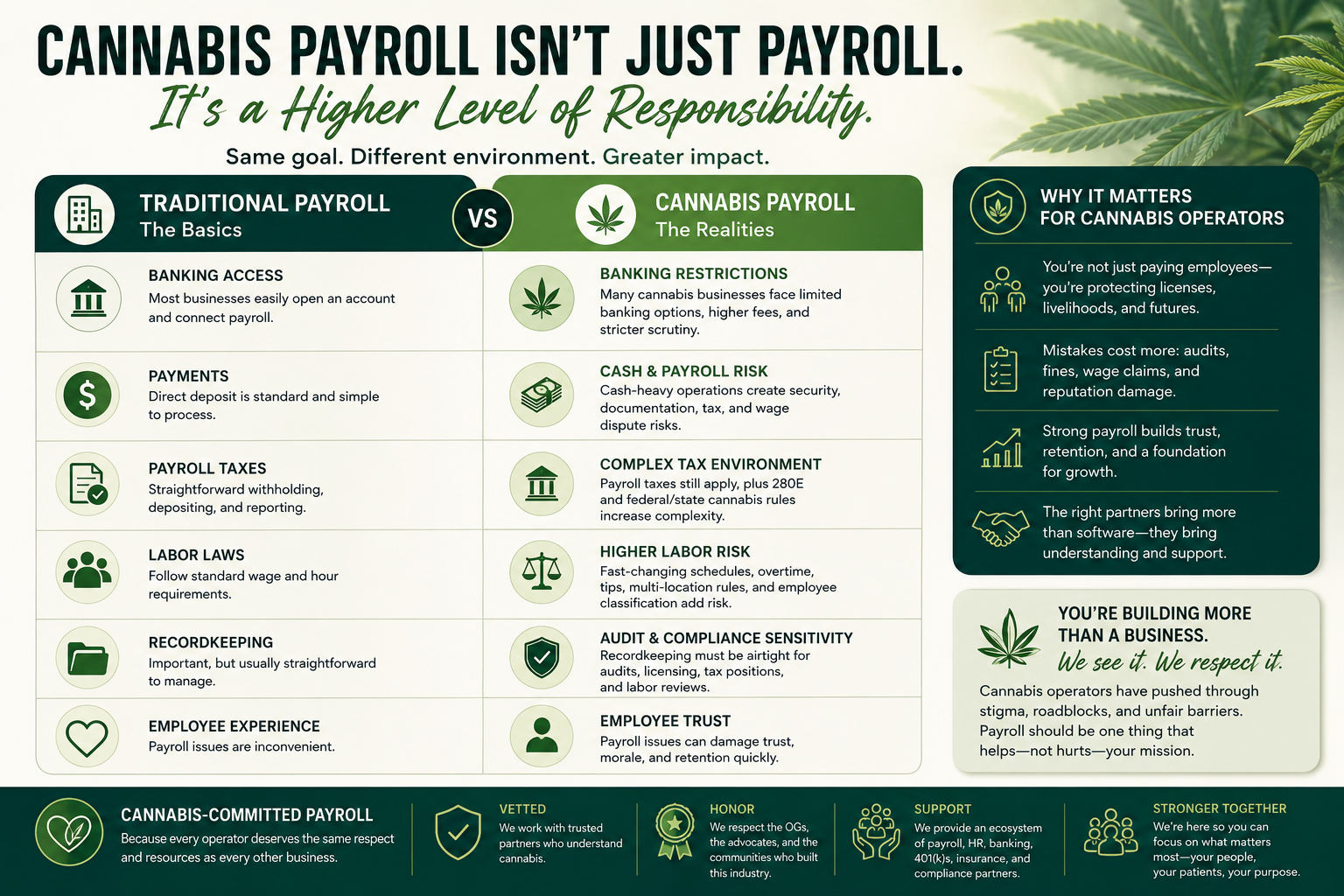
Cannabis payroll is different from traditional payroll because cannabis businesses operate at the intersection of state legalization, federal restrictions, banking limitations, tax pressure, labor compliance, cash handling risk, and employee retention challenges.
Traditional payroll usually focuses on paying employees, withholding taxes, processing direct deposit, generating paystubs, and keeping records.
Cannabis payroll has to do all of that while also navigating cannabis-specific complications like limited banking access, state-by-state compliance, high audit sensitivity, cash-heavy operations, employee classification risk, multi-location labor tracking, and vendor discrimination.
As of 2026, cannabis remains a highly regulated industry with strong economic impact. The 2025 Vangst Jobs Report, produced with Whitney Economics, reported that legal cannabis supported 425,002 full-time equivalent jobs while posting $30.1 billion in retail sales in 2024. That makes cannabis a major employment sector, even while operators continue facing regulatory and financial headwinds.
That contradiction matters.
Cannabis is a real industry with real employees, real payroll obligations, real tax responsibilities, and real operational risk.
It deserves payroll infrastructure that treats it that way.
Why Traditional Payroll Advice Often Fails Cannabis Businesses
A lot of new cannabis operators search for payroll advice and quickly find generic small business content.
Get an EIN. Register for state taxes. Choose payroll software. Pay employees on time. File taxes. Keep records.
That advice is technically correct.
But it is incomplete for cannabis.
A cannabis business is not just opening a coffee shop, boutique, restaurant, or warehouse operation. Cannabis operators are running businesses in an industry where federal law, state law, banking rules, tax treatment, labor expectations, and licensing obligations often collide.
A dispensary owner may be trying to hire budtenders while also managing inventory controls, customer verification, cash deposits, state reporting, and payroll approvals.
A cultivator may be trying to pay seasonal harvest workers while tracking overtime, breaks, safety documentation, and fluctuating labor needs.
A manufacturer may be running overnight shifts where missed punches, shift differentials, and safety documentation all affect payroll accuracy.
In a traditional business, a payroll issue may be frustrating.
In cannabis, a payroll issue can become a compliance issue, a retention issue, a licensing concern, or a signal that your operation is not as organized as regulators, employees, and partners expect it to be.
That is the difference.
Cannabis Payroll Requirement #1: Banking Is Still Not Normal
One of the biggest differences between cannabis payroll and traditional payroll is banking.
In most industries, payroll banking is boring.
You open a business bank account. You connect payroll software. You process direct deposit. Employees get paid.
Cannabis operators do not always get that luxury.
Because marijuana remains federally controlled, many financial institutions still treat cannabis businesses as higher risk. Even when a state has a legal cannabis program, banks and payroll processors may still be cautious, inconsistent, expensive, or unwilling to serve cannabis businesses.
That creates payroll challenges that most traditional employers never have to think about.
For a cannabis business, banking instability can affect direct deposit, payroll processing timelines, vendor payments, tax payments, cash handling, employee trust, and overall operational stability.
This matters deeply for new licensees.
A new dispensary may assume that once it receives a state license, payroll banking will be straightforward. Then reality hits. Some banks say no. Some payroll providers hesitate. Some vendors require additional documentation. Some services charge more because cannabis is considered higher risk.
That can feel exhausting.
And for operators who have spent years fighting stigma, criminalization, and exclusion, it can feel personal too.
Because sometimes it is not just a business inconvenience.
It is one more reminder that the industry still has to prove its legitimacy in rooms where other businesses are automatically trusted.
Cannabis Payroll Requirement #2: Cash Creates More Risk Than Most Operators Expect
Some cannabis businesses still rely heavily on cash because banking access remains complicated.
Cash may feel like a workaround.
But payroll and cash are a dangerous combination if systems are not airtight.
Cash-heavy payroll can create security risk, accounting confusion, wage disputes, tax documentation gaps, and employee dissatisfaction. It can also make it harder to prove what was paid, when it was paid, and whether taxes and deductions were handled properly.
Imagine a small dispensary trying to pay employees manually while also managing cash drawers, product inventory, customer flow, state compliance, and vendor payments.
One missed record can become a problem later.
One unclear payment can become a wage dispute.
One disorganized process can turn into hours of cleanup during tax season or a labor review.
Cannabis payroll needs more documentation, not less.
The more cash involved in the business, the more disciplined the payroll process needs to be.
Cannabis Payroll Requirement #3: Payroll Taxes Still Apply Even When Cannabis Law Feels Complicated
Some new operators assume that because cannabis has unusual federal treatment, payroll taxes somehow work differently.
They do not.
Cannabis employers still have payroll tax obligations.
The IRS explains that employers generally must deposit federal income tax withheld from employees, along with employer and employee Social Security and Medicare taxes and federal unemployment taxes.
That means cannabis businesses still need to withhold, deposit, report, and document employment taxes properly.
This is where new operators can get overwhelmed fast.
You may be thinking about licensing, inventory, construction, security, POS systems, investors, and opening day. Then payroll tax filing shows up as one more high-stakes responsibility.
But ignoring it is not an option.
Late deposits, incorrect filings, missing W-2s, poor payroll records, and unclear employee classifications can create penalties, audits, and operational stress.
This is also where cannabis operators need to understand that payroll taxes are separate from broader cannabis tax issues like 280E.
Payroll still has to run correctly regardless of how federal cannabis tax treatment evolves.
Cannabis Payroll Requirement #4: 280E Makes Recordkeeping More Sensitive
Section 280E has long been one of the most painful tax realities for cannabis operators.
At a simple level, 280E limits certain deductions for businesses trafficking Schedule I or II controlled substances under federal law. That has historically affected cannabis businesses by creating much heavier tax burdens than many traditional companies face.
As of 2026, cannabis tax treatment remains complicated, especially as operators follow rescheduling developments and possible changes for medical cannabis activity. Some sources note that proposed or emerging Schedule III changes may create tax relief for certain medical operators, while adult-use cannabis and mixed operations may still face uncertainty and documentation requirements.
For payroll, the key point is this:
Documentation matters.
If your labor costs need to be tracked by role, location, business line, medical versus adult-use activity, cost center, or operational function, your payroll system needs to support that level of clarity.
For example, a vertically integrated operator may have employees working across cultivation, manufacturing, retail, inventory, compliance, and administration.
If payroll records are messy, it becomes harder to understand labor allocation, support tax positions, answer accountant questions, and prepare for reviews.
Cannabis payroll is not just about paying people.
It is about creating a record of how labor actually supports the business.
Cannabis Payroll Requirement #5: Labor Laws Hit Harder When Operations Move Fast
Cannabis businesses are often built under pressure.
A dispensary gets closer to opening day and suddenly needs to hire quickly.
A cultivation facility hits harvest and needs extra labor immediately.
A manufacturer gets a large production order and adds longer shifts.
A delivery operation expands service areas and schedules employees across changing routes.
That speed creates payroll risk.
The U.S. Department of Labor states that the Fair Labor Standards Act sets minimum wage, overtime pay, recordkeeping, and youth employment standards, and that nonexempt employees generally must be paid at least minimum wage and overtime at not less than one and one-half times their regular rate for overtime hours worked.
For cannabis businesses, this matters because scheduling can change constantly.
A budtender may stay late because a line is out the door.
A trimmer may work longer hours during harvest.
A production worker may move between roles with different pay rates.
A delivery employee may have travel time, split shifts, or location-specific rules depending on the state.
If your payroll system does not capture time accurately, overtime errors can happen quickly.
And overtime errors do not just create math problems.
They create trust problems.
When an employee feels underpaid, unheard, or confused, payroll becomes emotional fast.
Cannabis Payroll Requirement #6: Employee Classification Can Become Expensive Quickly
Employee classification means determining whether a worker is an employee or an independent contractor, and whether an employee is exempt or nonexempt for wage and hour purposes.
That sounds technical.
But the consequences are real.
If a cannabis business misclassifies workers, it may create exposure around unpaid overtime, missed payroll taxes, benefits eligibility, wage claims, and labor investigations.
This matters in cannabis because the industry uses many different worker types.
A dispensary may work with budtenders, shift leads, inventory associates, delivery drivers, brand ambassadors, and managers.
A cultivation business may work with trimmers, growers, seasonal workers, facility managers, and compliance staff.
A manufacturer may use production workers, packagers, quality control employees, and overnight teams.
When the business is moving fast, it is tempting to classify people based on convenience.
But payroll should not be built on convenience.
It should be built on accuracy.
Cannabis Payroll Requirement #7: Recordkeeping Is Not Optional
Recordkeeping is one of the most underrated differences between cannabis payroll and traditional payroll.
Every employer needs records.
Cannabis businesses need records they can actually find, explain, and trust.
The Department of Labor explains that covered employers must keep certain records related to nonexempt employees’ pay and work hours, including identifying information, hours worked, and wages earned.
For cannabis operators, recordkeeping becomes even more important because payroll records may be needed during wage disputes, audits, licensing reviews, tax questions, insurance reviews, or internal investigations.
A lot of operators do not realize how important organized payroll records are until something stressful happens.
A labor audit may begin after an employee files a wage complaint. That means leadership may suddenly need to provide timecards, overtime history, pay records, break documentation, and classification details from months earlier.
An employee may dispute missing overtime pay. That means managers need to verify hours worked, schedule changes, time edits, and payroll calculations.
State labor investigators may request documentation about employee classifications, break tracking, or payroll procedures.
Tax documentation may be requested during filing season, and leadership may suddenly find itself searching through spreadsheets, inboxes, paper files, payroll exports, and text messages.
A compliance review may happen during license renewal, and the business may need to show organized workforce documentation quickly.
That is when operational disorganization becomes very expensive emotionally.
Not just financially.
Because trying to reconstruct payroll history after the fact is exhausting.
Strong payroll systems create clarity before panic sets in.
Cannabis Payroll Requirement #8: Payroll Impacts Employee Trust More Than Operators Realize
This is where cannabis payroll becomes deeply human.
A lot of cannabis employees already work inside stressful environments.
Budtenders are often expected to educate customers, follow compliance rules, manage long lines, handle emotionally intense interactions, and understand products that change constantly.
Cultivation workers may deal with physically demanding labor, repetitive tasks, harvest pressure, environmental hazards, and seasonal uncertainty.
Manufacturing teams may work long shifts, handle safety protocols, and deal with production deadlines.
When payroll is wrong on top of that, it does not feel like a small mistake.
It feels like disrespect.
An incorrect paycheck can mean a missed bill.
A missing paystub can delay a rental application.
A late payroll correction can make an employee feel ignored.
An unclear PTO balance can make the workplace feel disorganized.
Payroll is one of the clearest ways employees judge whether leadership has control.
That may sound harsh.
But it is true.
If employees cannot trust payroll, they may start questioning everything else.
How Cannabis Payroll Is Different by Business Type
Cannabis payroll requirements do not look the same across every license type.
A dispensary, cultivation facility, manufacturer, delivery operation, and vertically integrated operator may all face different workforce realities.
A dispensary usually needs payroll systems that can handle high turnover, part-time staff, tips, scheduling changes, employee self-service, and retail-style overtime risk.
A cultivation business often needs strong time tracking, seasonal labor planning, safety documentation, shift scheduling, and labor allocation across grow rooms, harvest, trimming, and facility operations.
A manufacturer or processor may need shift differential tracking, production labor reporting, overnight scheduling, safety documentation, and overtime controls.
A delivery operation may need mobile clock-ins, route-based scheduling, mileage or travel-time considerations, and location-specific labor compliance.
A vertically integrated operator needs even more structure because employees may work across multiple entities, departments, locations, or functions.
This is why generic payroll advice is not enough.
Cannabis payroll has to match the actual operation.
What Makes Cannabis Payroll Feel Discriminatory to Operators
This part matters.
And it deserves to be said carefully.
Not every vendor challenge is discrimination. Some providers have legitimate risk policies, compliance limitations, banking restrictions, or underwriting rules.
But cannabis operators know the difference between due diligence and stigma.
They know what it feels like when a provider treats them like a problem before understanding their business.
They know what it feels like when pricing is inflated simply because cannabis is involved.
They know what it feels like when support disappears after the word “cannabis” enters the conversation.
They know what it feels like when their business is legal in their state but still treated like it does not deserve normal business infrastructure.
That is why the conversation around cannabis payroll requirements is not just technical.
It is about access.
Access to banking.
Access to payroll.
Access to benefits.
Access to retirement plans.
Access to HR support.
Access to reliable partners.
Access to being treated like a legitimate employer.
And for the OGs who carried this industry before legalization became an investment category, that matters even more.
Because many of them helped build the culture, the customer base, the plant knowledge, and the community trust that today’s market depends on.
They deserve systems that honor that history, not systems that punish it.
What It Means to Choose a Cannabis-Committed Payroll Partner
A lot of companies say they are cannabis friendly.
That does not always mean they are cannabis committed.
Cannabis friendly may mean a provider is willing to accept cannabis clients.
Cannabis committed means the provider understands the burden cannabis operators carry and builds support around that reality.
That support may include payroll, HR, onboarding, time tracking, benefits, 401(k) access, banking relationships, compliance partners, insurance connections, and broader operational ecosystems that help cannabis businesses access what traditional businesses often receive automatically.
This does not mean every cannabis operator needs the same provider or the same stack.
It means operators should ask better questions.
Does this provider understand cannabis banking?
Do they understand wage and hour risk in dispensaries?
Can they support cultivation labor complexity?
Do they understand why recordkeeping matters for audits and licensing?
Do they have partners who can support benefits, HR, banking, or retirement needs?
Do they treat cannabis like a legitimate industry?
At Paragon, this is part of the larger idea behind being Cannabis Committed: not just serving cannabis businesses when it is easy, but helping build an ecosystem that honors, vets, and supports operators through the realities stacked against them.
This blog is not about saying every business must choose one provider.
It is about helping operators recognize that cannabis payroll should never be treated like a generic checkbox.
It is part of the infrastructure that protects your people.
Questions Cannabis Operators Ask Online About Cannabis Payroll
Is Cannabis Payroll Really Different from Regular Payroll?
Yes.
The actual mechanics of payroll are similar. You still calculate wages, withhold taxes, pay employees, file payroll taxes, and keep records.
But the environment around cannabis payroll is different.
Cannabis businesses often face banking restrictions, cash handling risk, state-by-state regulatory complexity, audit sensitivity, licensing pressure, and vendor discrimination.
That means the consequences of payroll mistakes can feel heavier than they do in many traditional industries.
Can Dispensaries Use Regular Payroll Software?
Sometimes.
But regular payroll software may not be enough if it does not support cannabis-specific needs like time tracking, multi-state compliance, cash-heavy payroll processes, employee self-service, labor allocation, and audit-ready records.
A small dispensary may be able to start with basic payroll software.
But as soon as scheduling, turnover, overtime, onboarding, and compliance documentation become harder to manage, generic software may create more work than it solves.
Why Do Payroll Providers Refuse Cannabis Businesses?
Some payroll providers refuse cannabis businesses because of federal cannabis restrictions, banking risk, internal compliance policies, insurance concerns, or underwriting rules.
From the operator’s perspective, this can feel incredibly frustrating.
Especially when the business is licensed, legal in its state, employing people, paying taxes, and trying to operate professionally.
The reality is that cannabis businesses need providers who are transparent about what they can and cannot support.
A vague “yes” is not enough.
Can Cannabis Employees Get Direct Deposit?
Yes, many cannabis employees can receive direct deposit when the business has cannabis-friendly banking and payroll infrastructure.
But not every bank or payroll provider supports cannabis equally.
That is why new operators should ask about direct deposit early, before hiring ramps up.
Employees expect direct deposit because it feels stable, modern, and professional.
When payroll feels unstable, employees often assume the business is unstable too.
Can Cannabis Businesses Pay Employees in Cash?
Some cannabis businesses still pay employees in cash, but it is usually riskier than direct deposit or structured payroll processing.
Cash payroll can create security concerns, documentation gaps, tax reporting issues, wage disputes, and employee trust problems.
If cash is part of your operation, payroll documentation becomes even more important.
Every payment needs to be traceable, documented, and compliant.
What Payroll Records Should Cannabis Businesses Keep?
Cannabis businesses should keep organized records related to employee wages, hours worked, overtime, paystubs, payroll tax filings, timecards, onboarding documents, employee classifications, direct deposit authorizations, and payroll corrections.
The exact requirements may vary depending on federal, state, and local law.
But the basic principle is simple:
If you cannot prove it later, it may become a problem later.
Why Is Overtime Such a Big Risk in Cannabis?
Overtime is a major risk because cannabis schedules often shift quickly.
A busy weekend, harvest deadline, product launch, staff call-out, delivery surge, or production delay can push employees into overtime unexpectedly.
If time tracking and payroll systems are disconnected, overtime may be missed or miscalculated.
That can lead to wage disputes, complaints, audits, and employee distrust.
What Is the Biggest Payroll Mistake New Cannabis Licensees Make?
One of the biggest mistakes is waiting too long to build payroll infrastructure.
New licensees are often focused on opening, hiring, licensing, banking, construction, inventory, and compliance.
Payroll can feel like something to “figure out later.”
But once employees are hired, payroll becomes immediate.
The better move is to build payroll, HR, time tracking, onboarding, and recordkeeping processes before the business starts scaling.
Why Does Cannabis Payroll Cost More?
Sometimes cannabis payroll costs more because providers are doing more.
Cannabis businesses may require additional compliance support, banking coordination, risk review, labor tracking, onboarding support, and audit-ready documentation.
But sometimes cannabis businesses are simply charged more because vendors see cannabis as risky or profitable.
Operators should ask what is included, what support is provided, what cannabis-specific experience exists, and whether pricing reflects real service or just stigma.
How Can Cannabis Businesses Tell If Payroll Is Already Broken?
Payroll may already be broken if employees regularly question paychecks, managers constantly fix timecards, overtime surprises happen often, onboarding paperwork is missing, payroll takes days to complete, employees cannot access paystubs, or leadership feels anxious every payroll cycle.
Those are not just administrative issues.
They are signs the business may have outgrown its systems.
Signs Your Cannabis Payroll System Needs Attention
Cannabis payroll problems rarely appear all at once.
They build slowly.
At first, a manager fixes one timecard manually.
Then another.
Then payroll takes longer.
Then employees start asking more questions.
Then onboarding paperwork gets harder to find.
Then leadership starts feeling tense every pay cycle.
If payroll has become emotionally heavy, that is worth paying attention to.
Not because your team failed.
Because the system may no longer fit the business you are becoming.
Best Next Steps for Cannabis Operators
Start by mapping your current payroll process from beginning to end.
Where do hours come from?
Who approves time?
How is overtime calculated?
Where are pay records stored?
How are payroll taxes filed?
Can employees access paystubs easily?
What happens when someone disputes wages?
Then look for the friction points.
If payroll depends on one person remembering every detail, that is a risk.
If employee records live across texts, spreadsheets, inboxes, and paper folders, that is a risk.
If your provider does not understand cannabis, that is a risk.
If employees do not trust payroll, that is a culture problem waiting to grow.
You do not have to fix everything overnight.
But you should not ignore the signs.
Helpful Government Resources for Cannabis Employers
The IRS employment tax resources explain employer responsibilities around withholding, depositing, reporting, and paying employment taxes.
IRS Publication 15 explains employer tax responsibilities, including withholding, depositing, reporting, and paying employment taxes.
The Department of Labor’s FLSA recordkeeping guidance explains employer obligations around wage, hour, overtime, and employee records.
Employer.gov also provides guidance around payroll and employee recordkeeping responsibilities.
NIOSH notes that as cannabis laws and business practices change, worker health, safety, and well-being in cannabis workplaces must also be addressed.
OSHA workplace guidance can also help cannabis employers better understand workplace safety responsibilities and labor protections.
These resources do not replace legal, payroll, HR, or tax advice, but they are useful starting points for cannabis operators who want to better understand the baseline responsibilities that still apply within the industry.
Key Takeaways for Cannabis Operators
Cannabis payroll is different because the industry operates under pressure that traditional businesses rarely face.
The payroll basics still matter.
But the environment is more complicated.
Banking may be harder.
Cash may be more common.
Labor laws may create more exposure.
Recordkeeping may matter more.
Employee trust may be more fragile.
Vendor access may be less fair.
Compliance pressure may be higher.
And for the operators who have already had too much stacked against them, payroll should not become another system that makes survival harder.
The right payroll infrastructure should create stability.
It should help employees feel respected.
It should help leadership breathe easier.
It should help the business prove what happened when questions arise.
And it should help cannabis operators build the kind of legitimate, sustainable companies this industry has always deserved.
Questions to Ask Yourself Before Choosing Cannabis Payroll Support
Before choosing a payroll provider or deciding whether your current system is enough, ask yourself:
Do we feel confident that every employee is being paid accurately?
Can we prove overtime, hours, classifications, and payroll corrections if questioned?
Do our employees trust our payroll process?
Can our provider support cannabis banking realities?
Are our records organized enough for an audit, tax review, or labor complaint?
Are we still using manual processes because they work, or because we have not had time to replace them?
Does our payroll partner understand the cannabis industry, or are they simply tolerating it?
And maybe the biggest question:
Is our payroll system helping us build stability, or quietly adding more weight to an industry that already asks too much of its operators?

