

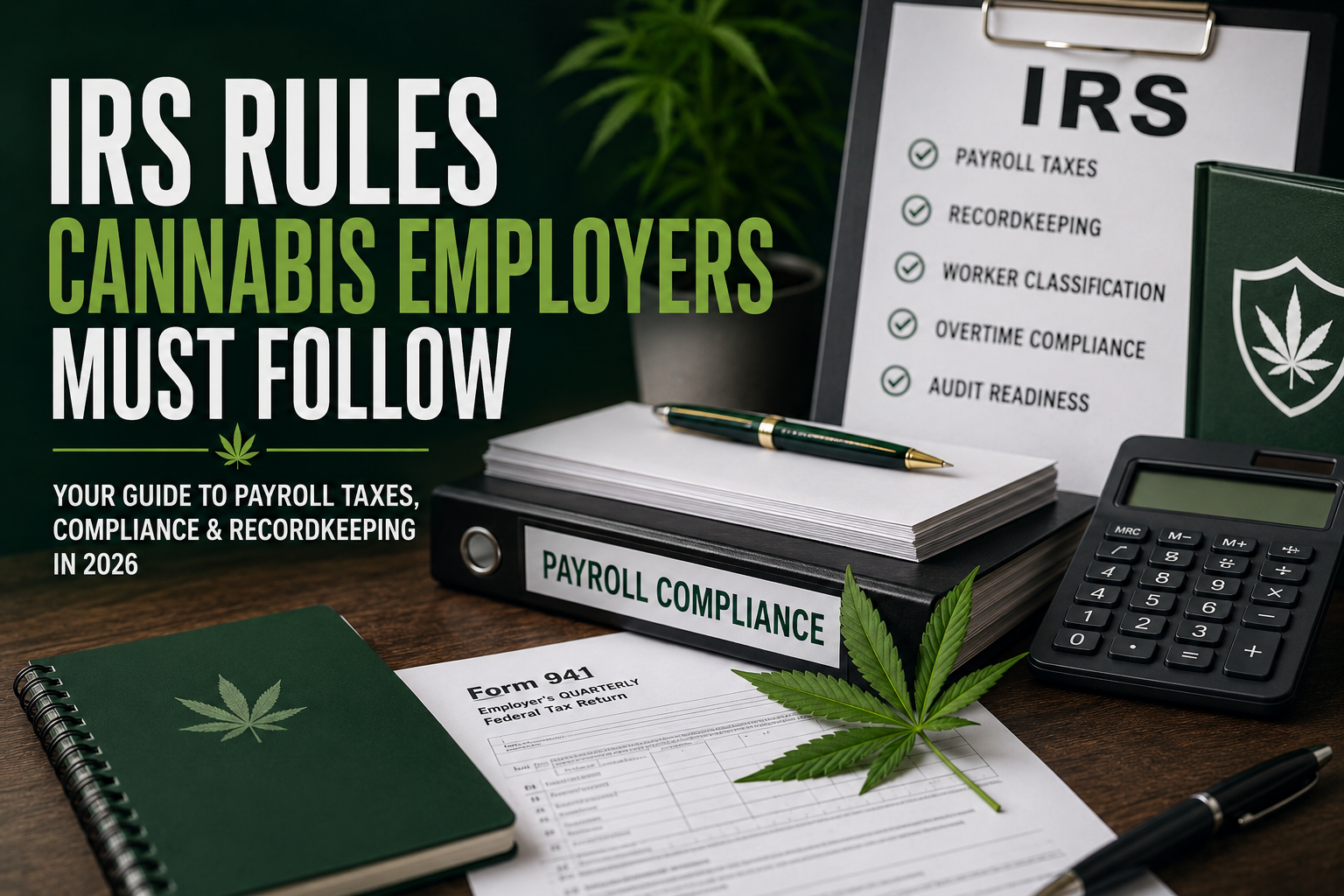
One of the hardest realities cannabis employers face is this:
Even though cannabis businesses are legal in many states, the IRS still expects cannabis employers to operate with the same payroll, labor, tax, and documentation standards as any other legitimate business.
Actually, in many ways, the scrutiny can feel even heavier.
And that creates an emotional contradiction many operators quietly struggle with.
Because for years, cannabis businesses were treated like outsiders financially while simultaneously being expected to maintain near-perfect compliance operationally.
That pressure becomes especially overwhelming for:
- new licensees
- founders
- dispensary operators
- cultivators
- social equity businesses
- HR teams
- payroll administrators
Especially when they suddenly realize how much responsibility exists behind payroll alone.
A lot of operators enter cannabis because they care deeply about:
- the plant
- patient access
- legalization
- advocacy
- entrepreneurship
- community
- opportunity
Then suddenly they are researching:
- IRS payroll rules
- 941 filings
- W-2 requirements
- 280E
- employee classifications
- payroll tax deposits
- labor documentation
- overtime compliance
- audit readiness
If some of these terms feel overwhelming already, that is completely normal. Many cannabis operators are learning these systems in real time while simultaneously trying to run and grow a business. For a deeper breakdown of many of these compliance concepts, you can also refer to our companion guide: “Cannabis Payroll Compliance (280E, IRS & Regulations)”
And honestly, it can feel like learning an entirely different industry overnight.
But understanding the IRS rules cannabis employers must follow is one of the most important things businesses can do to protect:
- operational stability
- employee trust
- licensing confidence
- financial organization
- long-term sustainability
Because in cannabis, payroll compliance is not just administrative.
It is operational survival infrastructure.
Why IRS Compliance Feels Different in Cannabis
Cannabis businesses often carry an emotional weight many traditional industries do not fully understand.
For years, operators were denied:
- stable banking
- lending access
- traditional financial infrastructure
- equal tax treatment
- federal legitimacy
And even now, as rescheduling conversations evolve and federal reform discussions intensify, cannabis businesses are still operating inside overlapping layers of uncertainty.
That uncertainty affects:
- payroll systems
- tax planning
- workforce administration
- financial reporting
- operational organization
Which means cannabis employers often feel like they are building businesses while simultaneously decoding constantly evolving compliance expectations in real time.
And unfortunately:
the IRS does not lower payroll compliance expectations simply because cannabis businesses face more operational complexity.
That is why understanding the rules matters so much.
For broader IRS employer guidance, operators can learn more here.
Important Cannabis IRS & Payroll Terms Employers Should Understand
One of the biggest reasons IRS compliance feels overwhelming in cannabis is because operators are suddenly exposed to an entirely new vocabulary of payroll, tax, labor, and operational terminology.
And honestly, many new operators feel embarrassed asking questions because they assume everyone else already understands these terms.
Most people do not.
Especially early on.
That is why understanding these concepts matters so much.
Because the more operators understand the systems surrounding payroll and compliance, the easier it becomes to build stable infrastructure intentionally instead of reactively.
280E
280E refers to Section 280E of the Internal Revenue Code, a federal tax rule that historically prevented cannabis businesses from deducting many ordinary business expenses because cannabis remained federally classified as a Schedule I substance.
For cannabis businesses, this created enormous financial pressure around:
- profitability
- workforce planning
- payroll structure
- labor allocation
- operational scaling
And even as federal reform conversations evolve, 280E continues shaping how many operators organize payroll and financial reporting.
Official IRS 280E guidance and tax information
FAQ: Does 280E affect payroll directly?
Not directly in the way payroll taxes work, but 280E heavily influences operational structuring, labor allocation, financial planning, and expense reporting inside cannabis businesses.
Payroll Taxes
Payroll taxes are taxes employers must withhold, report, and pay related to employee wages.
These can include:
- federal income taxes
- Social Security taxes
- Medicare taxes
- federal unemployment taxes
- state payroll taxes
Missing payroll tax deadlines or filing incorrect payroll tax information can create serious operational problems quickly.
IRS payroll tax deposit guidance
IRS Publication 15 (Employer’s Tax Guide)
FAQ: What happens if cannabis businesses miss payroll tax deadlines?
Businesses can face penalties, interest, IRS notices, operational stress, and increased scrutiny if payroll taxes are not filed or deposited correctly.
Labor Audits
Labor audits occur when government agencies review payroll practices, employee classifications, overtime calculations, wage records, timekeeping systems, and workforce documentation to ensure businesses are following labor laws correctly.
For cannabis businesses already operating under heightened scrutiny, labor audits can become especially stressful if records are disorganized.
Department of Labor wage and hour guidance
FAQ: Can cannabis businesses really be audited over payroll?
Yes. Cannabis businesses can face labor audits, payroll tax audits, licensing reviews, wage investigations, and workforce compliance reviews.
Employee Classifications
Employee classifications determine whether workers are legally categorized as:
- employees
- independent contractors
- exempt employees
- nonexempt employees
Improper classification can create:
- unpaid overtime exposure
- payroll tax liability
- labor disputes
- penalties
- operational stress
Especially during rapid growth.
IRS worker classification guidance
Department of Labor classification guidance
FAQ: Why is employee classification so important in cannabis?
Because rapid workforce scaling often increases the risk of payroll tax issues, labor disputes, and overtime exposure if workers are classified incorrectly.
Overtime Laws
Overtime laws are labor laws requiring eligible employees to receive additional pay when they work beyond certain hourly thresholds.
Cannabis businesses often face fluctuating labor demands during:
- harvest periods
- product launches
- busy retail seasons
- overnight production schedules
Without accurate overtime tracking systems, businesses can quickly create payroll inconsistencies and employee distrust.
Department of Labor overtime guidance
FAQ: Why does overtime become complicated in cannabis?
Because cannabis businesses often operate with fluctuating labor schedules, seasonal staffing, overnight production shifts, and varying state overtime laws.
IRS Documentation
IRS documentation refers to payroll, tax, and financial records businesses must maintain to comply with federal tax requirements.
This may include:
- payroll tax filings
- employee wage records
- withholding documentation
- payroll reports
- tax deposit records
Strong documentation creates operational clarity during audits, reviews, and compliance investigations.
IRS business recordkeeping guidance
FAQ: How long should cannabis businesses keep payroll records?
Businesses should follow IRS and state recordkeeping requirements carefully and maintain organized records that can support audits, payroll reviews, tax filings, and workforce questions.
Workforce Records
Workforce records are employee-related documents businesses maintain to support payroll, HR, labor compliance, and operational organization.
These records may include:
- onboarding paperwork
- timecards
- payroll history
- wage records
- PTO balances
- tax forms
- payroll corrections
- employee classifications
Employer payroll recordkeeping guidance
FAQ: Why do workforce records matter so much?
Because organized records help businesses respond faster during audits, employee disputes, licensing reviews, insurance questions, and operational reporting requests.
SAFE Banking
SAFE Banking refers to proposed federal legislation designed to protect financial institutions that provide banking services to state-legal cannabis businesses.
If passed fully, SAFE Banking could improve:
- payroll processing stability
- direct deposit access
- operational transparency
- banking relationships
- payroll tax payment systems
Federal FinCEN marijuana banking guidance
FAQ: Why does banking matter for cannabis payroll?
Because banking instability can affect direct deposit access, payroll processing reliability, tax payments, and operational consistency.
Rescheduling
Rescheduling refers to federal efforts to change cannabis’ classification under the Controlled Substances Act.
In 2026, rescheduling conversations intensified significantly after federal acknowledgment of accepted medical use for certain cannabis products.
Operators are watching closely because rescheduling could eventually affect:
- tax treatment
- banking access
- payroll infrastructure
- operational reporting
- financial compliance expectations
DEA Controlled Substances Act information
FAQ: Does rescheduling automatically solve payroll compliance problems?
No. Even with federal reform movement, cannabis businesses still must follow payroll tax laws, labor requirements, workforce documentation rules, and state compliance obligations.
IRS Rule #1: Cannabis Employers Must Properly Withhold Payroll Taxes
One of the most foundational IRS responsibilities for cannabis employers is payroll tax withholding.
Employers are required to withhold and remit taxes related to employee wages properly.
That typically includes:
- federal income taxes
- Social Security taxes
- Medicare taxes
- federal unemployment taxes
- applicable state payroll taxes
This may sound straightforward.
But payroll tax mistakes can create serious operational problems quickly.
Especially if businesses:
- miscalculate withholdings
- miss tax deposit deadlines
- fail to file required payroll forms
- improperly classify workers
- maintain inconsistent payroll records
And in cannabis, payroll tax pressure can feel even heavier because businesses are often simultaneously navigating:
- 280E tax burdens
- banking instability
- workforce scaling
- licensing costs
- operational expansion
Which means payroll taxes are not just “another task.”
They are part of the financial foundation keeping the business operationally stable.
FAQ: What payroll tax forms do cannabis employers usually file?
Common payroll forms may include:
- Form 941
- Form W-2
- Form W-3
- Form 940
- W-4 documentation
IRS Rule #2: Cannabis Businesses Must Maintain Accurate Payroll Records
One of the most underestimated IRS responsibilities in cannabis is recordkeeping.
Until something stressful happens.
An audit begins.
An employee dispute arises.
Tax documentation gets requested.
An acquisition conversation starts.
Suddenly the business needs:
- payroll reports
- employee tax forms
- wage histories
- timecards
- overtime records
- onboarding documents
- payroll corrections
- withholding records
- direct deposit authorizations
And if those records are fragmented across spreadsheets, paper files, disconnected systems, or email chains, leadership often ends up reconstructing payroll history retroactively.
That process becomes incredibly stressful.
Especially in cannabis, where operators are already balancing:
- licensing pressure
- workforce complexity
- compliance reporting
- investor expectations
- operational growth
IRS payroll recordkeeping guidance
Employer payroll recordkeeping guidance
FAQ: What payroll records should cannabis employers keep?
Businesses should maintain organized records related to:
- payroll tax filings
- onboarding paperwork
- tax forms
- timecards
- overtime records
- payroll corrections
- employee classifications
- direct deposit authorizations
- termination documentation
IRS Rule #3: Employee Classification Must Be Accurate
One of the most common payroll compliance mistakes cannabis businesses make is worker misclassification.
Especially during rapid growth periods.
The IRS expects businesses to properly determine:
- whether workers are employees or independent contractors
- whether employees are exempt or nonexempt
- whether overtime protections apply
FAQ: What happens if cannabis businesses misclassify employees?
Businesses may face payroll tax liability, wage disputes, unpaid overtime exposure, penalties, and labor investigations.
IRS Rule #4: Cannabis Employers Must File Payroll Forms Correctly
Cannabis employers are still expected to file required payroll tax forms accurately and on time.
FAQ: Why are payroll forms so important?
Because these forms document employee wages, tax withholding, workforce reporting obligations, and payroll tax compliance requirements.
IRS Rule #5: Cannabis Employers Must Track Overtime Properly
Overtime compliance becomes especially important in cannabis because workforce schedules often fluctuate heavily.
Department of Labor overtime guidance
FAQ: Why do overtime disputes happen so often?
Overtime disputes often happen when businesses rely on inconsistent timekeeping systems, manual payroll corrections, unclear scheduling practices, or inaccurate employee classifications.
IRS Rule #6: Cannabis Businesses Must Prepare for Potential Audits
Audit readiness simply means businesses can clearly explain and support:
- payroll records
- employee classifications
- tax filings
- wage calculations
- overtime tracking
- onboarding documentation
- payroll corrections
FAQ: What does audit readiness actually look like?
Audit readiness means payroll records, workforce documentation, tax filings, and compliance systems are organized enough to retrieve and explain clearly during reviews or investigations.
Workplace Safety & Workforce Protection Still Matter
Cannabis employers are also responsible for workplace safety and employee protections.
This matters especially in environments involving:
- cultivation facilities
- manufacturing operations
- overnight shifts
- repetitive labor
- extraction environments
- retail security concerns
OSHA employer responsibilities
CDC / NIOSH cannabis workplace guidance
FAQ: Does OSHA apply to cannabis businesses?
Yes. Cannabis businesses still must comply with workplace safety requirements and workforce protection standards.
Build a Cannabis Payroll System That Protects Your Future, Not Just Your Payday
If you are feeling overwhelmed after reading all of this, take a breath.
That does not mean you are failing.
It probably means you are realizing something many cannabis operators eventually realize:
payroll is not just payroll in this industry.
It is connected to:
- compliance
- employee trust
- operational stability
- audit readiness
- licensing confidence
- financial organization
- long-term sustainability
And the truth is, most operators were never formally taught how to navigate all of these systems while simultaneously building a cannabis business.
Especially in an industry that historically lacked:
- banking access
- institutional support
- operational infrastructure
- federal clarity
That is why your next step should not be trying to memorize every IRS rule overnight.
Your next step should be building operational clarity one layer at a time.
Start by asking yourself honestly:
- Are our payroll records organized?
- Could we confidently handle an audit tomorrow?
- Are we manually fixing payroll constantly?
- Are managers correcting timecards every pay period?
- Do employees trust our payroll process?
- Are our onboarding systems scalable?
- Are we prepared for multi-state growth?
- Do our payroll and HR systems actually communicate properly?
- Are we building infrastructure proactively or reacting to problems constantly?
Then identify the biggest operational gap creating the most stress right now.
Not ten problems.
Just the biggest one.
Maybe it is:
- payroll organization
- onboarding
- overtime tracking
- employee classification
- payroll tax filings
- workforce documentation
- disconnected systems
- compliance visibility
Start there.
Because sustainable cannabis businesses are rarely built by solving everything overnight.
They are built by creating stronger systems consistently over time.
And honestly, that matters now more than ever.
The cannabis industry is entering a new phase.
A phase where:
- investors are paying closer attention
- workforce expectations are increasing
- operational maturity matters more
- compliance visibility matters more
- scalable infrastructure matters more
The businesses most likely to survive long term may not necessarily be the loudest.
They may simply be the ones building systems strong enough to protect what they fought so hard to create.
Not because compliance replaces culture.
Because strong infrastructure helps preserve it.

