

To answer this question honestly, we have to start much earlier than payroll software.
We have to start with the reality that cannabis businesses were never built inside systems designed to support them.
This industry came from prohibition. From criminalization. From stigma. From communities being overpoliced while simultaneously creating the culture, advocacy, and demand that helped build today’s legal market. Long before cannabis conferences became polished and corporate, operators were already risking livelihoods, reputations, freedom, and financial stability simply trying to participate in an industry they believed in.
That history still matters today.
Because even though cannabis has evolved dramatically, the infrastructure surrounding it still carries residue from those years of exclusion.
For decades, cannabis businesses struggled to access basic operational support that traditional businesses often take for granted. Banking relationships were unstable. Insurance carriers hesitated. Payment processors disappeared overnight. Payroll providers declined businesses after learning they touched cannabis. Operators were forced to constantly prove legitimacy inside systems that were not originally designed with them in mind.
And honestly, a lot of cannabis operators still carry that emotional exhaustion.
That is why this conversation about specialized payroll for cannabis businesses matters so much more than people realize.
Because it is not really about payroll alone.
It is about whether the systems surrounding cannabis businesses actually understand the reality of the industry they are serving.
The Industry Is Entering a Different Era
Cannabis in 2026 feels very different than cannabis in 2016.
The federal rescheduling conversation alone shifted public perception dramatically. Institutional interest has increased. Multi-state operators continue expanding. Investors are paying closer attention to operational maturity. Regulators are expecting cleaner reporting and stronger compliance systems. Workforce expectations are evolving. Financial scrutiny is becoming more sophisticated.
According to the 2025 Vangst Jobs Report produced with Whitney Economics, the legal cannabis industry supported more than 425,000 full-time equivalent jobs while generating over $30 billion in annual retail sales. That makes cannabis one of the largest and fastest-growing labor sectors in the country despite the industry still operating under unusual financial and regulatory pressure.
On the surface, it can look like the industry has finally “arrived.”
But underneath that progress, operators still deal with many of the same structural challenges they always have.
Some businesses still struggle to secure stable banking. Some providers still quietly panic when compliance conversations become more complex. Some vendors say they support cannabis until internal underwriting teams get uncomfortable. Some businesses are still charged more simply because cannabis is attached to the company name.
And for the OGs who helped build this industry before it became profitable or publicly celebrated, that can feel incredibly frustrating.
Because many of those same people educated consumers, advocated publicly, normalized cannabis culturally, fought for reform, created businesses under enormous pressure, and kept the industry alive through uncertainty long before institutional support arrived.
That emotional context matters when we talk about “cannabis commitment.”
Because cannabis operators are not just looking for vendors anymore.
They are looking for partners who actually understand what this industry has carried.
The Industry Is Growing Up. Your Systems Have To Grow With It.
For years, survival itself was the victory.
Getting licensed was the victory. Keeping the doors open was the victory. Finding banking was the victory. Making payroll on time was the victory.
And honestly, considering what this industry has had stacked against it historically, that mattered deeply.
But cannabis is entering a different phase now.
Not because the culture disappeared. Not because the plant changed.
Because the expectations surrounding the industry are changing rapidly.
Regulators are watching more closely. Financial institutions are becoming more involved. Investors are demanding cleaner operations. Employees expect stronger workplace infrastructure. Operators are carrying more visibility than ever before.
That means businesses can no longer survive purely on hustle.
They need systems capable of protecting what the hustle built.
Not to become sterile corporations.
To survive long enough to preserve the culture, advocacy, equity, and opportunity this industry fought for in the first place.
Why “Cannabis Friendly” and “Cannabis Committed” Are Not the Same Thing
A lot of companies market themselves as cannabis friendly now.
That phrase is easy to say.
It looks good on websites. It sounds progressive. It feels marketable.
But cannabis operators have become extremely good at spotting the difference between a company that simply accepts cannabis clients and a company that is genuinely invested in the industry long term.
Those are two completely different things.
A provider can technically process payroll for cannabis businesses without understanding:
- cannabis banking instability
- labor volatility
- licensing pressure
- workforce turnover
- compliance anxiety
- audit sensitivity
- social equity realities
- the emotional burden leadership carries
A cannabis-committed provider understands the human reality behind the operation.
Because this industry has never been purely transactional.
For some people, cannabis represents medicine. For others, it represents second chances, advocacy, community rebuilding, generational opportunity, or criminal justice reform. For many operators, cannabis businesses were built despite systems actively working against them for years.
That changes the responsibility vendors carry.
At Paragon, 2026 marks ten years supporting cannabis businesses.
Ten years.
And for us, commitment was never just about processing payroll.
It meant showing up for the industry publicly. Supporting social equity conversations. Advocating in Washington, D.C. on behalf of clients and constituents. Helping operators access infrastructure they historically struggled to access. Building relationships around banking, HR support, benefits, retirement planning, workforce management, and compliance guidance because operators genuinely needed ecosystems of support around them.
Not because it was trendy.
Because cannabis businesses deserved better infrastructure than what had historically been available to them.
That is what commitment looks like.
Payroll Is Different in Cannabis Because the Industry Is Different
One of the biggest misconceptions new operators hear is:
“Payroll is basically the same everywhere.”
Technically, employees still need to be paid. Taxes still need to be withheld. Payroll taxes still need to be filed. Overtime still matters. Records still need to be maintained.
But cannabis payroll operates inside conditions most traditional businesses never have to think about.
Imagine trying to manage payroll while simultaneously navigating unstable banking relationships, licensing compliance, labor sensitivity, rapid workforce growth, multi-state operational complexity, cash-management risk, audit pressure, and shifting regulatory environments.
Now layer emotional pressure on top of that.
The fear of making expensive mistakes. The pressure to prove legitimacy constantly. The exhaustion of trying to create stable jobs inside systems that historically resisted supporting the industry at all.
That is why specialized payroll providers matter.
Not because cannabis businesses need “special treatment.”
Because the operational reality surrounding cannabis is genuinely different.
And pretending otherwise usually creates problems later.
What Operational Stress Actually Looks Like Inside Cannabis Businesses
A lot of cannabis operators do not realize how much pressure they are carrying until someone finally describes it out loud.
It looks like fixing payroll corrections at midnight before payday. Answering employee texts during dinner because PTO balances are unclear. Worrying a provider may suddenly pull support. Scrambling for onboarding paperwork during audits. Manually correcting timecards every payroll cycle. Feeling anxious every time labor laws change. Wondering whether systems can survive another location opening. Carrying the emotional weight of employees depending on the business to stay stable.
And the difficult part is that many operators normalize this level of stress because cannabis itself has always required resilience.
But survival mode is exhausting long term.
Especially when leadership is trying to build something sustainable, legitimate, and community-driven simultaneously.
What Happens When Cannabis Businesses Use the Wrong Payroll Provider?
Usually, the problems do not appear immediately.
At first everything may seem fine.
The provider says they support cannabis. Payroll runs correctly. Employees get paid. Leadership feels relieved.
Then the business grows.
Compliance questions become more complex. Workforce size increases. Banking structures evolve. Multi-state operations expand. Overtime tracking becomes more difficult. Licensing obligations become heavier.
And suddenly the provider starts feeling uncertain internally.
Support response times slow down. Compliance escalations increase. Payroll questions become harder to answer. Leadership begins sensing hesitation from people who originally sounded confident during onboarding.
Then one day the operator receives the email:
“Unfortunately, we can no longer support your business.”
This still happens.
And when it does, the damage spreads quickly.
Employees do not see vendor restructuring or banking complications. They see instability. Managers panic internally. Leadership scrambles trying to protect payroll continuity while simultaneously maintaining workforce trust.
And suddenly the business is rebuilding infrastructure reactively during active operations.
That emotional chaos is avoidable.
But only if businesses choose partners who truly understand cannabis operationally and culturally long term.
The Wrong Payroll Partner Can Quietly Damage Company Culture
A lot of people think payroll problems are administrative problems.
But employees experience them emotionally.
An incorrect paycheck creates stress. Delayed payroll creates anxiety. Missing overtime creates resentment. Confusing systems create distrust.
Over time, employees begin associating operational instability with leadership instability.
Especially in cannabis, where many employees already work inside emotionally demanding environments.
That matters because culture is not built through branding alone.
Culture is built through consistency.
Through trust.
Through employees believing the business is organized enough to protect them properly.
Payroll becomes part of that trust whether businesses realize it or not.
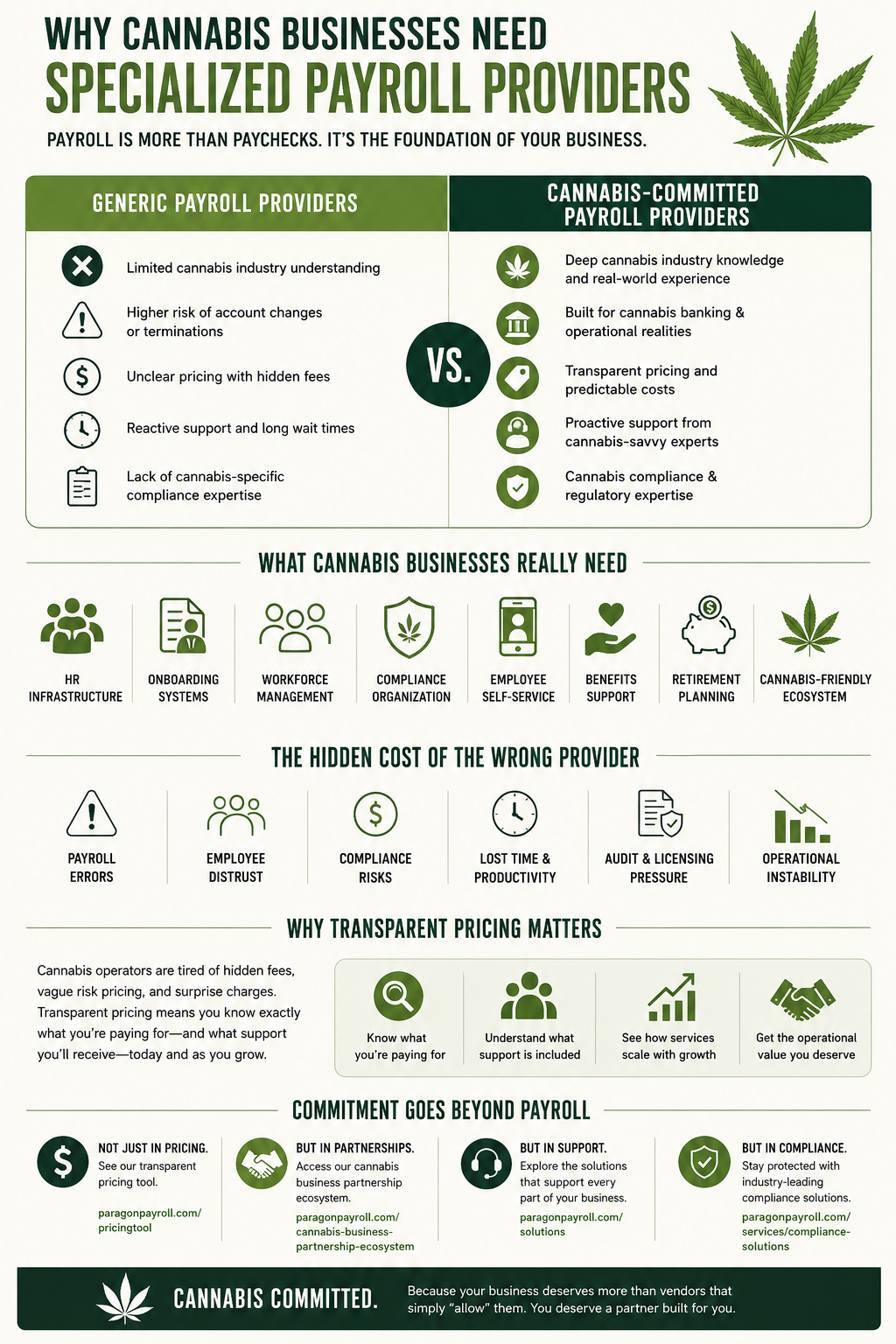
The Hidden Cost of Generic Payroll Support
A lot of businesses initially evaluate payroll providers based on price, onboarding speed, or software features.
Those things matter.
But the hidden operational costs usually appear later.
A generic provider unfamiliar with cannabis may not understand cultivation scheduling complexity, harvest overtime, tipped dispensary structures, employee classification sensitivity, labor allocation, audit preparation, cannabis banking relationships, or workforce documentation expectations.
So managers start manually correcting payroll every cycle. Employees begin questioning overtime calculations. Leadership spends hours reconstructing workforce records during audits or labor complaints. Onboarding paperwork becomes scattered across systems.
At first, businesses normalize this stress because cannabis itself already feels stressful.
But over time, operational chaos compounds.
And eventually that chaos starts quietly affecting employee morale, retention, workforce trust, leadership bandwidth, operational clarity, and scalability.
This is why “cheap payroll” can become incredibly expensive later.
Not just financially.
Emotionally.
Why Social Equity Operators Often Carry Even More Operational Pressure
For many social equity operators, the stakes feel even heavier.
Because a lot of these businesses were built by people directly impacted by the policies that criminalized cannabis in the first place.
Some operators entered legalization carrying limited access to capital, reduced banking relationships, fewer generational financial resources, smaller operational safety nets, higher personal risk tolerance, and deeper pressure to succeed.
That means operational instability can hit disproportionately hard.
A payroll disruption inside a heavily capitalized multi-state operator may create inconvenience.
A payroll disruption inside a smaller social equity business can threaten survival entirely.
That is why infrastructure matters so much.
Because equity without operational support is not really equity.
Why Clean Books Matter More Than Ever Right Now
The cannabis industry is entering a phase where operational maturity matters deeply.
That does not mean losing culture.
It means building enough stability to protect the culture long term.
As cannabis evolves, businesses increasingly need stronger workforce systems, organized payroll documentation, cleaner reporting, audit-ready records, operational visibility, and scalable infrastructure.
Investors are paying closer attention. Regulators are paying closer attention. Financial institutions are paying closer attention.
And businesses operating with fragmented systems may struggle more as expectations continue increasing.
This is especially important for social equity operators and smaller independent businesses because operational disorganization tends to hurt businesses with the least margin for error the hardest.
That is why specialized payroll providers matter now more than ever.
Not because cannabis businesses are fragile.
Because the industry already carries enough pressure without adding preventable operational instability.
Why Transparent Payroll Pricing Matters in Cannabis
One of the biggest frustrations cannabis operators quietly deal with is never fully knowing what something is actually going to cost them.
That uncertainty has existed across the industry for years.
Operators have dealt with hidden banking fees, sudden compliance upcharges, vague “risk pricing,” unexpected account changes, fluctuating vendor costs, and unclear service agreements that seem to shift the moment cannabis enters the conversation.
And honestly, after carrying so much operational uncertainty already, many cannabis businesses are exhausted by pricing conversations that feel intentionally confusing.
That is why transparent payroll pricing matters so much in cannabis.
Not because operators are simply looking for the cheapest option.
Because businesses need predictability.
Especially in an industry where margins can already feel tight, regulations can shift quickly, and operational pressure rarely slows down.
A lot of cannabis operators have experienced vendors saying:
“We support cannabis.”
Only to later discover surprise fees, unclear onboarding costs, added compliance charges, hidden support limitations, or increased pricing once the provider realizes the business is cannabis-related.
That kind of experience damages trust quickly.
Especially in an industry that has already dealt with enough instability.
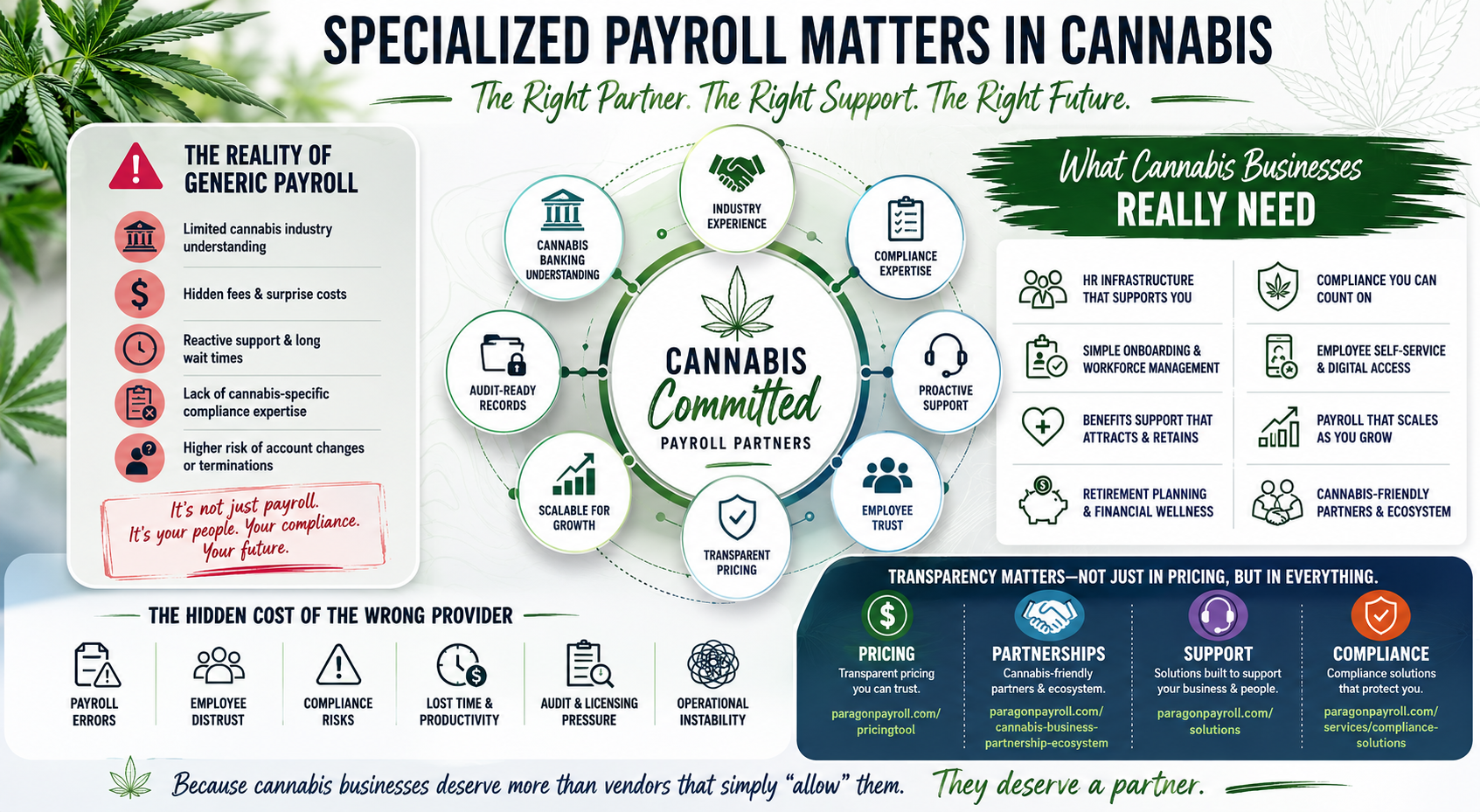
Transparent pricing is not just about numbers.
It is about respect.
It is about operators fully understanding:
- what they are paying for
- what support is included
- what services scale with growth
- what operational value the partnership actually provides
Because payroll in cannabis is rarely just payroll.
The right partner may also help support HR infrastructure, onboarding systems, workforce management, compliance organization, employee self-service, benefits support, retirement planning, and broader cannabis-friendly operational ecosystems that help businesses survive long term.
And businesses deserve clarity around all of it.
At Paragon, part of being Cannabis Committed means believing operators should not have to decode confusing pricing structures simply to access reliable workforce infrastructure.
You can explore Paragon Payroll’s transparent pricing approach here.
As the industry matures, transparency will matter more and more.
Not just in pricing.
But in partnerships.
But in support.
But in compliance.
And in the vendors businesses choose to build around them.
Because cannabis businesses deserve more than vendors that simply “allow” them.
They deserve infrastructure intentionally built to help them survive, scale, stay compliant, and protect what they have fought so hard to build inside an industry that has historically had to fight harder than most just to access basic business support.
This Is Not About Fear. It Is About Building Stability.
This conversation is not about fearmongering.
Cannabis businesses already carry enough pressure.
The goal is not to scare operators into believing everything is broken.
The goal is to acknowledge reality honestly so businesses can build stronger operational foundations intentionally instead of reactively.
Because cannabis operators deserve systems capable of supporting the future they are trying to build.
What Commitment Actually Looks Like in Cannabis
Commitment is not putting a cannabis leaf on a website during conference season.
Commitment is staying invested in the industry when things become difficult.
Commitment is helping operators access systems they historically struggled to access.
Commitment is educating instead of exploiting confusion.
Commitment is understanding that behind every payroll run are actual people trying to create livelihoods inside an industry that fought hard simply to exist.
Because cannabis businesses are not just processing payroll.
They are employing budtenders, cultivators, trimmers, caregivers, educators, advocates, patients, and community builders.
People trying to build legitimate futures inside systems that often made that journey harder than it needed to be.
That deserves more than generic support.
Questions Cannabis Operators Ask Online About Specialized Payroll Providers
Do Cannabis Businesses Really Need Specialized Payroll Providers?
Not every cannabis business starts with a specialized provider immediately. But as businesses grow, many operators realize generic providers struggle once compliance complexity, workforce scaling, labor sensitivity, and banking realities become more operationally demanding.
Can Traditional Payroll Providers Support Cannabis Businesses?
Some can.
Some cannot.
The more important question is whether the provider truly understands cannabis operationally and culturally long term.
A provider may technically process payroll while still lacking the infrastructure, partnerships, or operational understanding necessary to support cannabis businesses properly as they scale.
Why Does Employee Trust Matter So Much in Payroll?
Because payroll is emotional.
Employees may tolerate operational stress temporarily. But incorrect paychecks, overtime confusion, disorganized onboarding, or unstable payroll processes quickly create distrust.
And in cannabis, where many employees already work inside emotionally demanding environments, payroll instability can affect morale very quickly.
What Should Cannabis Operators Look for in a Payroll Provider?
Operators should look for providers that understand:
- cannabis banking
- workforce compliance
- audit preparation
- labor sensitivity
- workforce scaling
- operational recordkeeping
- employee trust
- cannabis operational realities
Most importantly, operators should ask whether the provider is truly invested in supporting cannabis businesses long term.
Cannabis Commitment Checklist: Questions to Ask Before Choosing a Payroll Provider
☐ How long have you supported cannabis businesses?
☐ Do you understand cannabis banking realities?
☐ Can your systems scale across multiple licenses or locations?
☐ How do you support labor compliance questions?
☐ What happens if banking relationships change?
☐ Do you support employee self-service and digital payroll access?
☐ Can you help support audits or recordkeeping needs?
☐ Do you have relationships with cannabis-friendly partners?
☐ How do you support social equity operators?
☐ What does “cannabis committed” actually mean to your company?
Helpful Government Resources for Cannabis Employers
The IRS employment tax resources explain employer responsibilities around withholding, reporting, and paying employment taxes.
IRS Publication 15 explains employer tax responsibilities, including withholding and payroll tax obligations.
The Department of Labor’s FLSA guidance explains employer responsibilities related to overtime, wages, and recordkeeping.
Employer.gov provides additional payroll and employee recordkeeping guidance.
OSHA workplace guidance helps employers understand workplace safety responsibilities.
Best Next Steps for Cannabis Operators
Start by evaluating your current systems honestly.
Not defensively.
Ask yourself whether your payroll infrastructure actually supports the business you are becoming, not just the business you were when you first opened.
Does payroll feel organized or reactive?
Do employees trust the process?
Could your systems confidently survive an audit, labor complaint, or rapid expansion?
Does your provider truly understand cannabis beyond surface-level marketing?
Then look beyond payroll itself.
Because cannabis businesses rarely just need software.
They need ecosystems.
Trusted relationships.
Reliable infrastructure.
Support capable of helping operators navigate banking, HR, benefits, retirement planning, workforce compliance, and operational scaling.
No cannabis operator should have to build all of that alone.
Especially not after everything this industry has already had to fight through.
Key Takeaways for Cannabis Businesses
Cannabis payroll is not just payroll.
It sits at the intersection of employee trust, workforce stability, operational maturity, compliance, audit readiness, leadership bandwidth, and financial visibility.
As the industry matures, operators need partners who understand the deeper realities surrounding cannabis businesses.
Not vendors simply cashing in on the industry’s growth.
Because the businesses surviving long term will likely be the ones building trustworthy systems, resilient infrastructure, organized workforce operations, stable partnerships, and strong employee experiences.
And for an industry that spent decades fighting for legitimacy, that infrastructure matters more now than ever.
Questions Cannabis Operators Should Ask Themselves
Before choosing payroll infrastructure or evaluating your current provider, ask yourself honestly:
Does our payroll system create stability or constant stress?
Would our provider still support us if the industry became more complicated tomorrow?
Do our employees trust our workforce systems?
Are we building infrastructure strong enough to survive growth?
Does our provider understand cannabis culturally and operationally?
Are we surrounding ourselves with vendors who truly support the industry or simply profit from it?
And maybe the biggest question:
In an industry that fought this hard just to exist, are the systems around your business helping protect what was built… or quietly making the journey harder?

