

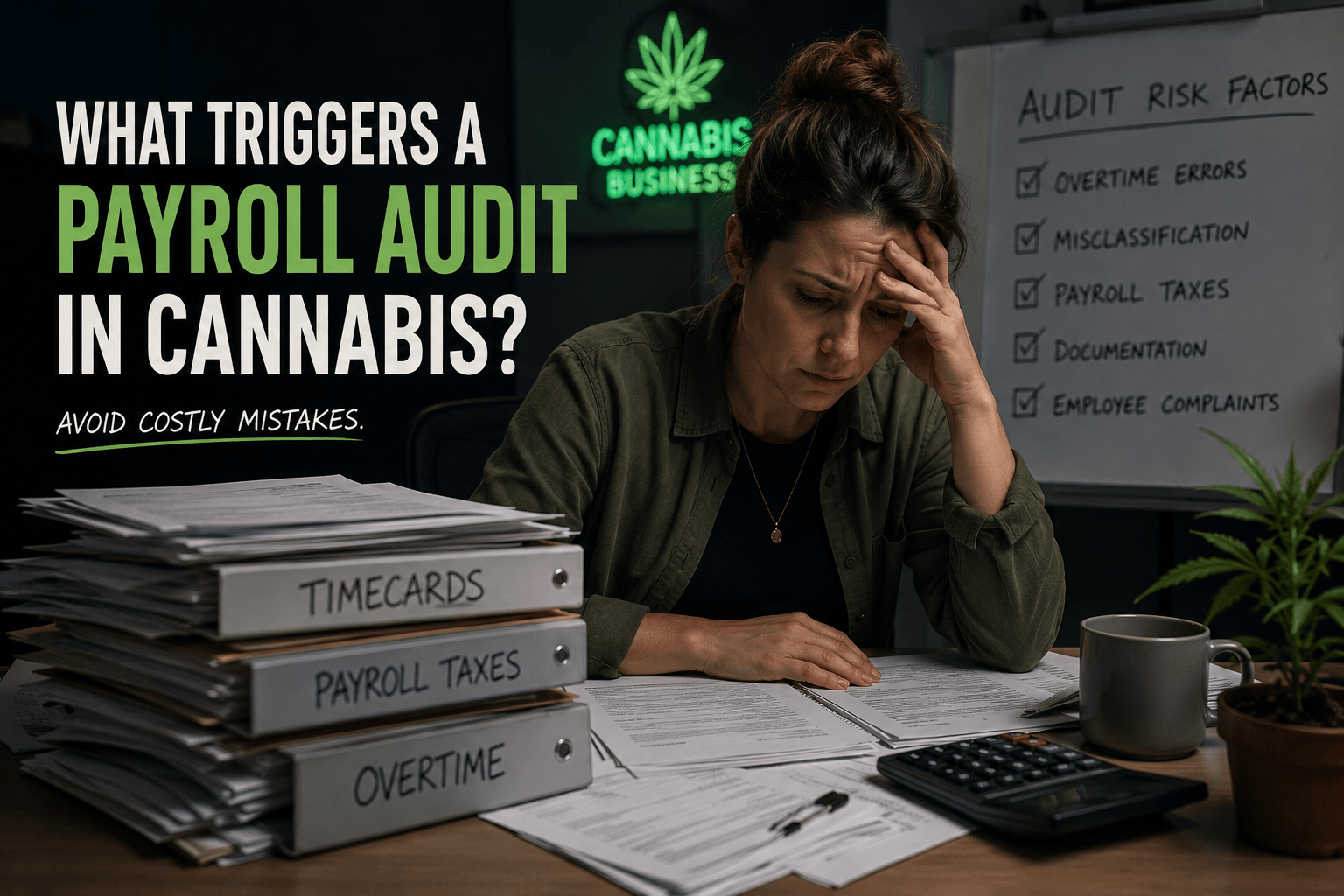
So… you finally got the license.
After months — maybe years — of applications, inspections, investor conversations, delays, buildout problems, regulations, and wondering whether this thing was actually going to happen… your cannabis business is finally real.
Then the emotional reality hits.
You are no longer just thinking about products, branding, menus, cultivation, packaging, or launch strategy.
Now you are responsible for:
- payroll
- onboarding
- overtime
- labor laws
- taxes
- employee records
- workforce systems
- compliance
- making sure people get paid correctly every single pay period
…while still trying to keep the business alive.
Nobody really prepares operators for how emotionally heavy that shift can feel.
Because cannabis founders are not just building businesses.
Many are carrying years of sacrifice, personal risk, financial pressure, community expectations, social equity hopes, family pressure, and the fear of losing something they fought incredibly hard to build.
That pressure builds quietly.
A founder finishes payroll late at night after inventory counts. A manager texts asking how overtime should be handled. Someone forgot to clock out again. Payroll corrections start piling up. HR folders live across spreadsheets, PDFs, emails, and sticky notes.
At first, it feels temporary.
Then one day leadership realizes:
“We’ve been patching systems together for months.”
That is usually the moment payroll stops feeling administrative and starts feeling emotional.
So when someone mentions the possibility of a payroll audit, it does not feel like a normal business inconvenience.
It can feel like:
“What if I missed something?”
“What if we built this too fast?”
“What if one mistake creates bigger problems?”
“What if I’m already behind?”
Those fears are more common than most operators admit publicly.
Especially because cannabis businesses were forced to build inside systems that historically were not designed to support them fully in the first place.
That context matters.
Payroll audits in cannabis are rarely just about numbers on a spreadsheet.
Usually they are the result of operational pressure quietly stacking on top of itself while businesses are trying to grow, hire, survive, stay compliant, and adapt all at once.
And most operators do not need more shame.
They need clarity.
They need someone to explain:
- what actually triggers audits
- what warning signs look like
- how problems quietly escalate
- which systems matter most
- how to protect themselves before stress becomes crisis-level
Because learning this now does not make you inexperienced.
It means you are trying to build something sustainable.
And operators thinking proactively about infrastructure early are usually the ones still standing years later.
So What Actually Triggers a Payroll Audit in Cannabis?
One of the most quietly terrifying phrases many cannabis operators can hear is:
“You’re being audited.”
Not because most cannabis businesses are intentionally doing something wrong.
But because many operators already feel like they are carrying the weight of an entire industry on their backs.
Cannabis businesses have historically had to navigate:
- banking instability
- federal uncertainty
- inconsistent vendor support
- heightened scrutiny
- complicated tax structures
- fragmented operational infrastructure
That pressure changes how businesses grow.
A lot of operators normalized:
- temporary workarounds
- disconnected systems
- reactive workflows
- manual payroll corrections
- operational survival mode
Not because they were irresponsible.
Because the industry itself grew faster than the infrastructure surrounding it.
And eventually reactive systems stop feeling temporary.
That is usually when businesses begin realizing payroll is not just “back-office work.”
It is operational infrastructure.
The danger is rarely one catastrophic mistake.
Usually it is dozens of small inconsistencies quietly stacking on top of each other over time until visibility increases.
An employee asks questions.
A former worker files a complaint.
Payroll reports stop aligning cleanly.
Overtime gets handled differently by different managers.
Documentation becomes harder to retrieve.
That is how audits often begin.
Not with dramatic scandal.
With operational instability quietly becoming visible.
Why Payroll Matters More Than Most Cannabis Businesses Realize
A lot of people think payroll is simply: “running paychecks.”
But payroll affects nearly every layer of operational stability inside a cannabis business.
Payroll impacts:
- employee trust
- labor compliance
- tax reporting
- workforce morale
- onboarding
- overtime tracking
- audit readiness
- licensing confidence
- operational visibility
When payroll becomes unstable, employees feel it almost immediately.
People stop trusting paydays fully.
Managers start improvising payroll decisions.
HR spends entire afternoons rebuilding missing records manually.
Leadership starts checking payroll reports with anxiety instead of confidence.
That emotional exhaustion compounds.
And eventually people stop feeling like they are operating a business and start feeling like they are constantly putting out fires.
Most people outside the industry never see that side of cannabis.
They see branding.
Retail.
Products.
Growth headlines.
They do not see founders sitting at kitchen tables late at night trying to figure out labor compliance while also wondering whether payroll taxes were filed correctly.
But that side of the industry is very real.
The strongest cannabis businesses are usually not the businesses growing the fastest.
They are often the businesses building systems strong enough to support the people inside them.
That includes:
- employees
- HR teams
- managers
- future expansion plans
- leadership mental health
Payroll is not “just administration.”
It is one of the systems determining whether growth feels sustainable or chaotic.
Why Choosing the Right Cannabis Payroll Provider Matters
One of the biggest mistakes cannabis businesses make is assuming every payroll provider understands cannabis operations.
Many do not.
Some providers say they “support cannabis” but have little understanding of:
- cannabis labor complexity
- multi-state cannabis expansion
- 280E operational pressure
- workforce volatility
- banking instability
- cannabis compliance realities
- cash-heavy operational environments
- rapid scaling risks
Eventually operators feel that disconnect.
Usually during the moments support matters most.
Like when:
- overtime rules become confusing across multiple states
- onboarding starts becoming inconsistent
- payroll corrections increase
- labor questions surface
- audits become possible
- expansion exposes operational gaps
A lot of cannabis operators become emotionally exhausted constantly explaining cannabis realities to vendors who fundamentally do not understand the industry.
That frustration rarely gets talked about publicly either.
Cannabis businesses deserve partners who understand what this industry has historically had to overcome.
Not vendors simply “allowing” cannabis businesses onto their platform.
The right payroll partner should help create:
- operational clarity
- workforce stability
- scalable infrastructure
- audit readiness
- long-term confidence
Because payroll problems rarely happen at convenient times.
And having experienced people in your corner matters more than many businesses realize once operational pressure starts increasing.
If you want to understand more about what Cannabis Commitment actually means, read this article.
So What Does a Payroll Audit Actually Look Like?
A payroll audit is essentially a review of how your business handles:
- employee pay
- payroll taxes
- overtime
- workforce documentation
- onboarding records
- employee classifications
- labor compliance procedures
Depending on the situation, audits can involve:
- the IRS
- state labor departments
- unemployment agencies
- workers’ compensation reviews
- wage and hour investigations
The goal is usually straightforward:
Did the business pay employees correctly, follow labor laws properly, maintain accurate records, and report payroll taxes appropriately?
That is it.
But for cannabis operators, audits can feel emotionally heavier because the industry already operates under heightened visibility.
A lot of founders quietly feel like: “We already have enough pressure on us.”
And that feeling makes sense.
Especially after years of federal uncertainty and evolving state regulations.
But one important thing to understand is this:
an audit does not automatically mean someone believes your business is criminal.
Many payroll audits begin because systems became inconsistent during growth.
Sometimes the biggest consequence is not even the audit itself.
It is the six months leading up to it where leadership already knew systems were becoming unstable but felt too overwhelmed to slow down long enough to fix them properly.
That kind of operational anxiety follows people home.
Why So Many Cannabis Businesses Struggle With Payroll Systems Early
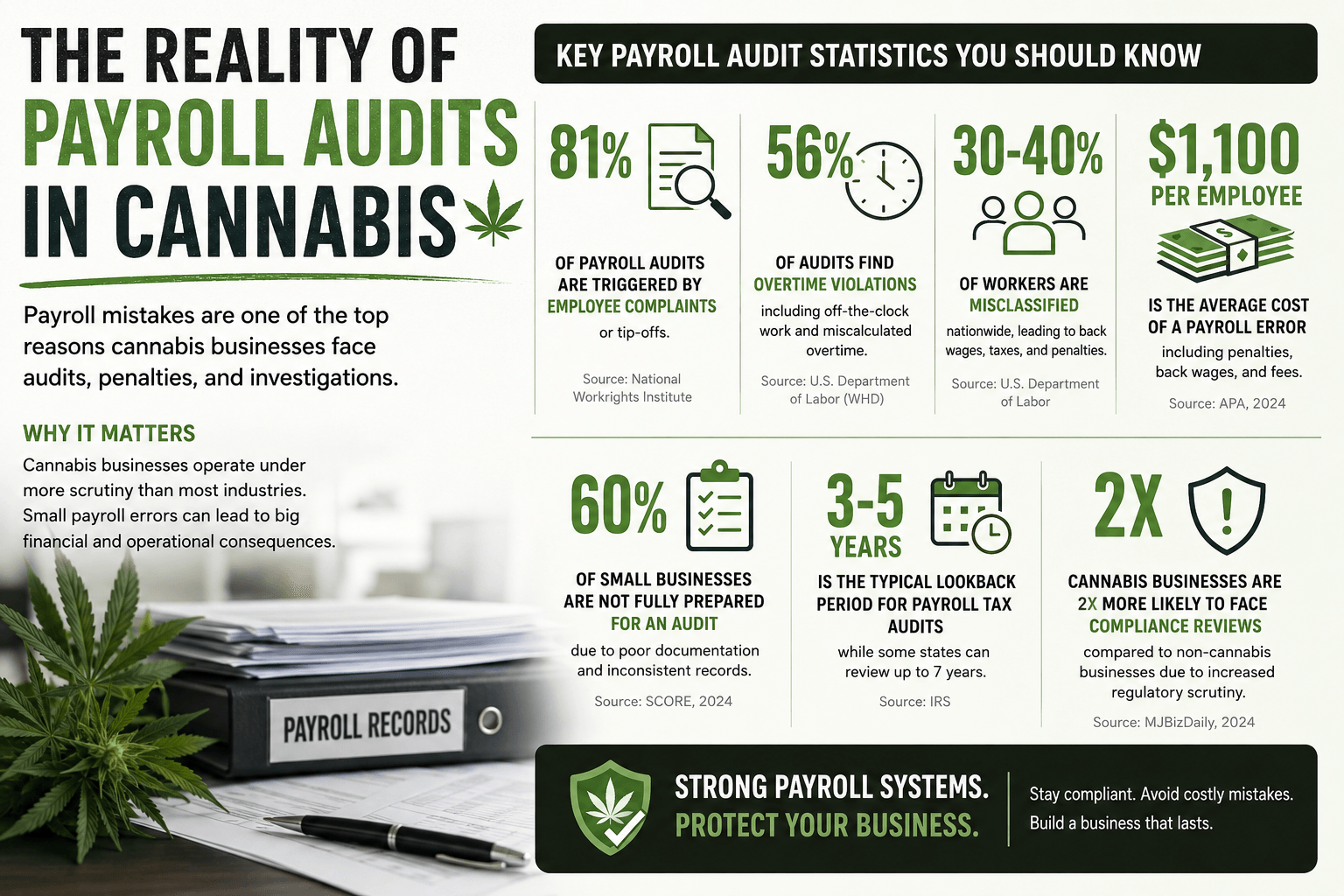
This part deserves to be said clearly: many cannabis businesses struggle with payroll systems early on.
Not because operators are careless.
Because the industry itself developed faster than operational infrastructure did.
Many founders entered cannabis because they believed in:
- legalization
- advocacy
- wellness
- entrepreneurship
- cultural change
- generational opportunity
Not because they dreamed about payroll tax filings and labor audits.
At the same time, cannabis businesses historically had:
- fewer banking options
- fewer payroll partners
- inconsistent vendor support
- changing regulations
- fragmented systems
So many operators normalized operational chaos because survival required it.
There should not be shame attached to recognizing your systems need improvement.
Most operators are learning this in real time.
And truthfully, many businesses are far more overwhelmed behind the scenes than they appear publicly.
The operators who survive long-term are rarely the ones pretending everything is perfect.
They are usually the ones willing to admit:
“Okay. We need stronger systems before growth gets bigger.”
That moment is not failure.
That moment is operational maturity.
The “We’ll Fix It Next Payroll” Trap
One of the biggest payroll audit triggers in cannabis is inconsistent overtime tracking.
And it usually starts innocently.
A manager asks someone to stay later during harvest.
A dispensary employee works through a break during a busy launch.
Someone forgets to clock out properly.
A manager says: “We’ll fix it next payroll.”
At first, it feels manageable.
Then the business grows.
And slowly those temporary payroll fixes become operational habits.
Cannabis work rarely follows neat schedules.
Harvests run long.
Inventory takes longer than expected.
Retail traffic spikes suddenly.
Manufacturing shifts stretch into overnight hours.
That unpredictability creates real overtime risk if systems are inconsistent.
California cannabis operators face especially strict overtime scrutiny because state labor laws include:
- daily overtime requirements
- meal break protections
- rest break rules
Meanwhile multi-state operators expanding into places like Maryland, Illinois, New York, or Ohio may accidentally apply incorrect overtime standards across locations if payroll systems are not configured properly.
Department of Labor overtime guidance
What This Feels Like For Operators
A lot of founders genuinely believe their team “understands the grind.”
And many employees do.
Cannabis workers are often deeply passionate and willing to step up when the business needs them.
But good intentions do not automatically create compliant payroll systems.
The emotional blur between startup hustle and operational discipline is where many businesses quietly create risk without realizing it.
One manager is fixing timecards from their phone after closing.
Another is texting employees asking what hours they worked yesterday.
Payroll assumes HR finalized onboarding already.
HR assumes payroll handled it already.
That is how operational instability quietly grows.
Not through one catastrophic decision.
Through small inconsistencies repeating long enough to become normalized.
What This Actually Means Operationally
Overtime compliance is not just about paying employees extra money.
It is about proving:
- hours were tracked correctly
- breaks were handled properly
- payroll corrections were documented
- overtime calculations stayed consistent
- managers followed procedures properly
Once businesses grow, inconsistent overtime becomes much harder to explain retroactively.
Especially when:
- managers edit timecards differently
- systems are disconnected
- schedules change rapidly
- payroll corrections lack documentation
Worst Case Scenario
An employee leaves frustrated.
Months later they file a wage complaint claiming:
- overtime was inconsistent
- breaks were skipped
- timecards were edited manually
- payroll corrections lacked transparency
The state requests payroll records.
Leadership realizes different managers handled payroll differently across locations and meal-break documentation is incomplete.
Now leadership is not just dealing with payroll stress anymore.
Now they are managing:
- workforce distrust
- legal exposure
- operational confusion
- emotional exhaustion
- reputational damage
The Empowering Reality
Most overtime problems become manageable once businesses implement consistency early.
You do not need perfect systems overnight.
You need intentional systems.
Reliable time tracking.
Manager training.
Clear payroll correction procedures.
Operational discipline.
Six months from now, when the business is larger and payroll cycles feel calmer instead of chaotic, leadership will be relieved those systems already exist.
That is what operational stability starts feeling like.
FAQ: Can one employee complaint trigger a payroll audit?
Yes. In some cases, one employee complaint can trigger broader review of payroll practices across multiple employees or locations.
FAQ: Can payroll mistakes affect licensing?
In some states, severe compliance problems, labor violations, or unresolved tax issues can create broader operational concerns that may affect licensing reviews, renewals, or expansion opportunities depending on the situation and state regulations.
When “Temporary Help” Quietly Becomes Misclassification Risk
Another major audit trigger in cannabis is worker misclassification.
This usually happens when businesses incorrectly classify workers as:
- independent contractors
- salaried employees
- exempt workers
…when labor laws may actually view those workers differently.
This happens constantly during growth phases.
A brand ambassador starts helping more regularly.
A cultivation worker becomes permanent.
A “temporary” team member starts working fixed schedules every week.
And because the business is moving fast, nobody pauses long enough to reevaluate classification structure.
The issue is that labor laws care far more about how someone functions operationally than what title they were casually given.
States like New Jersey and Massachusetts carry especially strict worker-classification standards, which increases complexity for cannabis businesses trying to scale quickly.
IRS worker classification guidance
Department of Labor classification guidance
The Emotional Reality
Many operators quietly think: “We’re small right now. We’ll formalize things later.”
That mindset makes emotional sense in startup environments.
Cannabis businesses often operate lean. Friends help. Teams wear multiple hats. Everyone is trying to survive and keep momentum moving.
But labor issues tend to grow quietly in the background while leadership focuses on bigger operational fires.
What This Actually Means Operationally
Worker classification affects:
- payroll taxes
- overtime eligibility
- benefits
- labor protections
- reporting obligations
- wage requirements
And once someone functions operationally like an employee, businesses may carry responsibilities they did not initially realize.
Worst Case Scenario
A former employee files a complaint after leaving the company.
The state requests:
- schedules
- payroll records
- onboarding documentation
- communications
- timekeeping history
Leadership realizes someone classified as a contractor functioned operationally like a full employee for over a year.
Now the business faces:
- payroll tax reviews
- back wages
- labor investigations
- operational stress
- leadership burnout
The Empowering Reality
Small operational reviews today can prevent massive stress later.
The operators willing to slow down long enough to strengthen systems are often the operators still standing years later.
That is not “being overly cautious.”
That is protecting the business people sacrificed so much to build.
FAQ: How do I know if my payroll provider actually understands cannabis?
A cannabis-committed payroll provider should understand labor complexity, state-by-state compliance differences, workforce volatility, onboarding challenges, banking realities, 280E operational pressure, and how cannabis businesses actually function operationally day to day.
The Hidden Danger of Disorganized Payroll Records
One of the fastest ways businesses increase payroll audit risk is through inconsistent documentation.
And this usually happens slowly.
Payroll corrections get made manually without notes.
Timecards live across multiple systems.
Onboarding paperwork gets saved inconsistently.
Managers communicate schedule changes through texts.
Payroll reports stop aligning cleanly.
At first, it feels manageable.
Until someone suddenly requests documentation.
Then leadership realizes reconstructing payroll history feels nearly impossible.
This becomes especially common in rapidly growing cannabis markets where businesses scale quickly after licensing approval.
Operators in states like Maryland, New York, Missouri, and Illinois have all experienced rapid workforce growth while simultaneously trying to build infrastructure in real time.
IRS payroll recordkeeping guidance
Employer recordkeeping guidance
What This Feels Like Emotionally
Many founders already know their systems are messy.
They just do not always know where to begin fixing them.
And when businesses are growing fast, documentation cleanup keeps getting pushed lower on the priority list because everything else feels more urgent first.
Until suddenly documentation becomes urgent too.
That low-level operational anxiety follows many founders around quietly whether they talk about it publicly or not.
What This Actually Means Operationally
Disorganized payroll records create problems because businesses lose operational visibility.
Leadership cannot quickly explain:
- who worked when
- why payroll edits happened
- whether overtime was approved
- whether onboarding paperwork is complete
- whether payroll reports align properly
And when businesses cannot explain payroll clearly, audits become exponentially more stressful.
Worst Case Scenario
An employee dispute begins.
Leadership attempts retrieving payroll history.
Different systems contain conflicting information.
Managers remember events differently.
Documentation gaps create additional scrutiny.
Now leadership is spending weeks reconstructing records instead of actually running the business.
The Empowering Reality
Organization compounds too.
Small operational improvements create enormous relief over time.
Centralized systems may not feel exciting immediately.
But eventually payroll cycles become calmer.
HR becomes less reactive.
Managers stop improvising.
Employees trust systems more consistently.
That operational peace is worth far more than most businesses realize while they are stuck in survival mode.
FAQ: Are spreadsheets enough for cannabis payroll?
Spreadsheets may work temporarily for very small teams, but most growing cannabis businesses eventually need integrated payroll, HR, onboarding, and timekeeping systems to reduce documentation gaps and operational risk.
Sometimes Employee Complaints Are The First Warning Sign
A surprising number of payroll audits begin because employees raise concerns.
That does not automatically mean the business acted maliciously.
Sometimes employees:
- do not understand pay calculations
- believe overtime was missed
- question paycheck inconsistencies
- dispute hours worked
- feel payroll corrections lacked transparency
But once complaints escalate externally, agencies may begin reviewing payroll practices more broadly.
And if multiple employees raise similar concerns, visibility increases quickly.
The Emotional Reality
This part can feel especially painful for founders who genuinely care about their team.
Many cannabis operators view employees like family.
So when someone files a complaint, it can feel deeply personal emotionally.
But payroll confusion can happen even in businesses with good intentions.
Intentions alone unfortunately do not eliminate operational consequences.
What This Actually Means Operationally
Employee complaints create visibility.
And visibility often creates deeper operational review.
If systems are organized, businesses can respond calmly and clearly.
If systems are inconsistent, small payroll problems can snowball quickly.
Worst Case Scenario
A frustrated employee posts publicly online about payroll problems.
Other employees begin sharing similar experiences underneath.
Now what originally felt like a small internal issue becomes:
- workforce distrust
- reputational damage
- increased labor visibility
- operational stress
- leadership exhaustion
The Empowering Reality
The businesses that navigate complaints best are rarely the businesses with zero mistakes.
They are usually the businesses with:
- transparency
- documentation
- communication
- operational consistency
Employees do not expect perfection.
But they do want trust.
And trust becomes easier to maintain when systems stop feeling chaotic internally.
FAQ: Can one employee complaint really trigger a larger investigation?
Yes. Depending on the complaint and supporting documentation, agencies may review broader payroll practices across departments, teams, or locations.
Signs Your Payroll Infrastructure Is Becoming Stronger
Healthy payroll systems usually feel calmer over time.
Not perfect.
Calmer.
Managers stop improvising payroll decisions.
Payroll corrections decrease.
Employees trust paychecks more consistently.
HR spends less time untangling confusion.
Leadership feels more proactive than reactive.
Those are meaningful signs of operational maturity.
Strong infrastructure does not remove all business stress.
But it prevents payroll from becoming the thing quietly destabilizing everything else.
And that emotional relief changes organizations more than many founders expect.
If You’re Unsure Whether Your Systems Are Stable Yet, Start Here
Ask yourself honestly:
- Could we confidently explain payroll corrections right now?
- Are managers handling overtime consistently?
- Could we retrieve payroll documentation quickly?
- Are onboarding systems organized?
- Would employees describe payroll as reliable?
- Are we scaling faster than our infrastructure?
- Are payroll, HR, and timekeeping systems connected properly?
- Do we understand labor requirements in every state we operate in?
If reading those questions makes you uncomfortable, that does not mean your business is doomed.
It simply means there are systems worth strengthening now instead of later.
That awareness alone is a major advantage.
Many businesses wait until operational chaos forces them to pay attention.
Best Tangible Next Steps To Protect Your Business
If you are wondering where to begin, start simple.
Do not try fixing everything in one week.
Start with:
- reviewing employee classifications
- auditing onboarding paperwork
- centralizing payroll records
- documenting payroll corrections consistently
- training managers on overtime expectations
- reviewing state labor requirements
- evaluating whether current payroll systems actually scale with growth
Then ask yourself:
“What operational stress do we keep normalizing that probably should not feel normal anymore?”
That question alone can reveal a lot.
And remember: stable infrastructure is not about becoming “corporate.”
It is about protecting:
- your employees
- your future
- your sanity
- your expansion goals
- the business you fought to build
A Reminder For New Licensees
If nobody has told you this lately: you are carrying a tremendous amount.
Building inside cannabis requires resilience most industries never fully see.
You are navigating uncertainty, regulations, stigma, workforce pressure, operational complexity, financial pressure, and constant adaptation all at once.
And despite all of that, you are still trying to build something meaningful anyway.
That deserves respect.
So if this article made you realize there are systems needing attention, do not spiral into shame.
Use it as clarity.
The businesses most likely to survive long term are rarely the businesses pretending everything is perfect.
They are usually the businesses willing to:
- learn
- strengthen systems
- ask questions
- improve intentionally
- protect their people
- adapt proactively
Years from now, when your operation is larger, your systems are cleaner, your employees trust the structure around them, and payroll no longer feels like a source of panic, you will be grateful you slowed down long enough to strengthen the foundation early.
That is not weakness.
That is leadership.
You Do Not Need To Figure This Out Alone
If reading this article made you realize your payroll systems feel more reactive than stable right now, that does not make you a bad operator.
It makes you a growing one.
Most cannabis businesses are learning these systems in real time while simultaneously trying to navigate regulations, staffing, taxes, operational pressure, and an industry that still does not always receive the same support traditional businesses do.
The important thing is not whether your systems are perfect today.
It is whether you are willing to strengthen them before small problems become expensive ones.
Start by identifying the area creating the most operational stress right now:
- overtime tracking
- onboarding
- payroll corrections
- employee classifications
- documentation
- multi-state compliance
Then begin building calmer systems around it one step at a time.
Because payroll should not feel like constant anxiety.
And the businesses most likely to survive long-term are usually the ones willing to strengthen their foundation before pressure forces them to.
If you want support from people who understand the operational realities cannabis businesses face every day, explore Paragon Payroll’s cannabis-focused payroll and compliance resources here.

